Fighter pilot, Royal Navy 1945, Hydrographer Iraq 1947-52 India 1952-53, Canadian Hydrographic Arctic explorer 1953-1960, Writer-producer Canadian National Film Board 1961-72, Freelance journalist, audio-visual producer 1972-2009, National Press Club of Canada 1961 - 2006

Thursday, June 10, 2010

Guiding the big guns on target


Simulations for the attack on Japan

On foul weather days when we were socked in as regards flying our squadron’s Seafire XV fighters we had various training aids to keep us busy.  The most notable and best enjoyed was the Operational Crew Trainer.  This elaborate contraption took up a sizeable amount of space in a large darkened building.  Its purpose, already somewhat outdated in 1945 though probably still ready for operational use in the forthcoming final assault on Japan, was to teach us to direct the guns of large warships onto their targets.  
Of course, by this time most of the world's great battleships had been sunk by attacking aircraft, but we carried on in proper naval tradition.
  Two of us at a time, one to act as pilot the other as observer, would climb up into a mock model of an aeroplane and, as the lights dimmed right down, instrument dashboard lights would glow, the aircraft would come to pulsating life, earphones would hum and curtains would draw back to reveal, down below and seemingly ahead a couple of miles, the vista of a shadowy coastline as viewed by moonlight from about a 3,000-foot altitude.  By using his controls, the pilot could turn the aircraft and fly along the coast in either direction with harbours, towns and villages, rivers, inlets, railway lines and stations, woodlands, hills and factories all passing by in realistic fashion and appearance.
The observer would receive information and instructions regarding the selected target, perhaps a railway marshalling yard or dockyard.  Then the code word ‘Flash’ (the guns have fired) would come over the headset followed by a varying number, ‘seventeen’ (meaning the warship’s high-explosive shells will land near the target in seventeen seconds time).  And sure enough in seventeen seconds the shells would burst with a small flash of light down below.  Perhaps a fountain of water would rise up if the shells missed short and fell into the sea or a river, or several trees rise up and fall down if the salvo fell in the woods, or perhaps buildings in a nearby town would be seen to topple.  
As the pilot turned the aircraft to pass by that part of the coast again, the observer would be radioing the compass bearings and distances off of the shooting errors back to the ship. 
 Then again we would hear: ‘Flash, seventeen’ (or sixteen or eighteen) and the game would go on until the target was hit.  The realism was amazing.  After a few minutes of turning this way and that in the dim, muted light, the murky illusion of actually flying became very real.
After many sessions, we were allowed to see the trainer's workings.  The aircraft was mounted on a stationary pedestal, but could be turned through 360 degrees.  The mock-up coastline and inland topography was a vast relief model resting on a thirty-foot-diameter turntable, which had its turning speed synchronized in ratio with the aircraft's heading and indicated airspeed.  
The relief model itself was a mass of little pegs which when activated by electrical impulse would rise up differing fractions of an inch accompanied by a flash of light.  These pegs underpinned tiny model houses, trees, locomotives, factory chimneys and other fragments of infrastructure and landscape, some of them hinged so they could topple over in lifelike fashion.
Underneath the turntable was a bewildering spaghetti-like mass of electrical wires and tiny electric bulbs of varying intensity.  Through a wonderful system of relays and switches, the controller, hidden away in her hidden cubicle, could select appropriate pegs to rise up sharply with a burst of light and then sink back more slowly into their recesses.  All this long before transistors or computers appeared.
We loved playing this game.  Especially Goff Parker.  His Wren girlfriend, Mary, who was one of several who shared many of our evenings in the lounge of the nearby Ugadale Hotel, was one of the trainer's controllers.  At war's end they were married and I expect carried on playing similar such games by moonlight happily ever after.

proulxough@rogers.com

Sunday, June 6, 2010

The Manned Mars Lander to be strawberry free


Helping to filter out any strawberry-obsessed Captain Queegs

(Explanation:   Captain Queeg was Politzer Prize winning author Herman Wouk’s fictional US Navy officer whose erratic mental instability as commander of the destroyer-minesweeper USS Caine culminated in his paranoid belief that one of his officers was stealing spoonfuls of his personal supply of preserved strawberries.  This best seller book, The Caine Mutiny, also became several Broadway plays, and in 1954 appeared as an excellent film with Humphrey Bogart in the title role). 

An international team of six researchers in Russia are spending 520 days (that’s one whole  year and five months) locked into artificial spaceship quarters as an isolated company to mimic the expected psychological effects during proposed interplanetary travels to Mars and back.

Having experienced two uninterrupted small ship voyages lasting 180 days (six months) in duration myself, plus many other months-long trips on other ships, all added to my 1,500 or more or less sustained days and nights in charge of a small vessel manned only by myself and a crew of twenty Iraqis plying the waters of the Persian Gulf, all probably totalling the equal of one return trip to Mars, perhaps gives me provenance to make comment.

Example:
Here is one little drama I observed while sailing in lonely northern waters.
After a few weeks, as our chartered sealer lay at anchor off the northwest uninhabited  coast of Hudson Bay, it was plain to me that Vic Goodwill, our chief of party, was annoyed by something occurring daily in the vessel’s small dining room.  As the hydrographers mess table  and the Theron  officers table were separated by half-a-dozen feet I knew there was no friction there.  At meals, Vic and I faced each other at the head of the long table.  Vic, somewhat pudgy and rather a landlubber, was a meticulous engineer seemingly somewhat out of place in a  working vessel.  His passions were: strawberry-flavoured (oh-oh!) ice-cream; his strawberry-coloured Studebaker sports car; and his constantly meticulous diary keeping — which I would be very interested in reading these sixty years later on.  He was an exceedingly keen and knowledgeable bird watcher (which rubbed off on me and for which I must thank him) in connection with which hobby he recorded hundreds of feet of 16 mm movie film .  He was also a teetotaller. 
   Mindful of Vic’s edginess at the dining table, one day when I was in Vic’s office-cabin, I asked him if he would like me to shift further along the mess table.  Oh, no! he replied.  Not at all.  It was the fellow next to me he couldn’t stand.  His face reddened a little. Not that there was anything wrong with him in general, he said.  Vic’s face reddened a little more, became almost strawberry tinted.  It was just that the chap next to me insisted on spreading butter over his bread again and again and again and again even when it had already been thoroughly and evenly spread the first time, the second time, the third, the fourth, the umpteenth time.  By now Vic’s face was almost livid.  Why did he do it, Vic asked.  Again and again and again—right through the length of the meal.  Kept spreading it like this and this, Vic’s hearing aid dropped from his ear and dangled by its cord as his hands went through repeated precise and decisive butter-spreading motions, again and again.  Then Vic shook his head, regained his composure, put his hearing aid back in and muttered something about it all being a joke.
I went and confided to my trusty sidekick, Barrie Macdonald.  Between us we engineered some excuse to move the butter spreader to the far end of the table on Vic’s side so he was unseen by our party chief.   
From then on all went well.  
  Vic’s other passion apart from wild bird life was Lea & Perrins Worcestershire sauce which he would sprinkle liberally on his several pieces of buttered bread at every meal time.  He would also remark, three times a day, week after week, that he rather liked the taste of that particular sauce.  Though facing him across the narrow mess table this long-lasting savoury obsession of his and his oft repeated daily, weekly, monthly, soliloquy regarding it’s desirability left me quite unaffected.  Happily, I use it very often even to this day.  Honest.  
Luckily, NASA take note, the MV Theron carried a goodly supply of Lea & Perrins Worcestershire sauce.
  As well as butter.

It was unfortunate, or maybe fortunate, that as an arctic-bound vessel the MV Theron  was classified by the customs office as a foreign going vessel and therefore allowed duty-free alcoholic supplies.  Though such privileges did not come into legal effect until the ship had reached Cape Chidley at the northern extremity of Labrador.  Yet we were often stuck half way up the coast by heavy ice formations for weeks on end.  So whether that particular legal stipulation was strictly adhered to by all our ship’s officers I’m not quite sure.  But it certainly applied to we six law-abiding hydrographers, even ones like me who happened to be friendly with the chief engineer whose cabin was right next to mine.  Well, at least mostly.  I’m pretty sure about that.
As far as I can remember...


proulxough@rogers.com


Friday, May 28, 2010

How to see in the dark


Learning the sideways look

When we arrived at HMS Macaw, the Royal Navy night vision training establishment at Bootle, in what was then Cumberland in northwest England, we were at once treated to a very effective demonstration.  
As our group of two dozen pilots stood outside the main building in the bright early summer sunshine in 1945, we were each handed a pair of what appeared to be welders goggles of extreme obscurity.  After putting these darkened goggles on, we could hardly see each other.  Only dimly could we make out the division between earth and sky despite the sunny day.  Then we were told to remove our goggles and one pair, chosen at random, was given to one of the institution’s Women's Royal Navy staff officers.  After she put them on a box of matches was scattered on the ground.  With no hesitation or fumbling she bent down and picked them all up one by one.  
We were amazed.  But we were warned that by the end of the course we would certainly not have that Wren's expert proficiency, but that we would be able to see in the dark much better than we could before.  
And it was true.  We could.  It worked. 
For the next two or three weeks we spent at that school, we had a routine of every day being a hardworking play day.  After one full day of lectures concerning the elements of night vision, the physical make-up of the human eye and the role played by the eyes' so-called rods and cones, we went straight into the serious daily business of playing day-long games.
Every morning before sunrise, we were woken by a loud buzzer in all the rooms.  This was the signal for everybody to reach out for a set of white-light opaque goggles and put them on.  Then it was back to sleep until still begoggled we went to begoggled breakfast, followed by begoggled teeth brushing and all the other little duties of the morning.  Then a typical play-day would take us into a completely blacked-out hangar illuminated only by dim red lights or alternatively artificial lights that could simulate various degrees of starlight or faint moonlight.  Once everybody was in, we removed our goggles and the fun began.
One game we played in the dark was negotiating an elaborate obstacle course marked out with white painted objects and trip wires.  Though at first we could only feel our way along in slow motion to avoid the traps and bumping into our fellow students, we soon improved to a slow walk, then a walk, then a jog and eventually we raced against each other on bicycles.  We also played soccer and basketball with white-painted balls.  Another more punishing game employed a circle of large diameter drawn in white on the hangar floor.  We stood on the perimeter of this circle facing inwards to where a heavy white medicine ball was suspended from the high hangar roof.  When given sufficient impetus to swing like a pendulum, the ball's silent travel was diabolically about nose high when it reached our positions on the circle.  Thus it was in the student's significant interest to keep a keen lookout at all times as the ball could arrive from any of about 160 degrees of direction-very suddenly.  Naturally in such a situation, we kept our hands up in a defensive position at all times in order to try and catch the ball and push it away into the darkness towards another of our unseen colleagues.  But occasionally the ball would swing in and penetrate these defences and result in a rare bloody nose.
So by learning to be conscious of seeing with our eyes’ offset eye rods, by looking about twenty degrees to one side of any discerned object and strictly shielding the eyes from any bleaching white light, we hoped to improve our ability to be triumphant in darkened battle — even against the suicidal native sons of the benighted rising sun nation itself.

proulxough@rogers.com

Saturday, May 15, 2010

Staying on the level in India


A Street Person of Bombay

In January 1953, I was employed to make a detailed hydrographic chart of Bombay harbour in India.  I flew out by Air India in company with two civil engineers and a land surveyor.
 As our plane approached Bombay some type of official landing declaration forms were handed out to be filled in by the passengers.  As George Macdonald, the land surveyor, and I were licking our pencils at this task one of the most  graceful of the Indian female flight attendants —there was absolutely no doubt about her delicious gender—came over, looked at our forms, then said: “What are you doing? These forms are not for you, they’re only for foreign people".  And she tore them up.  
It was, and still is, one of the nicest things ever said to me.
January or not, as we stepped down from the aircraft tropical warmth enveloped us.  We gathered our many boxes of instruments and other equipment and drove to the army officers’ mess at Colaba at the tip of the Bombay peninsula.  There we were each apportioned a venerable and spacious room and bath in shaded and peaceful quarters still steeped in the ambience of the lately departed Imperial Raj.
My job, to produce a hydrographic chart or, in this case, a hydrographic engineering plan, meant I had to show all the shoreline features in relation to the varying harbour depths running out to the deep water in the middle of the harbour.
Prominent features included Mazagon Dock, Ocean Pier, the Gateway to India monument, a nuclear research station, an Indian naval establishment and several busy city streets teeming with an exceedingly high-density population.

The proposed engineering work was to take several years to complete.  As much of it was for the benefit of the Indian navy I was happy to get their full co-operation and the use of their facilities and workshops to carry out my marine survey.  George Macdonald was busy verifying the topographical features and triangulation network on shore and as our jurisdictions met and overlapped at the shoreline, we worked together when required.
As a work party I was given a very mixed bunch of a score or more dock workers, consisting of pairs of men who all seemed to speak a different language from the rest of the gang though one of each pair could speak the language of one, and only one, of the other pairs.  If this sounds complicated that’s because it was.  So when we were at work and I wanted a man several hundred feet away holding a level staff to go uphill a little I had first to tell my assistant in English who told another in Hindi, who told another in Gujerati, who told another in Urdu, who told another in Madrasi who told another in another tongue who told the guy with the level staff who instead of going a little higher went downhill a little.  Or a lot.  Or even disappeared over the horizon.  I soon found it easier to take the time to instruct all the staff holders in the hand and arm signals used by many surveyors.
At first I was allotted a young naval officer to act as my first assistant.  Though he was very nice, even debonair, and socially very delightful as a proper naval officer should be, he was rather lacking in any technical ways and was quite opposed to picking anything up or being associated with any of my multi-lingual motley crew of brigands.  He was quite relieved after a couple of days when I told the authorities that as he had now taught me all he knew I hoped I could flounder along without his continued help.
In his place I secured Able Seaman Albert.  AB Albert was dressed in square rig and was a godsend.  Very dark complexioned and short in stature he came from the southern tip of India.  He described himself as being LMS.  This was nothing to do with the London, Midland and Scottish railway company in Britain (whose towels, serviettes and even blankets, because of being adorned with the initials LMS, were reputed to be stolen by dishonest neo-bridegrooms who presented them to their fiancees telling them that LMS stood for Love Me Sweetheart) but meant he had been brainwashed for better or for worse by the London Missionary Society.  Willing and able as his title required him to be, AB Albert was also quick and intelligent.  He confessed to me one day that during the swell of nationalistic fervour in 1947 he was in a cruiser when the crew mutinied.  He said he was helpless and had to passively take part in the mutiny or be chucked over the side by his shipmates.  In one day I taught AB Albert to use the level instrument and keep a levelling book of notations so accurate that I would often, as a form of relaxation, spend an hour holding the level staff for him and letting him do all the meticulous technical work.  Between us we taught some of our gang to act as rodmen which was a boon when our work took us out of the comparative quiet of the dock areas and into the bustling crowded streets of Bombay.
I decided to run a line of levels from an old established bench mark in the downtown area to an automatic tide-gauge housed in a little stone gazebo kind of structure at the water’s edge. This was probably put there a century or more before by some pukka sahibs of the Colonial Survey or the Survey of India.  But I wanted to check for myself as a lot of engineering work was to take place and the utmost accuracy was vital.
The route between the bench mark and the tide gauge wended its way down some of the busiest streets in Bombay.  And busy Bombay streets are really busy.  However, there was no other route to take and so we began our slow, leapfrogging mode of progress through the dense throngs of people.
Sixty years ago levelling involved, and probably still does, a surveyor setting up a precision instrument on a tripod to sight onto a staff graduated in hundredths of a foot and held vertically by a person called a rodman or, probably today, a rodwoman.  To start off, the instrument is set up anywhere from two feet to a couple of hundred feet distant from the bench mark.  The height of the benchmark above mean sea level has been established over many decades or centuries and its value is related to all the other bench marks in the region or country or continent.
The surveyor looks through the adjusted telescope of his level and notes down the readings bisected by the cross hairs.   This back sighting gives him the height of the cross hair in his telescope.  For example, if the value of the benchmark, as determined by the original surveyors many years ago, is 12.31 feet and the reading on the cross hair is 3.56 feet then the height of the instrument is 12.31 plus 3.56 or 15.87 feet.  When this is definitely established the rodman carries the staff past the surveyor in the direction they wish to go and finds a suitably rock-hard immovable spot upon which to place his staff.  This spot, called a turning point, can be the tip of a very large rock, the doorstep of a solid building, the edge of a curbstone, a long wooden peg driven down into soft earth or any other ground feature that will remain fixed for the near future.
When the staff man rests his rod on the chosen spot, in this case we’ll say a curbstone, the surveyor swings the telescope around and sights on the rod again, taking what is called a foresight.  If the cross hair now bisects the staff at the 4.76 reading the curbstone must have a value of 15.87 feet minus 4.76.  This gives the curb stone a height of 11.11 feet above mean sea level.  Now to carry the level value along in the direction required it is the surveyor’s turn to leapfrog the rodman by picking up the tripod and level and walking past the rodman a suitable distance further on to erect the tripod again and take another backsight on the staff to establish the new height for the instrument.  And so it goes on at intervals of anything from two or three feet to several hundred or so between set-ups of the instrument.
Well that’s all very easy to do in good weather and across flat or undulating terrain.  Not so easy across mountains or during storms.  But though Bombay cannot boast any real mountains in the downtown area and the weather was hot and sunny I at once ran into a real difficulty upon starting to run my levels.  Because Bombay has several million citizens who all appear to be very interested in the art of surveying or at least in interacting socially with the surveyor.   To try to interfere with the fewest number of good citizens as possible I made my set-ups at the curbside and told the rodmen to also use the curbstones as turning points.  As soon as I adjusted the level and applied my eye to the telescope to look at the rodman a couple of hundred feet away, about a dozen passersby at intervals between us would jostle each other in trying to look into the telescope’s other end.  So usually all I could see was a variety of dark eyes peering back at me.  Other people would try to take a turn at my end of the telescope.  This was disastrous as even a slight touch on the instrument or one of the tripod legs can alter the accuracy of the sightings and make repeat set-ups necessary.  Then there were the many unfortunates, tricksters and beggars who saw that here was a fellow trapped into making very slow progress along the street, someone who couldn’t just brush them aside and stride off to safety.  In fact they soon saw that I was temptingly quite stationary for long periods.  A sitting duck.  So during the long minutes when I was glued to the eyepiece trying to catch two-second glimpses of the staff graduations as they might briefly appear between massed bodies I would be constantly trying to free one hand to brush off unseen other hands tugging at my clothes to get my attention.  When I finally straightened up from the instrument to make a note in my level book I might have a snake charmer’s basket with its writhing occupants between my legs, a fortune teller jabbering into each of my ears,  an ear-cleaner wanting to make a contract with me to clean both those organs, and a couple of pitifully deformed beggars clutching at my feet.  
So even with able-seaman Albert at my side and with three or four of my motley work gang to help it was obvious that we were going to be a long time getting to the distant tide-gauge.
I solved the problem to a large extent in three ways.  I went to the naval authorities and arranged for my little group to be accompanied by half-a-dozen policemen to keep the line of sight fairly clear.  This worked out quite well after an initial period when instead of seeing casual passersby’s eyes looking down the wrong end of the telescope I just had policemen’s eyes looking back at me.
The second thing I did was to favour and retain around me, as a sort of personal bodyguard, the first batch of fortune tellers, snake charmers and other professionals who had accosted me that morning.  In a way this was quite brutal as poor people who have nothing are vicious to those others in a similar predicament who might horn in on their act.  Thus I now had a retinue of street people who followed me each day from level set up to level set up—a variation of the private staff members politicians and dictators have always relied upon.
Some of these people were amazingly astute and soon learned where my next approximate instrument set up would be.  I think I might well have taught several of them to actually operate the level in quite a short time.  They certainly knew enough to be waiting in the early morning at the last curbstone temporary bench mark we had marked with surveyors chalk in the late afternoon before.
The third precaution I took was to my working dress.  I now passed the little bits of money I carried for beggars and such over to Albert and for myself I wore only a pair of creased and worn short shorts and a pair of old sandals.  With the pocket linings of the shorts turned out it was obvious I had nothing of value on my person.  This ploy worked very well.  So well that on one rare occasion when we were progressing along one of the better shopping areas I caused no little embarrassment.  While waiting for AB Albert to settle some dispute with the rodman and give out a few annas to the deserving poor I wandered up the wide sidewalk to the window of a rather high-class souvenir-curio-furniture-knick-knack shop.  I was followed as usual by some of my retinue of beggars, snake charmers and fortune tellers.  As some of the stuff in the window looked interesting I went inside the shop to poke about among the items for sale.  After a few moments a tall, sophisticated and well-dressed lady came bustling up to me waving her hands and yelling in a language incomprehensible to me.  I was quite stunned at her behaviour and just stood there in open-mouthed amazement.  Then another equally gracious-looking lady came from behind the shop and also shouted at me in English to get out of her shop.  Suddenly the first lady went outside the shop and called over to a couple of my police bodyguard.  They came running into the shop, looked at me, then turned around and spoke to the first lady.  And that was when intense embarrassment overtook us all, especially me.  For, with stricken mien she at once collapsed into abject apologies in perfect English.  How could she have mistaken me for some penniless Bombay citizen sullying her nice, clean shop?  She and the other lady were in tears at their awful gaffe.  Their perceived gaffe.  I told them it was my fault.  I had unwittingly deceived them.  And I was truly penniless as could be seen by my turned-out pocket linings.  I then told them it was all a big laugh.  It was funny.  Forget it.  I just said how nice their shop was and that I’d come back with some of my friends sometime.  Then I picked up the instrument which Albert was guarding a little way up the street and followed by my retinue of street people I moved on past the shop with a wave to the two ladies.
One of the street hawkers with whom I did some small trade was the bidi  maker.  His bidis  were little cigarettes made with a strong tobacco and dark brown papers.  He rolled them custom made on the spot for his customers who bought them just one at a time.  He even licked them to stick them together for his patrons.  I made it a point that when it came to licking time he held my bidi  up to my mouth and I licked the thin strip of gum myself.  A week or two previously I had for some reason given up cigarette smoking.  This was quite unintentional on my part.  I just stopped—like giving up eating liquorice lollipops or mangel-wurzel.  I expect those few bidis  I smoked on the streets of Bombay just confirmed and extended my unintended abstinence.  Some months later when out with my father in England he stopped at a tobacconist for some pipe tobacco.  I also bought some together with a pipe and never smoked another cigarette again.
After about three days my line of levels finally tied into the tide-gauge.  There was an error of exactly one foot.  Such an exact error pointed to a simple misreading of the level staff.  But where?  There was nothing for it but to do the whole thing over again and hope we found the error sooner than later.  So praying to AB Albert’s LMS gods that I had made the error just recently rather than earlier in the run we started back from the tide-gauge using the same edges of curbstone as turning points as we had on the way in.  But I never found an error.  We arrived back at the official government benchmark and still had an error of one complete foot.  
I pondered this situation carefully.  I checked my figures for the umpteenth time.  All was well.  But all was not well.  The benchmark value was irrefutable.  Engraved in stone in every sense of the term.  It was like questioning a direct quote from Jesus to the faithful.  In fact it was even more blasphemous to question the work of the prestigious Survey of India than to question the Pope about the Virgin Birth.  Blasphemy!
So off we went again, laboriously wending our way even more slowly and carefully back over the same ground, all the way back to the tide-gauge.  And nothing changed.  An error of one foot, to within one hundredth of a foot remained to haunt me.  Had the tides of Bombay been out a foot for the past century or so?  Or had that primary benchmark’s value, recorded in the annals of the Imperial Raj, been unthinkably put down 12 inches in error?  I took the problem to George, our top-notch land surveyor.  He must have then consulted with Hamish our chief of party.  It was their problem now.  
Me, I was going to get afloat and begin my hydrographic charting.  Get in some nice restful plain sailing.  Some hope!

To be continued...

Saturday, May 1, 2010

Editorial Caution


Notice of Copyright:

No part of this missive may be retrieved either manually, electronically, or by bird-dog, carrier pigeon, or telepathy.  Nor may it be used to form pieces of a children’s jigsaw puzzle, or used as evidence in a court of law, or for enhancing political blarney during national election campaigns, or as a filler during any dreary stage appearance by famous personages at a London Palladium Royal Command Performance, or as part of a Royal Navy Petty Officers’ Sods Opera, or during  artistic scenes presented by the National Ballet of Kookkistan, or as part of a Salvation Army Training Film for Tambourine Players, or in historical documentaries applauding 21st century nouveau art, or in any other similar wise, without instant payment of enormous amounts of lolly per word or illustration.   
So there.
But apart from all the foregoing if you feel moved to use any of this stuff for legitimate or nefarious purposes, in keeping with popular and topical mores, just fill your boots while mentioning that it emanated from the Ough-Zone.

Saturday, April 24, 2010

In Old Iraq


Sindbad the Sailor and me

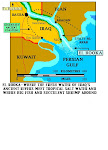
On various maps I’ve drawn of Iraq’s extreme southern extremities I have indicated that a mixture of local coffee-house legendary storey-telling and hydrographic-geography has it that though in 1950 the fabled Mesopotamian city of Basra was 70 miles upriver from the blue headwaters of the Persian Gulf, that back in the legendary time of Sindbad the Sailor, Basra was actually on the coast.
Such a legend is not too far fetched on consideration.  The confluence of the Tigris and Euphrates rivers are so greatly augmented by the mighty Karun sweeping down from the snow-capped mountains of Iran, that when the silt-laden spring waters of these three rivers combine to form the Shatt-al-Arab, they have, over the centuries, deposited enough suspended silt material to move the coastline 70 miles southward.  This is easy to believe by the fact that in the spring flood season, as the snows in the distant Iranian mountains melt,, 18 inches of soft mud can be laid down in the shipping channels during the course of just one single tidal cycle.
So if Sindbad the Sailor was dissolutely spending his night-time hours amid the pleasures of the Al Faribi, or even perhaps Abdullah’s place, in Basra about 1600 years ago, as has been reported, that should mean that since I left Iraq in 1952 the coastline should have migrated about (70/1600 x 58) — or around about a 2.5 miles southward. 
Looking at Google Earth and the latest Admiralty chart of the area I don’t see any really hard evidence of this.  
To verify it I’d need to somehow return to the area, find my old survey vessel, El Ghar (not too promising a search — she was built in Bombay in 1914) poke around and try to access  my old hydrographic work sheets, and then and make some updating survey observations.  
Unfortunately, I do not think I’ll have the opportunity to do so just now.  Nor, for obvious reasons, in the foreseeable future.
Anyway, after all the wars and political turmoil of the past sixty years all my twenty crew members are probably dead.  Sadly, the good old days of Iraq are over.  For now at least.


proulxough@rogers.com 

Friday, April 16, 2010

Dundee Trawlermen


A Wonderful Night in Oban, Scotland

One autumn evening in 1952, in Oban, in western Scotland, I fell in with a couple of seafaring fellows in a pub.  They were Dundee trawlermen from the other side of Scotland.   
Their fishing vessel was tied up alongside in Oban.  When, as we spun yarns together, I told them how I had just spent the last five years living aboard my Iraqi survey vessel, El Ghar, at the northern end of the Persian Gulf, we easily accepted each other as fellow seafarers.
We yarned and chatted over several pints of beer and later went together to a dockside cafe where we met half a dozen of their shipmates.  
When I realized I had missed the only bus back to Taynuilt they said not to worry, they had a spare bunk on their trawler and would not be casting off until midmorning at the earliest.  
So I went back aboard with this happy gang and found that all hands slept in the fo'c's'le where about a dozen bunks, one atop the other, were ranged around the forward part of the ship.  In fact it was just about the same size as had been my cabin aboard my survey vessel El Ghar, of which, being in command, I had been the sole occupant, .  
Before turning into their bunks these hardy fishermen didn't remove any clothes, they put more clothes on.  Even though we were still in a warm autumn.
As we fell asleep, late that night, and later the next morning as I joined them in their simple but hearty breakfast, they recounted stories of their encounters with the deadly black ice during cold winters off Iceland and Greenland and also of the fabled characters with whom they had sailed on previous ships.  
They all laughed and contributed personal segments of a long saga concerning one particularly eccentric woman of Dundee.  It seems she was noted for her quick and prolific sandwich-making prowess.  In fact, all aboard that trawler vowed, she was the champion sandwich maker in all of Scotland.  In this capacity she was famed for growing an enormously long thumbnail on her right hand.   With this natural appendage she could scoop up just the right amount of butter and then spread it accurately and evenly over slices of bread in the briefest flash of time and without recourse to the use of any artificial tool. 

One of the older fishermen told of how when he was a child back in the 1890s his mother, every Saturday, made a batch of oatmeal porridge for her six children and husband, a batch so big, as to last them all for the coming week.  This gallon or two of porridge was poured into the top drawer of a clothes chest and left to solidify.  Then each morning the mother would open the drawer and cut a slice for each child to take to school or work for his or her lunch.
All the trawler crew agreed that herring had played an important part in their daily diet as children.  They also all agreed that they still relished herring as a favourite food.  No wonder they were all such tough trawlermen.  
No wonder, also, that the soldiers of the highly-acclaimed Scottish regiments have always given such good account of themselves in battle.  
Personally, if I were serving in an enemy army opposing such tough, white-hatted, good guys, I'd rather be facing the spam, french-fries and apple-pie eaters than ferocious oatmeal-and-herring eaters — the renowned hardy kilties of the Highland Division.  

Saturday, April 10, 2010

Wings Parade Pageantry


The Magic of it all

Several topical Hollywood movies made during the Second World War era showed for their emotional climax the wonderful passing-out parade scenes of  newly-fledged heroic young pilots receiving their hard won wings.  
They showed the triumphant lined-up ranks of the hero graduates, the watching crowds of cheering, proud parents and emotionally- charged admiring girlfriends, the massed bands and guards of honour and the distinguished four-star generals who were along to pin on the newly gained shiny wings and take the salute at the grand final march past.

Well, we Royal Navy, Fleet Air Arm ratings didn't expect to get a show like that.  
And we didn't.
Instead, a couple of days before, we were instructed to each go to the navy stores and buy a rating's red-cotton-embroidered pilot's flying badge.  They cost fourpence in Britain and so I think we had to pay a dime in Kingston, Ontario.  
We each had to drop the badge we had bought into an old cardboard box.  
Then on the cold and gloomy early morning of February 6, 1945, in a dark and freezing hangar, we were lined up—all the final nineteen of us who remained of the contingent of 121 which had landed in Boston ten months before.   Our names were called and (because I think our resident navy lieutenant was off somewhere else that morning, or maybe was still in bed) one by one we marched up to a Royal Canadian Air Force flight lieutenant and saluted him.  
A sergeant from the orderly room had the cardboard box in one hand and with the other he fished out the first pair of red wings he found.  These he handed to the RCAF flight-looey who shook the student's hand and gave him the wings.  They weren't even the same pair one had forked out ten cents for.  And they couldn't be pinned on because no one really knew where they should be worn by men dressed in traditional square rig.  Anyway, the badges didn't have any pins.  
So we just stuck them in our jersey pockets.  
For an audience we had, over on the far side of the hangar, half-a-dozen mechanics banging away with wrenches and ballpein hammers and in another corner a couple of guys hanging around the pop-dispensing machine, waiting for someone else to get the one-in-every-sixth empty bottle, which was the arbitrary way the pop makers manoeuvred things to keep payments in balance with the new one cent increase from five to six cents as the price of a Canadian bottle of pop at that time.  
Then we all just sloped off without anyone playing even a mouth organ.  That was it.  
I guess we had the rest of the day off.  
But, so what if there was no fanfare.  
We were Royal Navy.   
We had Royal Navy wings. 
And best of all, they were our wings.  
Also that day we were upped to petty officers with an accompanying modicum raise in daily pay.
That night we had a wings party in the local Kingston Yacht Club.  Just we nineteen and our handful of wonderful RCAF instructors.  
And just lots of beer and bits and pieces to nibble on.
The next day I helped clear up the empties and the day after that we were entrained for Halifax to board our ship back to Britain.


Thursday, April 8, 2010

Ottawa Citizen newspaper editor shares a giggle...

...is he suffering from too much sensitivity training?

Head placed over a letter-to-the-editor, April 8, 2010:

Machete attack shows
lack of tolerance


Is this the understatement of the semester?
Hmmm!  Well, I suppose, in Canadian universities these days, it’s a debatable cutting point in discussion. 

Tuesday, April 6, 2010

Dateline : 110 - 71 Years Ago


Items of Concern

Rooting around amid my office clutter regurgitates four copies of the British Daily Mail newspaper, one each for the years:
1900, 1923, 1936 and 1939.
They are fascinating.  

Examples:

The front pages of the 1900 issue are full of advertisements of all kinds including one  headed:

D.D. DIRTY DICK’S D.D.
(Established 1745)

No this was not a personal hygiene promotional ad.  It merely sought customers for Dirty Dick’s  — a pub on Bishopsgate, opposite Liverpool Street Station in London, and a place I myself often supped a few pints of ale many years ago.  
Another prominent item was the Shipping News, with weather reports and reported sightings of incoming vessels passing points in the outer approaches to the Channel (no ship-to-shore radio then).  

Among personal columns of urgent and serious mien there were two or three like this one:

PW   (illegible)  (sic).  

Yeah!  That’s it.  All there was of it.  Probably sent in anonymously with no return address.  The editor had no choice.  He took the enclosed money-order fee and published what he could of the item.

Some were in code, thus:

FAITH—Zshbsav nym zyhp jdwljumxxn-ty fw owxx lag tiffin-jwldwhp nymdh always.
(obviously a secret code between two illicit lovers who sent erotic messages to one another, and whose great-great-grandchildren probably text-code each other in similar fashion today).  Clue: Tiffin is Hindi for dinner.  
The Daily Mail charged these personal ads at eight words for three shillings and fourpence per word after.  
(Note: The first Ough-Zone reader to solve this early Enigma-coded message and send it in, accompanied by the lids torn from 24 non-Macintosh laptop computers, will receive a guided tour of the Bletchly Park secret WWII code-breaking facilities in UK.)

Along with ads wanting to buy scrap metal, second-hand watches and jewellery, and stuff, were widespread demands for ‘old used false teeth’.  Yuck!!  Prominent among the ads are those by pawnbrokers with ‘amazing bargains and sacrifices’. 

Other oddments from 1900 include one reporter’s comments on an economic situation which described one group of people as “being screwed” by a certain decision.  I’ve always though that term to be a modern crudity, akin to the other popular term of “blowing opportunities” as often used by the most staid of public figures.  So perhaps both these figures of speech are derived from circumstances different, and less earthy, from what I hitherto believed to be the case with my vulgar seafarer’s vocabulary.

One ad offers “A gentleman’s horse for sale, equally good for riding or driving, £25”.  It’s daring owner indicates his reason for selling is that he has thoughts of buying a motor car.
And a lengthy column is devoted to railway companies’ promotions of special excursions to all parts of Britain.

Chapter XXIX of a gripping serial fiction story is somewhat spoiled by the author butting rudely into his own script to clumsily destroy the magic entrancement he has striven to create, with interjections like:  ...now the curtain rises upon a different scene and a wonderful change has taken place in the fortunes of the principal actors in our drama...  This surely brings the reader back down to reality with a bump from the trance of imagination the author must have hoped he had put them in.

And here's an 87-year-old shade of Afghanistan...

News item (1923):
Two British army officers who took their dogs for an after tiffin walk along the Khyber Pass were found later, each with three bullet holes in their heads.  Happily, their dogs were ok and found guarding the bodies.

In 1936 the Royal Air Force was advertising for young men 18-25 to apply for Volunteer Reserve pilot training.  Daily pay of 15/6d was offered, followed up with a £2 annual retainer.  See that?  They got three bob more as flying pay than we were paid on the squadron nine years later—and this when they were still undergoing training.

Also, strangely, in 1936 the British Broadcasting Company (BBC) was already under observation and criticism by the Press and Parliament regarding not only their secret balance sheets and accounting but complaints of having bias and opinions of a subversive character.  This led to a ruling that in future all BBC officials must be British subjects.  
What on earth was this all about?

A lengthy and detailed column on Week-End Angling Prospects for coarse fish, for different parts of the realm, forecast good sport unless the wind was from east or north.

Of real interest is the September 4, 1939 issue—printed just a dozen hours after war was declared.
Of utmost importance, this was the first day that the Daily Mail placed its big news items on the front pages—displacing the classified advertisements from their hallowed traditional place of prominence to unaccustomed obscurity back among the twelve inner pages. 
And what a medley and welter of pertinent-for-the-times ads they carried.
ARP —(Air Raid Precautions) was the advertisers’ key word for attracting customers.  Everything for the astute, abreast-of-the-situation, householder was advertised:  
Rolls of blackout cloth and paper, cans of black paint (guaranteed dense and fully opaque), first-aid kits, blankets, extra-thick combination underwear, camp cots and portable heating stoves for home air raid shelters, flashlights (electric torches), water bottles, rubber boots, and — for the extra timid — there were advertisements for real estate:  dwellings, properties, and accommodations for sale or rent in ‘safe areas’ such as Ireland, Wales, Devon and Scotland.

The blackout curtaining industry was given a government boost when the penalty for allowing stray light through curtains, or doors, was threatened to be as much as two years in jail and a really hefty fine.  If rigidly enforced this law would have seen two-thirds of the population in prison — living on the public purse.

Car lights had to be shaded almost to obscurity with just 1/2” slits (and hooded slits at that) over headlamps, and shades over side lights and the single rear red light (British cars only had one rear light in those days, something modern war film movie makers today are quite ignorant of by always showing staff cars and other WWII vehicles with two rear lights).  
All a bit far fetched this light hiding business, anyway.  Do you think you could have seen a faint glow from a dim 1939 rear light or the thin glowing end of a Wills Wild Woodbine or Players Weight  cigarette from 10,000 feet?  And if you did see it what information could you gather from this momentary glimpse?  Would the keen-eyed enemy observer have at once yelled out by radio to his whole squadron or wing:  “Break starboard 180 and release all bombs”.  Poof!  There goes Farmer Giles field of prize mangel-wurzels or turnips.  Furthermore, if a traitorous glow from a rural citizen’s pipeful of Digger Shag, could possibly have been seen  from two miles above on one particular night, it might well have saved Coventry Cathedral and its surroundings from the devastation they suffered that same awful night.

Yet all in all, this issue of the Daily Mail shows how wonderfully prepared Britain was, how well planned and executed were the essential services required for wartime.  The evacuation of children and mothers was right on time.  All who had applied were already gone or were on their way.  Hesitant, nervous latecomers were given yet another chance  to go to meeting places for latecomers’ removal.  All had been issued with gas masks, thousands more were being manufactured.  
Rules were in force to punish employers who fired male staff of call-up age.  
Free delivery of air raid shelters, stirrup pumps, and small sandbag bags had been carried out smoothly and quickly.  Emergency water supply tanks had been built and street air-raid shelters constructed.  And no terrible foul-ups, political haggling or waste seemed to have marred these efforts.
All this showed that droopy old Prime Minister Neville Chamberlain, now, probably rightly so, ridiculed for presenting himself in his silly, kind-old-innocent-gentleman-role vis-à-vis Hitler, was nevertheless all that time also allowing Britain to be readied for war, had been doing so for at least a year, and probably much longer—see item above regarding RAFVR pilots being trained in 1936 (when prototype Hurricane and Spitfire fighter aircraft were first being put through their paces) as examples.  And today the pathetically over-civilized gentleness of Sir Neville’s overdone appeasement of the ambitious, cruel and heartless evil ones, so dangerously echoed by the faint of spirit and the barmy ‘we’re all loving brothers and sisters’ multitudes of today, can be seen being re-enacted ineffectually against  an even more diabolical threat.  It all goes to show that absolute nasty mental-deficients can always rely on being abetted by other well-meaning, faint-hearted, home-grown mental-deficients.

Back on the evening of September 3, 1939, the King’s radio address to the nation is just about the most excellent example of its kind one might ever hear.  Beautiful in word, texture and meaning, clear and simple, not at all insipid, right on target, it is especially a delight to read today.  

The pound sterling, on that historic September 4, 1939, was worth $4.20.  Ten years later it was to be devalued by 45 per-cent.  
Today, it is around $1.52.

Monday, April 5, 2010

I watch an over-indulgent Polar Bear...


...and remember aspects of very effective
Early Educational Methods


It was past midnight on August 17, 1956, as the powerful Canadian Government icebreaker d’Iberville crushed through the ten-foot-thick sea-ice of the Arctic Archipelago.  But here, on the top of the world at north latitude 80 degrees, there was still enough light to see the huge polar bear.  He had obviously just finished eating a seal.  A very big seal by the look of the bloodstained surface of the ice hummock upon which he was lying.  And a big seal by the bear’s sleepy non-reaction to the loud screeching and scraping made by our ship’s two-and-a-half-inch-thick steel bow plates as they rasped aside hunks of ice as big as double-decker buses. 
That vividly-coloured, two-tone bear, still snow-white on top but now with blood-red underparts, was relaxing in exquisite post-prandial tranquillity.  So, as I saw Captain Caron reach over to the whistle handle to give a sudden blast to startle the Arctic stillness and get the bear up and moving, I raised my hand in polite protest and shook my head.  The captain, shrugged, smiled, and desisted from his usual practice upon seeing a bear and came over to the port side of the bridge next to me.  We were now within a few hundred feet of the somnolent bear and it looked as if we would pass within little more than thirty yards of him.  Yet still he didn’t move.  Just raised his head a little and looked at the ship’s massive bulk through glazed, uncomprehending eyes.  He must have eaten a giant of a seal.  
As we passed by, the captain and I engaged the bear in an eye-to-eye exchange through our binoculars.  We could make out every detail of the bear and his bloodstained coat and surroundings.  The staring contest went on for several long seconds.  We won.  He blinked first.  And for the second and third times, also.  That massive meal had left him totally bereft of any antagonism or interest in anything in his field of vision, direct or peripheral.
Even before the vessel’s midships had passed him by, his head had subsided back down onto the ice in the torpor left by overeating and he slept the confident sleep of a king in his own domain.  We strange, arrogant egoists were nothing to him.  No more than an absurd dream brought on by overindulgence.  A passing fantasy to be immediately forgotten.

As the sated bear was left behind, only a few yards from the lead of open water the d’Iberville’s massive hull  had created, I couldn’t help wondering what my twenty-man Iraqi crew of the Survey Ship El Ghar,  which I had commanded during the years from 1947 to 1952 at the head of the Persian Gulf, would think of the scene of which, as the d’Iberville’s  hydrographer, I was now a part.  I also thought of Able Seaman Albert of the Indian Navy, conscripted as my survey assistant and with whom, in 1952 while working for a London based engineering company, I had ventured into the terrible darkness of the Bombay sewers.  How he, Albert, would appreciate being here amid this snow-white, pristine and unblemished region of the world.  This in turn made my mind go back the dozen years to when I was a fighter pilot and I wondered what my closest friends, with whom I had flown in Royal Navy Fighter Squadron, No. 805 (Seafires), were presently about.
  In 1956, as I watched that slumbering polar bear recede from view in the ice-pack, I also thought of the two proceeding years that I had spent aboard the chartered sealer, Theron,  and the adventures and thrill I had experienced of personally discovering and naming new geographical features to be placed on the maps and charts of northern Canada.  
Then, in anticipation of the future, I wondered what it might bring.  Did I suspect and hope then, that the fickle finger of fate was to bring me back again to the High Arctic aboard other Canadian and United States Coast Guard vessels?  And that soon other assignments would take me up to the wild Yukon and later around the world.

Then, again, looking back, even farther in time, my mind went back a full twenty-five years to the year 1931, to when I had learned to read under the formidable Miss Bagg.  First by learning the alphabet, then short words like cat and dog, then longer words like lion, tiger and bear.  And then just not any old bear, but:  Polar Bear.  
 In my mind I could still picture the elderly Miss Bagg, the awesome head mistress of the crowded infants school, and the sketch of a polar bear on an ice floe that she pinned up on the board.  
Not too accurate a picture.  Probably drawn by some artist who had never been farther north than London’s Epping Forest.  But it had nevertheless fired my imagination and spawned a desire to travel and see things for myself.
At the age of five years, in 1931, I had already begun my travelling —  riding three miles each day on the top deck of London Passenger Transport double-decker buses, to SS. Peter & Paul’s elementary school in Ilford, northeast London.  There I was one of the new boys and girls who met face-to-face with Miss Bagg.
Miss Bagg was always dressed in black.  She was grey-haired, severe, and to us tender infants, a most fearsome figure.  This was mostly owing to Miss Bagg’s possession of a very effective learning aid:  a two-foot-long, solid wood, rock-hard, tapered-to-a-point, pointer stick.  This instrument of enlightenment was as unbending as was Miss Bagg.
Purportedly designed by its manufacturers for the primary task of pointing to the large ABCs printed on the blackboard, Miss Bagg’s secondary, but not very secondary, use of the pointer was to sometimes stand close to the currently selected student and repeatedly rap five-year-old finger knuckles until their owner had learned how to give a reasonably correct phonetic rendering of the particular letter of the alphabet that had been chosen at that particular moment for intense discussion.  Obviously, Miss Bagg thought some students’ poor pronunciation was more the result of defiance than ineptitude.
Looking back to this very effective educational method, now fallen largely into disuse, it is obvious that if used today by the Berlitz and other similar schools of languages, they could turn out polished speakers of Chinese, Swahili, Serbo-Croation and Urdu by the many thousands in very short order.

But all dark clouds eventually pay off with a silver lining.  And in the case of our weeks of enduring Miss Bagg’s persuasive tuition, the silver lining following closely on the healing of bruised knuckles eventually appeared as a magical flooding of enlightenment —we had learned to read. 
So already at the age of six most of us became members of the children’s section of the big public library attached to the Town Hall of the Ilford Borough Council.   And there we discovered the wondrous worlds of Dr. Dolittle and other infant stories that now opened up before us, to be followed later by the adventures of William Brown, Biggles, Arnold Adair, Grey Shadow Master Spy and others.  And of course, travel books like, With Rod and Gun in Canada, with actual photographs of far off things like grizzly bears.
A couple of years later, with our new found literacy, we invented a way to make dull, classroom reading-out-loud practice sessions into hilarious entertainment.  A dozen of us agreed that when following the text, we would mentally transpose all nouns beginning with a “c” into cabbages, all those beginning with “s” into sausages, and all those starting with “p” as puddings.  This made even the most morbid text of some life-of-a-saint a spluttering comedy.  The teachers took weeks to fathom out the cause of our uncontrollable mirth and when having pried out our secret even they would sometimes embarrass themselves by bursting out laughing at some particularly ludicrous passage.

Four or five years later, after graduating from Miss Bagg’s jurisdiction, another example of our school’s educational curriculum was provided by a young, athletic and dashing teacher named Mr Riley.  This rather likeable and personable teacher was, as much as Miss Bagg had been unbending, of quite opposite bent, being an almost daily proponent of bending.  That is, he kept discipline in his classes using the same teaching aid as Miss Bagg but using it on the backsides of presumed errant boys (never girls) whom he ordered to bend over to receive a couple of brisk strokes of his wooden pointer.
  It was also to the dapper blond Mr Riley that the younger women teachers, notably among them the stern-looking but very handsome and raven-haired Miss Harden, usually turned to for help when they decided one of the boys in their class was in need of official corporal punishment.  They would summon Mr Riley to perform the physical caning of the palms and fingers of upturned, outstretched hands.
  This ritual punishment began with the misbehaving boy being sent to the headmaster’s study to ask for the punishment book and a cane.  Kindly Mr Saurin who always seemed to regret having to comply to this request, would motion to the cabinet where the book and canes were kept and the victim would carefully select the cane of his choice (thick ones bruised and thin ones stung) according to his experience in such matters.
Back in the classroom, the lady teacher would send someone to ask for Mr Riley’s presence as executioner and the whole class would fall into silent fascination as the tableau personalities assembled for the real life play depicting crime and punishment.
The accused boy would be ordered to stretch out his arm to his utmost reach with the palm of his hand turned up.  Mr Riley would take three or four false strokes to measure the correct distance and then would administer the first energetic punishing stroke of two, four or six, whichever number had been decided upon by the instigating teacher.  Some boys would endure their ordeal stoically, perhaps even defiantly, refusing to utter a single whimper or protest to mask the loud swish of the cane through the air and the smack of wood against flesh.  
Then after receiving their due number of strokes on alternate hands, they would return quietly to their seats and regard the teachers with unblinking, silent disdain, sitting on their stinging hands as if they were but unconcerned witnesses quite remote from the incomprehensible scene and happenings that had just occurred.  Then the boy’s name, offence, number of cane strokes administered and the date would be entered in the large hardcover, crimson-coloured punishment book and the entry duly signed by the members of officialdom involved.
For other boys, poorer in spirit and of much leaner moral fortitude, there was often the fearful and futile last moment pulling back of hands as the cane descended.  This would often cause a titter from a few of the more callous student onlookers but would only increase the duration of agony for their poor weak classmate.  Because, even if the cane painfully only caught the outermost tips of the retreating hand, that stroke still did not count and it would be repeated.
Such scenes, perhaps repeated two or three times and often accompanied by tears, moans and even screams, clearly stimulated the two pretty girl teacher’s-pets who were seated together in the front row one school year.  With flushed faces, fleeting half smiles and nervous giggles, these two delicate eleven-year-olds brought to mind the carnival atmosphere of mediaeval public executions.  Of course, in those pre-World War II days, when television was only just being experimented with in Britain, there were very few programs at all and certainly none to entertain or excite with daily doses of sex, mayhem and violence as there are today.  And the drama movies of the time were quite innocuous and corny in comparison to the realism of modern horror dramas.