Fighter pilot, Royal Navy 1945, Hydrographer Iraq 1947-52 India 1952-53, Canadian Hydrographic Arctic explorer 1953-1960, Writer-producer Canadian National Film Board 1961-72, Freelance journalist, audio-visual producer 1972-2009, National Press Club of Canada 1961 - 2006

Thursday, March 10, 2011

Daily life in the last surviving remnant of the British Raj, 1947-1952


Rats, dhows, and dates
— life aboard the El Ghar, my little Iraqi Survey Vessel.


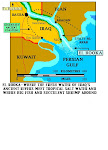
After India was given its independence in 1947, the year in which the Jewel in the Crown was so awkwardly and hastily chiseled from its Imperial setting, there was one outlying and functional adjunct of the Royal British Raj that still continued working smoothly and peacefully for several more years.  This was the Basra Port Directorate in southern Iraq.
The Colonial Indian Government had long considered the extreme southern tip of Iraq, as also was the Kyber Pass leading down from Afghanistan, to be part of a vital first line of defence against any encroachment or invasion from possible Russian expansion.  So the Indian Government, which often acted surprisingly independently of the British government in London (even siding with the French against Westminster on one occasion) fostered much interest in the Basra area and the wide reaches of the Shatt-al-Arab river.

Following the British-Indian Army’s overthrow of the Turkish Empire’s 500-year-long occupation of Mesopotamia, in the opening years of the First World War, 1914-1918, the Port of Basra had operated as part of the British Mandate, formed in Paris during the 1919 Peace Conference under the auspices of the League of Nations.

Though in 1932 Britain persuaded the League to grant Iraq full independence as a royal kingdom under King Faisal, the directorate remained responsible for keeping the commerce of Iraq, and the flow of Iranian oil from Abadan steadily available for the sea-going tankers arriving in a steady stream from many nations around the globe. 
This was especially important as before the 1960s there was no hardened road across the desert between Baghdad and Syria or other Mediterranean country.  The only such travel was by infrequent desert buses across the sandy wastes following an ever shifting track marked out and constantly updated by empty oil drums every two or three miles.
So the port of Basra was of vital national importance.  Before the advent of air travel most all commerce and passengers arrived and departed by ships sailing up the Persian Gulf.

In the post-war years following 1945, British influence in Iraq, though militarily unobtrusive, was still diplomatically significant in the region.  It was quietly backed up by the presence of two semi-operational RAF stations, one near Baghdad, another near Basra, and also by the frequent courtesy visits of Royal Navy warships, which regularly patrolled the Sheikdoms of the Persian Gulf, displaying their White Ensigns.   

Thus the flavour of colonial India was ever present in Basra and especially in the tiny compound of Fao, nestled on the Shatt-al-Arab river shore amid the date palms that sheltered it from the nearby empty desert.  
In Basra, a few days staying at the notably luxurious rest house with its pleasant bar and fine dining room was always a festive occasion.  This holiday spirit was augmented by visits to the nearby luxurious Port Club not far down the road in Ma’gil, the pleasant residential area for the authority’s officials. 
Mainly because of the myriad little lights strung through the trees and bushes around the spacious club gardens with its swimming pools and tennis courts, it always seemed to be Christmas at the club.  And the long curving bar and sumptuous meals served in the spotless dining room were delights to enjoy.  Much of this sumptuous living was due to the meticulous professionalism and diplomatic competence of Mr John, the club’s Armenian manager.

Though it was a faithful remnant of colonial bureaucrats and office wallahs in their air-conditioned administrative quarters in the ornate Port Office Buildings up in Basra who dealt with the paperwork and diplomacy it was a smaller force of mainly wartime hardened British Merchant Navy officers stationed 75 miles down river in the tiny compound called Fao, who kept the ships coming in and the ships going out.
The main force of this prosaic operation consisted of five big seagoing suction dredgers, which operated at the head of the Persian Gulf.
There, where the Shatt-al-Arab, carrying the combined outflows of Iraq’s Euphrates and Tigris rivers, was massively swollen in springtime by water from melting winter snows in the far distant Persian mountains.  All these formed a torrent of outgoing silt-laden fresh waters, which confronted head on, the strong incoming tides of salt water of the Persian Gulf itself.  The result was huge deposits of silt that if left to natural forces would block the river’s entrance to any but the smallest of vessels.

The five tough sea-going dredgers, built in Scotland, and each manned by three deck officers, three engineer officers and scores of Iraqi crew members, spent continuous periods of ten days, or more, far out at sea, continuously sucking up the sea-bed silt washed down from the Shatt-al-Arab and keeping open the ever-changing shipping channels across the far reaches of the estuary, far off from the sight of land.
Periodically for a weekend, they would come up the river to tie up at Fao for two or three nights before heading back down to resume their lonely work at the head of the Gulf again.

At that time the little port of Fao consisted of a wooden wharf connected by a crane track to the workshops a few hundred feet inland. From the end of the wharf a chain of four massive iron barges was permanently anchored in a line parallel with the extremely muddy and soft silt shoreline. The dredgers and other large vessels tied up to the outsides of the barges and smaller craft like my El Ghar survey vessel tied up to their inshore sides.

In the compound onshore there was a marine workshop, a modest office for a small number of Iraqi draughtsmen and clerks, and a generator house. Half a dozen bungalows housed such people as the workshop manager, the electrical-radio engineer, the Cable and Wireless man, and their wives.  Others bungalows served the bachelors: the medical officer; the communications officer; and the overall boss—the Dredging Superintendent.  Also there were several dwellings for Iraqi office staff, a small hospital, a swimming pool, two tennis courts and, in the centre of everything a bare sandy football field for the local Iraqis. As relief there were patches of greenery and date palms.  There was also a thick mud-walled building, left over from the centuries-old Turkish era of the Ottoman Empire.  This housed the local Iraqi customs chief, his harem and his motley force of a dozen khaki-clad, rifle-toting, soldier-constables.

Most importantly, there was the club or Port Officers Shore Mess, a rather nice airy, high-standing, cool, building containing a polished red tiled hall about the size of a school gymnasium, a billiard room with snooker table, a small library and again most importantly, a bar. It was here that the dredger and other port officers intermittently congregated and where our special parties and dances were held.  Isolated as we were by the ninety miles of indistinct desert track stretching south from Basra, our club was the social centre of our tiny community.
Outside, through the compound gate, which was left permanently open to all, and all around and along the shore line, were scattered the spread-out serifa mud dwellings of the local inhabitants, interspersed with date palms, narrow irrigation ditches and a few rickety places of basic commerce.
Half a mile to the west, away from the river and the last date palms, the desert abruptly began.
Our small compound, of perhaps six acres in extent, populated with its sparse dozen and a half British residents, and distanced from contact with any other compatriots, was the ideal setting for an Agatha Christie mystery.   But any small intrigues that may have been present were either mild or tinged with good humour.  The unchanging lives for the compound’s dozen officials and a few wives and children were harmonious.  The swimming pool and tennis courts, books and a rare film show in the club, helped ease our placidly quiet lives.

In many ways Fao’s traditional close links with the newly defunct British Raj in India were apparent day by day.  Our dredgers would sail to Bombay for boiler cleaning when necessary, several local shopkeepers were Indian, many of our Iraqi crewmembers spoke Hindi or Punjabi, as did many of our Port Officers.  Our daily routine included being addressed as sahibs, burra sahibs, memsahibs, and noonday Tiffin-time chota pegs were followed by distinctly Indian curries with chappatis.
My crew members would accuse each other of being jungly if considered careless or ignorant, and most every day one of the British-India Steamship Lines’ passenger vessels, either the Dwarker, Dumra or Daressa, would pass up or down river, on their routine voyages between Basra and Bombay.  In fact there were still a dwindling number of travelers between India and Britain who took passage by ship from London to Beirut, then rode the big overland Nairn Transport Bus over the unstable and ever-changing track across the desert between Damascus and Baghdad, (roads were non-existent at that time) then by train to Basra and passage by BI liner down the gulf to Bombay.  Two or three years later burgeoning air travel would eclipse such romantic forms of travel.

Just down river from the jetty at Fao there would often be a score of deep-sea sailing dhows anchored just offshore. Some would be from far off Zanzibar, Malaya and other parts of the Persian Gulf and far distant parts of the Indian Ocean perimeter.  Many were larger in size than the vessels in which Columbus and other western explorers of old had made their epic voyages, and had crews of fifty or sixty men. These lateen-rigged sailing dhows showed distinct characteristics as to their place of origin especially in the shape of their bowsprits, which ranged from scimitar shapes to dauntingly two-fathom long painted phallic symbols.
Though some traded in general merchandise the main cargo they loaded in Fao consisted of tons of dates for which they would get high prices owing to their top-banana quality. This because their limited cargo tonnage would mean much of their load would be in good shape and not overly squashed. This was in like manner to the top layers of bananas, carried by freighters in other parts of the world, which are better preserved from damage by not having the weight of too many other tons piled on top of them—hence the term ‘top-banana’.

The crews of the dhows would often be many weeks at sea if hindered by adverse winds and storms and sometimes, while I was surveying the far offshore areas, we would see one flying a distress flag as it approached the estuary of the Shatt, or perhaps lying becalmed some miles off.  So we would give them a few gallons of fresh water and a sack of rice to last them until the flood tide would make and take them northwards up river.
When becalmed a dozen of their crew might man a long boat and tow their ship by pulling on the oars to the rhythm of a song and the haunting playing of a conch shell.
When they came ashore at Fao after so many hard weeks at sea I was intrigued at seeing the dhow captain and his senior officers saunter proudly up the wharf dressed in highly coloured ladies swagger coats, mostly tailored by New York garment factories. If out of fashion or miss-made in some way these cut-price slim-waisted coats would be shipped out east by their western manufacturers to find an eager market.
After an hour or two sitting in the coffee shop outside the compound gate, or doing whatever else they did for relaxation, these sea captains would return to their ships perhaps dangling a half-dozen small sardine-like fish from a string. Forbidden by religion from usurious dealings the dhows carried gold for buying and selling their cargoes.

Often through ignorance or because of bad visibility a dhow would anchor in the deep water of one of the shipping channels to wait for a favourable wind or time of the tide. But sometimes a loaded tanker was already traversing the narrow dredged channels on its way into deep water. In this case we would take the El Ghar alongside the dhow, make ourselves fast to it, and tow them to safer waters. And then often the knockader or captain would invite me and my serang, Ashoor Ahmed, to go on board for coffee. This was served during a rather elaborate little ceremony as we sat squatted down by the ship’s steering position upon the raised aftercastle. A young boy would come with a tray of little metal cups and a typical long, thin-spouted metal coffee pot nestled over his shoulder. He would hand one a cup to each and with a little twitch of his shoulder send a spurt of coffee that would unerringly land in the cup without a drop being spilled. A few little noisy sips and the tablespoonful of extremely bitter hot coffee would be gone whereupon another shoulder twitch by the serving boy would send a refill into one’s cup.
I soon found out that this sequence of events would go on and on despite my holding up my hands and making other gestures of ‘No thanks. No more coffee.’ Little spurts would continue to come my way until I learned to use the correct ‘no-more, thank you’ signal, which was to waggle the little cup from side to side.
Using my serang, Ashoor, as interpreter I would question the dhow captains about their navigation techniques, which were both surprisingly simple and yet puzzlingly involved at the same time. Passed down from fathers to sons over the many centuries they relied heavily on clearly seeing the night heavens during their deep-sea passages. But they also showed me their copies of British Admiralty charts and some showed me their sextants, all made by the Hughes factory in Barkingside where I had worked as a young teenager.
It was strange being there in such exotic circumstances and seeing the testing and error calibration certificate affixed to the inside of the lid of the sextant box, with the certifying signature of Mr. Perkins, the sextant shop manager at Hughes whom I had known, reproduced at the bottom. Often I would explain how that test sheet should be used, how to look after the instrument and how to adjust the index error. I could only do this because Ashoor had such a fine command of English.

One totally wrecked dhow aground on a mud bank had a dozen or more crazed rats running back and forth along its broken spars. I sent a couple of men to take off the ship’s wheel for me. I had some idea of using it as an ornament. But it somehow it disappeared, how I just don’t know. I found that strange because over the years I never lost anything else even though I was careless in leaving my things all over the place.
In the same way, even in Ashar, the oldest part of Basra, there was no fear of being mugged nor did any of the wives and daughters of port officers worry, even when out shopping alone. Iraq under the royal family of King Faisel, Prime Minister Nuri Said, and the Nakibs, was safer then than are our own cities today.

Rats abounded on our survey vessel. At night I used to balance empty tins on the angle-iron longeron that ran alongside my bunk so that any rat running along it would make a clatter and wake me up—and it was a common occurrence. I also had a stick by my pillow with which to rap on the double deckhead above my bunk. The rats’ constant scuffling and pattering up there would sometimes keep me awake but often a loud tattoo on the metal would quieten them down long enough for me to fall asleep.
Once a year we sailed up the river to Basra for our annual fumigation. With the El Ghar alongside the wharf all the crew were ordered off the ship to nearby accommodation for three days while I took myself off to the rest house and the amenities of the luxurious Port Club. Then the next morning the vessel was sealed up and the cyanide pumped in and left to poison everything for a day and a night.
The first time this happened the serang told me that during the first night all the rats left the ship. Then the night the ship was left open to air out the gas all the rats jumped back on board. The only rat caught was one which in the middle of the night was seen to be undecided as to whether to go in a cage-trap after the bait, or not. The serang said one of the lascars leaped out of bed and kicked it into the cage. After the fumigation the crew swept up several buckets of dead cockroaches from the underdecking and bilges. Then we sailed back down the river with a brand new certificate of fumigation attesting to our vessel being rat-free in my desk drawer. That night I was awoken by something heavy on the covering over my legs. I looked down into the eyes of the largest rat I had yet seen on the ship.

Sometimes before going ashore in the evening to our club in Fao I would bait a rattrap cage placed at the bottom of the ladderway leading down to my cabin. If the dredgers and tugs were all out at sea all would be extremely quiet along the mooring barges which were connected end-to-end by little wooden bridges as walkways. This deep silence was enhanced because as soon as our ship tied up to the farthest barge our vessel’s mistri, or engineer, would plug us into the shoreline's 220-volt current and switch off the ship’s 110-volt generator. So in the midnight silence as I walked back along the crane track and was yet still about four hundred feet from the El Ghar I would know if I had caught a rat. Because at the sound of my coming I would hear it starting to scream.
As I stepped from the first little wooden bridge onto the metal surface of the first massive iron barge my footsteps would echo eerily in the still night and resound from the surface of the fresh water stored below in each barge. And the trapped rat would scream louder. As I crossed the next little bridge onto the second barge the screams would become louder still and even louder as I crossed onto the third. When I trod down onto the fourth and last barge I would wonder why the terrible screams did not wake any of my crew who were sleeping on board, let alone the watchman, who as usual, was fast asleep at his post.
Then I would climb down my ladderway and see the frenzied rat with its mouth a bloody mess from trying to bite through the cage and its droppings and urine fouling the deck. Then I would grasp the rope tied to the top of the cage and climb back up the ladderway and carefully cross the upper deck to the ship’s side and lower the screaming cage into the water and at last listen once more to the blessed silence of the night.
Then. Leaving the trap well submerged, I would bend the rope to the ship’s rail with a clove hitch and go back down the ladderway once more, step over the mess where the trap had been, and get into my bunk. And fall asleep.
For this night at least, for an hour or two, after the screaming of my victim, the rest of the rats would lie quiet and subdued.

Wednesday, February 9, 2011

Canada and the USA


Raising the Drawbridge and flooding the Moat


Stridently obvious events indicate that the age-old political, cultural and religious global upheavals that have unceasingly and violently transformed world civilizations, ever since the beginning of human time, are still as volcanically active as ever they were in ancient or modern human history.
So the prospect of a mutual agreement with the USA regarding the establishment of a common security zone around our joint geographical perimeter is a clear and timely requirement.  It is a practical and sober precaution for ensuring the safety of our almost exclusively shared continent — North America. 

For Americans are more than just our cousins.  Overall, compared within the larger sphere of modern civilizations, they are us and we are them.

 Canadians are to Americans as firemen are to policemen.  As pork chops are to spare ribs.  As ale is to beer.
 So low key murmurings about the close links we have with our American cousins, while at the same time emphasizing—in a much louder voice—how we must safeguard our precious Canadian sovereignty and our so much superior culture considering the exigencies of today, is pointless academic bilge.  Why?  Because Canadians are Americans already—geographically, historically and most especially culturally.  And we have been for some time.  We just couldn’t help becoming so.  Period.
We’ve been close neighbours for too long to be otherwise.


In fact because of our shared geography, imposed by globally-shifting tectonic plates and planetary evolution, we have often shared political responsibilities for many scores of decades past.  For example, long before the Global Positioning System appeared, our two countries, along with Mexico, relied on mutual agreements for measuring and positioning the size, extremities, and salient features of our continent by referring all map making endeavours to the same point of reference: the North American 1927 datum point in a farmers field in Kansas, know as the NA Datum 1927, and marked by a bronze marker plug set in a bed of concrete.  Thus the entire myriad Canadian bronze plugs set across the length and breadth of Canada and its Arctic territories, were calculated in reference to that central plug in Kansas.
The St. Lawrence Seaway is another example of shared responsibility and mutual benefit in managing the vital commercial and international responsibilities of our two countries.
As is of course, NORAD, with its desolate Arctic network of warning radar stations providing a continental stretching defence and deterrence against the extremely real nuclear devastation of all North America, was the most critically required, decades-long, partnership for our shared very existence.

Once, in a convivial social gathering, I asked the dozen or so people within earshot to raise their hands if they had family members or very close friends who were permanent residents of the United States.  Every hand was raised. 
 Such a showing affirms the plain fact that with most Canadians living very close to our normally peaceful border, which for the better part of two centuries past has been wide open for the convenience of honest citizens from both our countries, an inevitable intermingling has taken place. 
 For a hundred years or more we have fought together against common foes, experienced the same economic downturns and upturns, eaten the same food, mostly delighted in the same laughter, suffered the same setbacks, shared the same lifestyles, treasured the same art forms, enjoyed the same recreations, weathered the same snowstorms, sweltered in the same heat waves, and talked the same talk.

 I imagine my own Ottawa family is typical.  We have welcomed many visitors from the USA.  My wife has relations in Arizona and California.  Our son has close friends in San Francisco and New York City and we have fond memories of trips and peewee hockey tournaments south of the border.
 Also, I personally can boast of having an American twin first cousin—born in the US mid-west on the same day as I myself was born in England.  His father, my uncle, emigrated to America from England a hundred years ago.  Notwithstanding that we only keep in touch by e-mail these days, there was one time when we actually met for a few days.  It was in 1945 in London, England.  He was on leave from his US Army regiment and I was on leave from my squadron.  Though he was the visitor and I was the native Londoner it was he who showed me the Tower of London, Buckingham Palace and other notable sights I had never bothered with before.  Afterwards I took him to a couple of nice pubs where we discussed the sharing of our mutual cultural values.   
Today, as for most other Canadians, they are still just about identical.
Apart from many being somewhat dauntingly Biblically over religious.

Yes, ok!  I admit it.  I’ve been a Yankeephile since 1941 in wartime Britain when Pilot Officer Weir, an American RAF Eagle Squadron pilot, took me up for my first flight ever at North Weald fighter station.  Pilot Officer Weir was killed just one week later.

I have also spent six-month-long periods during each of the years 1954-59, sailing along, exploring, charting and defining the coastline and geography of the Arctic perimeter now under discussion.


So what I say is this:
What this three-country-continent needs is a self-sufficient, safe, firmly unified, North America which is intelligently alert to rigidly protecting itself from the hideous ambitions of obviously insane aliens. 
With tomatoes and sunshine in good supply from Mexico; with oranges, grapes, and with shared continental-wide defences against ballistic nukes by the USA; and with maple syrup, poutine, wheat, real beer and ale and, most importantly, vast oil and natural gas production from Canada, North America will be a haven of democracy and freedom. 
Richly developed and civilized, with a trilingual — Spanish-French-English population — a united North America would be the mainstay in preserving global civilization.  

As a more unified, confident, and powerful continent we will have a distinct advantage in conducting our political and commercial dealings with the rest of the world.


proulxough@rogers.com

proulxough@rogers.com


Wednesday, October 6, 2010


A Tale of two Churches

Sunday Mornings in the London suburbs during the 1930s

In 1928, our family moved to 13 Coniston Gardens, located in the new housing estates off Woodford Avenue, which was part of London’s North Circular arterial highway.  Here the neighbourhood children could enjoy a pleasant sub-suburban recreational environment.  This because though on the fringes of one of the largest cities on earth, we were also on the fringes of green and semi-wild spaces. 
This part of north Ilford bordered on Woodford and Wanstead, then Conservative boroughs once noted for being the parliamentary constituency of Winston Churchill.  This was the newer part of Ilford, built up after the the First World War, and was mainly a suburban dormitory area for people who travelled up to the City of London to their work and businesses each day.  Living here and being three miles from SS Peter & Paul’s School meant that I also had a daily commute and took a penny ride, at first on the double-deckers belonging to the old Pirate and General private bus companies and later on those of the  London Passenger Transport Board.  Our school was in the older part of the borough, midway along Ilford High Road, between Ilford Broadway and Seven Kings. 
Of course there were several newer, more local schools, which most of my friends attended, but my mother was a Catholic and so I and some of my siblings were destined for mandatory indoctrination into the mysticism of Rome.  
However, because my father was an indeterminate non-practising Protestant, we thankfully had a fairly relaxed religious home life, apart from the bother of having to trudge churchward each Sunday. 
  But even this was lightened by my usually going with my older brother, to the very late mass at the new modernistic church in Wanstead, where the large number of fine motor cars shiny and sparkling in the parking lot bespoke the affluence of so many of the faithful.
Inside the Wanstead church, from high up in his fashionable and contemporary light-oak pulpit, pink, clean-shaven, pragmatic, somewhat portly Father Booker, looking as though he was the Governor of the Bank of England during the week and just dressed up in surplice and cassock on Sundays, would hold forth discreetly on a little highbrow theology and then allow his cultured choir to sing several of the more sophisticated hymns in their repertoire.  With those regulation formalities of the mass accorded their due time slot, he would follow up with plenty of businesslike discourse on how improved the church, and the manse, would look with yet another designer-aisle or other appropriate addition and enlargement.  Then he would stress how God and he, as usual absolutely unanimous in these matters, expected all their well-heeled parishioners to be prompt and generous in contributing to its financing.  And so it was.  And so it became.  And not much later, as was to be expected with all that immaculate new stonework and all those expensive and glistening Humbers, Jaguars and Wolseleys outside, Father Booker became Canon Booker.

Going to mass at Wanstead, instead of to the big, gloomy, musty church attached to our school in Ilford, ensured that none of my school teachers was likely to be among the congregation and, therefore, there was little chance of my receiving lectured disapproval for not attending one of the early morning services.  Also, at Wanstead, my similarly easy living brother and I could invariably arrive quite late and leave quite early thus cutting down on the tedium of the lengthy service.  Canon Booker didn’t seem to mind our sudden disappearances after the general blessing.  He probably suspected that our contribution to the church building fund, if any, would hardly compensate for our somewhat off-putting presence in the parking lot gawking at the limousines as they floated off smoothly and importantly from the hallowed grounds.
Walking to and from Wanstead church meant a mile or more of wending our way through the housing estates’ well-kept, modern homes, then down a leafy lane to a footbridge over the River Roding. 
Then we followed a path running beside the river, which was full of sticklebacks and other small fish and frogs for my interest, while on the other side of the path, for my older brother’s interest, it passed a large group of tennis courts full of bouncing, leggy, young ladies in very short, frilly tennis skirts.  Then we passed up into part of the old Wanstead village.

Along the way was a strange, very small shop owned by a wizened little old lady left over from mid-Victorian times, or even earlier.  Through a small display window of thick bubbled glass containing a most weird collection of curious items, the interior of the dark shop hinted at secreting even more eerie oddments inside.  Among those bizarre novelties I remember most clearly several bowls filled with glass eyes of varying sizes and colours.  Probably wounded veterans of the Crimean war, or maybe even older pensioned-off sea pirates, contemplating discarding the black eye-patch covering an empty socket, had once riffled and fingered through those ancient bowls looking for a comfortable colour match for their one remaining organ of sight.  
But dimly, upon repeatedly clicking on my brain’s Search and Find option, I can conjure up half-hidden memories of other oddments in that little shop.  Malevolent and ugly Punch-and-Judy puppets, intricate handmade and hand-painted toys made of wood and tin, a horse-coachman’s whip and post-horn, roughly carved false hands and hooks, and children’s tops that when spun at a certain speed spelled out a special word of endearment or curse.  And surely it was there that I saw a dressmaker’s busty and panty-waisted dummy figure.  It was an old and rare dummy, complete with a dummy head and face. And incongruously, in that place of all places—a dummy with one eye missing!
The several times my older brother took me inside that musty place (Sunday shopping in the thirties), the old lady with her ancient, spiralled tin hearing-trumpet and her close-up intense scrutiny of my face, plus the odour of darkness and antiquity, all combined to unnerve me.  So much so that I was quite happy for once to get to Canon Booker’s no-nonsense, matter-of-fact, easy on the incense, bright and airy, modern-day house of worship to which he graciously bestowed residential privileges to his well-behaved and sophisticated God.

To me, this was all in pleasant contrast to SS Peter & Paul’s sombre church where God measured about four acres in extent and hovered like a dense storm cloud just ten feet above the massive, cavernous, roof.  Actually, this murky cloud was pierced, a little way to the westward, and for older worshippers only, by one bright hundred-foot-square hole.  This hole in the thick cloud allowed some rays of sunshine to fall in on a hall where the gallant Knights of Columbus had a cosy private pub. 
 There, after the ten o’clock mass they had just attended, those churchgoers so inclined could have a beer or whisky even before the half-past-eleven mass had commenced.  Not too many dismal Presbyterian faces in there.
  In this large church, old Canon Palmer, all craggy features, thick spiky eyebrows covering lurking piercing eyes, was the undisputed pious and revered leader.  Old enough to be the slightly younger brother of the ancient Victorian lady in the shop at Wanstead, Canon Palmer had already been sainted by most of his vast congregation.  His church was packed to overflowing and standing-room-only five times every Sunday morning and twice in the evening, as well as several times during the week.  His choir alone appeared to equal the total attendance of one of Wanstead Canon Booker’s early low mass congregations. They were certainly much noisier.
Of course this observation is hearsay on my part.  I never went to early low mass at Wanstead.  Always late High Mass.  When I performed my obligatory once-a-year early morning communion, I wanted to gain full credit for it in the eyes of my teachers.  So suitably pious, I went to SS. Peter & Paul’s that one Sunday in the year I was forced to fulfil my mandatory Catholic obligation.
It proved to be just about the end of my future church going.


Tuesday, August 17, 2010

UFOughs


Important Notice:
There are roughly (at times very roughly) six point something billion (6,???,???,??? billion) human beings living on planet Earth.
Though usually known by the madding crowd as ‘people’ these organisms were always known and classified, in the Royal Navy, simply as ‘ratings’.
This is the terminology used in this educational UFOugh offering...   

A Ramble along the Rocky Planetary Road 
to Alien Ratings

Recent astronomical observations disclosing the existence of a hitherto unknown multitude of earth-sized planets — many of them probably of a rocky composition — could well mean our contemporary blinkered world philosophy is on the verge of gaining fresh insight into the real nature of our solar system and the incredibly modest part it plays amid the actual mechanisms of universal existence.
Because the tantalizing possibility of there being other forms of life, distinct from our own terrestrial array, is now strengthened and appears to be obvious.

This will surely mean that all the ludicrous fictional ju-ju religious beliefs manufactured and practised by mystics, charlatans, propagandists, witch doctors, and other such artists throughout the many past millenniums since the dawn of history, and still amazingly noisily embraced either rampantly or softly muted, and still so pervasive even today, will soon be so discredited as to lead to their final blessed demise. 

Already there are indications by the more rational segments of society to entertain sober considerations of the seemingly increasingly reality of the hard core of facts in UFO sightings.  
This despite the continuation of dispassionate witnesses and moderate advocates being mocked by the majority of earthlings who are as yet still intellectually paralysed by the fairy tales indoctrinated into them from infancy by their elders, who were themselves, either gently or severely, mentally misled in similar fashion when children.
There is also derision from otherwise rational and educated people burdened with excessive ingrained codes of credence for reasons of blurry conformity.  They cannot visualize meeting alien ratings of similar intelligence to themselves.
Yet there is no reason to expect that our first contact with other vastly differently-evolved advanced life forms will compare in any understandable degree to our own uniquely developed but limited intelligence.

At last it appears, some earthly national governments are investigating the facts, tenuous as they are, and realizing that all the prosaic airline and military aircrew who have publicly recorded actual sightings (plus many more who do not, for fear of ridicule and potential harm to their careers) and also the scads of reports by other responsible ratings, and groups of ratings, could indicate that there actually may well be unknown super-intelligent ratings poking about inside our solar system’s boundaries.  
It’s all made out to be rather dopey by stories about little green men or beings with big heads, bulging eyes and other animal grotesqueness but basically built (as we’re so instructed by our own somehow superior religionist shipmates modestly clad in their long flowing gowns and funny head-dresses) in the likeness of our own particular genetic chief rating — usually known as God.
Even reputable science publications and organizations steer well clear of making plain comment in favour or against giving credence to the controversy — because of the possibility of further evidence unfolding either way in the near future. 
Surely more credence must be given to reports by clear-headed practical aviators than the fuzzy scary appearances, as related in religious fable, by feather-winged angels, playing trumpets, to ju-ju-believing shepherds of suspect reasoning powers.

But today, despite the automatic pooh-poohing by so many of our otherwise laudable senior leadership ratings, there is more likely evidence for the existence of intelligent other-world life forms, and thus a rational belief that those such ratings plausibly possess better forms of interplanetary travel than do we poor ratings who still have trouble designing even a decent and reliable toenail clipper.   
In fact, the evidence for the probability of existence of aliens who possess a capability for cosmic travel is much stronger than there is, or ever has been, for believing in the existence of any of the welter of gods generated through fanciful human imaginings over the past several thousands of years.  

The Vatican’s chief astronomer, one José Funes, when asked by the New Scientist magazine’s Eugenie Samuel Reich if religion affected his research agenda, replied that he had discussed the matter with the Pope and received complete freedom for research and so his astronomers studied planetary science, clusters of galaxies, cosmology, and the big bang — all of which seem quite appropriate subjects for any astronomer.
He also averred not to see any religious implications for Catholic theology by possible discoveries of extraterrestrial life.   So that’s all right then.  Full steam ahead.
(But on this point it now seems likely that Britain’s famed Second-World-War Prime Minister and the Supreme Allied Commander, General Dwight Eisenhower, disagreed with the modern view held by the Vatican’s José Funes and the Pope.  Because evidently our W.W.II allied leaders banned the, newly-disclosed, RAF report of a soberly believable wartime UFO encounter, partly because they considered it would degrade the religious beliefs of the allied civilian population).

There is no earthly or cosmic reason to suspect that any of the ratings we may contact from other planets would appear or share similar characteristics with the assembly-line look-alike appearance as do most of we ratings here gathered together on planet Earth.  You know the type (just take a look in the bathroom mirror) — all we ratings with a wonky round head stuck atop a body full of gurgling fleshy plumbing apparatus, an arm thing sticking out on both sides and two legs poking out underneath.  (Yeah, plus motley other bits and pieces which we needn’t get into just now.  We’ve had enough trouble with those on our own planet).

With aliens having their own particular brands of chemistry, physics, brewing techniques and favourite comestibles it is highly unlikely that they would look, behave, or think anything remotely akin to that which we good and true ratings here ensconced on Earth consider normal.  And if they are a bit loopy and partial to cogitating about supreme beings they probably have their own distinctly godly ideas and views.  

So all in all, intriguingly, with new scientific observations confirming a plethora of planets of differing masses and gravity in orbit around a variety of stars, double stars, and even multiple stars, the likelihood of their harbouring very strange other life forms is increasingly to be expected.

Of course, what would suddenly bring some of us up standing with a sharp round turn (and simultaneously vindicate others) at such a first meeting with intelligent alien life ratings, on a planet millions of light years away from earth, would be if the ratings inhabiting the place were found to be deeply religious and at once marched our first visiting astronauts off before their Pope, senior Imam, Rabbi or Buddha to be forcibly converted, confirmed or otherwise processed — thus unexpectedly proving that the hitherto completely imaginary existence of all our traditional earthly Gods is indeed part of a cosmic reality.


A very interesting note:

The first absolutely creditable and believable witness to record a UFO sighting — eighty years ago.

An excerpt about Sir Frances Chichester:

In 1940, as a fourteen-year-old mailroom office boy, my several daily trips around a scientific instrument factory  were full of interest.  There was the echo-sounder shop, the sextant shop, the compass shop and shops where Ralston Stability and Trim Indicators, binnacles, Kent Clear-View Screens, navigational dividers, telescopes, binoculars and many other aids and instruments of marine and aerial navigation were made and tested.  One mail stop of special interest was an electrical shop set-apart in some secrecy which was devoted to the research and production of the first radar sets.
 But, even this paled in interest against my second port of call.  Because this stop on my never changing internal mail route, at times with live episodes of the Battle of Britain taking place in the blue skies overhead, always took me into the office of the adviser on navigational design matters.  
The room contained his secretary’s desk, his own large desk, and always several navigational sextants, both marine and aeronautical bubble, and fascinating wooden models of devices in the design stage, together with other oddments of intriguing appearance.  And around the walls were shelves of books on aviation matters, maps, and many pictures of aeroplanes, predominant among them photographs of a de Havilland Gipsy Moth.  It was just as well that he, who occupied this office, was nearly my first client as his copious mail was often heavy with books and copies of wonderful, though somewhat expensive, glossy magazines.  The Aeroplane, Flight, The Aeroplane Spotter  and other technical and general-interest publications on aviation made his slot in my mail carrier bulge to full capacity. 
 Though already well known and respected in aeronautical circles for his epic feats of navigation in flying his light aeroplane between England and Australia and New Zealand, at that time, during the early years of the war, this gentleman whose office so delighted me each working day was, to me, just that — an extremely interesting, and kindly, gentleman.  This especially because, when he saw how absorbed I was in his photographs and magazines, he not only took to passing on to me some of those books and magazines, but even at times asked his secretary to pour me a cup of tea and give me a biscuit from his managerial tea tray.  His name many years later became a household word in Britain and other parts of the world for his record-breaking and adventurous, around-the-world, solo ocean voyages in his yacht, Gipsy Moth IV.  He was also knighted by the Queen and became Sir Francis Chichester.
At that time, when I was confiding in him my ambition to become a fighter pilot, I did not know that he himself was busily bombarding the Air Ministry and Royal Air Force with applications to get a wartime flying job.  Yet with all his valuable experience, he was refused time after time.  Eventually, I believe his expertise was acknowledged by an appropriate appointment at the Air Ministry.

But of most importance, Chichester was probably the first absolutely creditable and believable witness to publicly record a UFO sighting, though at the time the term was unknown.  In one of his books, I think it is Return to Australia,  he recorded that in the middle of his remarkable and epic feat of air navigation in flying from New Zealand to Australia, in 1931, he saw:        
 Suddenly, ahead and thirty degrees to the left, there were bright flashes in several places, like the dazzle of a heliograph.
  I saw a dull grey-white airship coming towards me.  It seemed impossible, but I would have sworn that it was an airship, nosing towards me like an oblong pearl.  Except for a cloud or two there was nothing else in the sky.  I looked around, sometimes catching a flash or a glint, and turning again to look at the airship I found that it had disappeared.  I screwed up my eyes, unable to believe them, and twisted the seaplane this way and that way, thinking that the airship must be hidden by a blind spot.  Dazzling flashes continued in four or five different places, but I still could not pick out any planes.  Then, out of some clouds to my right front, I saw another, or the same, airship advancing.  I watched it intently, determined not to look away for a second: I'd see what happened to this one, if I had to chase it.  It drew steadily closer, until perhaps a mile away, when suddenly it vanished.  Then it appeared, close to where it had vanished: I watched with angry intentness.  It drew closer, and I could see the dull gleam of light on its nose and back.  It came on, but instead of increasing in size, it diminished as it approached.  When quite near, it suddenly became its own ghost--one second I could see through it, and the next it had vanished.  I decided that it could only be a diminutive cloud, perfectly shaped like an airship and then dissolving, but it was uncanny that it should exactly resume the same shape after it had once vanished.  I turned towards the flashes, but those too, had vanished.

1960 report:

Squadron-Leader Gordon Burgess, whose RAF service dated from 1940, reports that in 1960 he was flying a Shackleton long-range maritime patrol aircraft with twelve people aboard, from Cyprus to Malta.
During two hours of morning daylight, beginning in the vicinity of Crete, a cylindrical-shaped metallic-appearing object, with red illumination at its forward end took up position on the Shackleton’s port side and followed its every movement for two hours.
After reporting this sighting two RAF Javelin fighters flew out to meet the Shackleton and their pilots also confirmed the object’s presence just before it suddenly disappeared skywards at extreme speed where at 60,000 feet it was lost to Malta radar.
All concerned reported what they had seen and the incident became an Official Secret.


Recent News item that’s causing a flurry of speculation...
Winston Churchill was accused of ordering a coverup of an encounter between a UFO and an RAF aircraft in the Second World War because he feared a "panic" and a loss of faith in religion, state newly-released secret files.
The claim is contained in files on UFOs declassified today by the National Archives. The files, covering 1995 to 2003, are made up of more than 5,000 pages of reports, letters and drawings.
The allegations involving Churchill were made by the grandson of one his personal bodyguards, who wrote to the Ministry of Defence in 1999 inquiring about the incident after he learned of the details.
According to the letters, a reconnaissance aircraft was returning from a mission when it was shadowed by a metallic UFO near the coast of England, possibly over Cumbria. Its crew photographed the object, which they said "hovered noiselessly" near the aircraft.
The writer, a physicist from Leicester, claimed that his grandfather, an RAF officer, overheard Churchill talking to Eisenhower about the incident.
During the meeting, a weapons expert dismissed suggestions the object was a missile because the event was "totally beyond any imagined capabilities of the time." Another person raised the possibility of a UFO, at which point Churchill ordered the report to be classified.
"There was a general inability for either side to match a plausible account to these observations, and this caused a high degree of concern," wrote the physicist.
"Mr. Churchill is reported to have made a declaration to the effect, 'This event should be immediately classified since it would create mass panic among the general population and destroy one’s belief in the church.


Is this where the views of the Pope and his chief astronomer, which contradict those held by Winston Churchill and Supreme Commander General Eisenhower in World War Two, are answered?  (I wonder if they asked generals Montgomery and de Gaulle for their views at the time)

Here's another little peanut of a squib
Following four years of Arctic exploration from Hudson Bay to Eureka, at eighty degrees north latitude, 1958 was for me another active year, during which as a Canadian advisor I spent many weeks aboard the United States Coast Guard Cutter Bramble, engaged on charting the waters of Baffin Bay between northern Baffin Island and western Greenland, followed by weeks aboard HMCS Nootka running Decca Navigational tracks between the Atlantic and Quebec City.
But those duties followed an earlier two-month period as the senior assistant to D’Arcy Charles who was in charge of the large new Canadian Hydrographic Service research icebreaker, CGS Baffin, employed in charting the extensive waters of Cyrus Field Bay off southeastern Baffin Island and around Monumental Island.
During this earlier part of the season I spent periods in charge of two shore parties erecting temporary Decca transmission masts on two widely separated and isolated islands at the southern end of Cyrus Field Bay.
One of these shore excursions included the only time I was to be touched by the mysticism of the arctic loneliness.  
If I was asked right now, after the passage of a half century of time, I would be hard pressed to pinpoint the exact location of which I speak—even though I made several astronomical  observations to fix its position at the time (we had no GPS or computers then).  Now it would require a complicated, and cooperative, delving into old records buried somewhere in Canadian Government storage rooms to locate its position.  Years ago I did search for for the location on aerial photographs to no avail.  
Anyway, like an unbeliever who sees a ghostly, inexplicable occurrence, or I imagine, a dyed-in-the-wool scoffer who himself sights strange flying objects, which to my chagrin I never experienced, I would prefer to keep it all a private memory.  Something special to myself.  Something to mull over in quiet moments.  Because, it is still hauntingly, familiar in my mind:  
The whole beautiful scene that was displayed that evening I strolled through a deeply-coloured arctic landscape along an Arctic shoreline.  Maybe, it was nothing.  Or perhaps everything in its implications?  One thing is certain.  It was no passing, momentary thing.  If it was then, then it is now.  And can still be confirmed by other eyes.  Unless...
Let me try to describe what I experienced.

It was during a late evening with a most strangely purple-coloured sky.  After supper I decided to leave the hut and my five or six semi-marooned companions and stroll along the island’s northern shoreline.  All was still and quiet.  The sun was low down in the north with the greater part of its orb below the horizon. The varying hues and tones of purple touched the sea, the beach and the bare, rocky inland hills.  Not even the smallest wavelets washed the beach.  The sea was mirror calm, a tranquil palette of colours from the deep blue end of the spectrum.  The only sound in the desolate landscape was the constant wild calling of a pair of arctic loons on a small lake nearby.  The only other sign of wildlife I encountered was the massive hulk of a dead walrus lying on the high-water line.  There was no smell, death had been very recent and the large tusks gleamed their own sheen of purple.
Half a mile further on I turned a bend in the coast and was brought to an abrupt halt by the scene before me.  Along the gentle slope of the bare rock-face, stretching up from the shingle beach and reaching inland as far as I could see, was a wide, flat, level scar.  Straight as it was, at right-angles to the shore and about two hundred feet wide, it appeared to extend inland for thousands of feet to where the hills rose up from the plain.  Startled to be suddenly standing on the edge of such a harsh and definite geometric feature after wandering for so long amid the natural randomness of the regional geography, I could not at first grasp its reality.  My first bewildered thought was wonderment at why anyone had decided to build an airport runway in that remote place.  And left it uncompleted!  At once I dismissed such a ridiculous notion.  No wartime or peacetime use could have been made for an airfield in that remote area.  And surely the cutting of the feature before me would have entailed an impossible amount of equipment and blasting operations at astronomical expense.  Therefore, what was it?  A geological formation?  Could an ancient sheering movement of rock against rock leave such a spectacular fault? 
I could not credit it.  And also it seemed, the deep purple colour of the exposed vertical rock faces which formed the sides of the scar appeared on a closer look to be scorched.
Scorched?
By what?
What was I thinking of?
No meteorite would leave such a scar.  A crater, yes.  But not a survey-straight dimensional scar.
Where did that leave my capacity for rationalization?
Bemused, I sat on the edge of the scar, quietly smoking my pipe for some time in the low light of that late summer arctic night.
Finally I roused up, took one final look around to prove to myself I was not dreaming, then slowly wended my way the couple of miles back along the shore to the huts.  The next day I was picked up by one of the Baffin’s six launches on the other side of the peninsula and within days I was far distant from that strange place.
For me, it remains my only unsolved arctic mystery.

Of course now, I curse my foolishness, not only in this event but many others over those Arctic years for not always carrying a camera with me.  The small number of black and white photographs I did take were mostly of the fish I caught, boats and ships.  Many were used in magazine stories I wrote.  But the old folding camera that I used, purchased in Iraq years before, was inconvenient to carry and use.  But before leaving Ottawa that particular year, 1958, I had bought one of the first compact 35 mm reflex cameras, an Asahiflex.  Some of the Kodachrome slides I took with it appeared in the Canadian Geographic Magazine and elsewhere.

But even with all the other cameras I’ve owned since then not in one single instance did I get the chance to photograph a UFOugh.
It’s a mystery.


proulxough@rogers.com

Thursday, June 10, 2010

Guiding the big guns on target


Simulations for the attack on Japan

On foul weather days when we were socked in as regards flying our squadron’s Seafire XV fighters we had various training aids to keep us busy.  The most notable and best enjoyed was the Operational Crew Trainer.  This elaborate contraption took up a sizeable amount of space in a large darkened building.  Its purpose, already somewhat outdated in 1945 though probably still ready for operational use in the forthcoming final assault on Japan, was to teach us to direct the guns of large warships onto their targets.  
Of course, by this time most of the world's great battleships had been sunk by attacking aircraft, but we carried on in proper naval tradition.
  Two of us at a time, one to act as pilot the other as observer, would climb up into a mock model of an aeroplane and, as the lights dimmed right down, instrument dashboard lights would glow, the aircraft would come to pulsating life, earphones would hum and curtains would draw back to reveal, down below and seemingly ahead a couple of miles, the vista of a shadowy coastline as viewed by moonlight from about a 3,000-foot altitude.  By using his controls, the pilot could turn the aircraft and fly along the coast in either direction with harbours, towns and villages, rivers, inlets, railway lines and stations, woodlands, hills and factories all passing by in realistic fashion and appearance.
The observer would receive information and instructions regarding the selected target, perhaps a railway marshalling yard or dockyard.  Then the code word ‘Flash’ (the guns have fired) would come over the headset followed by a varying number, ‘seventeen’ (meaning the warship’s high-explosive shells will land near the target in seventeen seconds time).  And sure enough in seventeen seconds the shells would burst with a small flash of light down below.  Perhaps a fountain of water would rise up if the shells missed short and fell into the sea or a river, or several trees rise up and fall down if the salvo fell in the woods, or perhaps buildings in a nearby town would be seen to topple.  
As the pilot turned the aircraft to pass by that part of the coast again, the observer would be radioing the compass bearings and distances off of the shooting errors back to the ship. 
 Then again we would hear: ‘Flash, seventeen’ (or sixteen or eighteen) and the game would go on until the target was hit.  The realism was amazing.  After a few minutes of turning this way and that in the dim, muted light, the murky illusion of actually flying became very real.
After many sessions, we were allowed to see the trainer's workings.  The aircraft was mounted on a stationary pedestal, but could be turned through 360 degrees.  The mock-up coastline and inland topography was a vast relief model resting on a thirty-foot-diameter turntable, which had its turning speed synchronized in ratio with the aircraft's heading and indicated airspeed.  
The relief model itself was a mass of little pegs which when activated by electrical impulse would rise up differing fractions of an inch accompanied by a flash of light.  These pegs underpinned tiny model houses, trees, locomotives, factory chimneys and other fragments of infrastructure and landscape, some of them hinged so they could topple over in lifelike fashion.
Underneath the turntable was a bewildering spaghetti-like mass of electrical wires and tiny electric bulbs of varying intensity.  Through a wonderful system of relays and switches, the controller, hidden away in her hidden cubicle, could select appropriate pegs to rise up sharply with a burst of light and then sink back more slowly into their recesses.  All this long before transistors or computers appeared.
We loved playing this game.  Especially Goff Parker.  His Wren girlfriend, Mary, who was one of several who shared many of our evenings in the lounge of the nearby Ugadale Hotel, was one of the trainer's controllers.  At war's end they were married and I expect carried on playing similar such games by moonlight happily ever after.

proulxough@rogers.com