proulxough@rogers.com
Saturday, April 24, 2010
In Old Iraq
proulxough@rogers.com
Friday, April 16, 2010
Dundee Trawlermen
Saturday, April 10, 2010
Wings Parade Pageantry
So we just stuck them in our jersey pockets.
Thursday, April 8, 2010
Ottawa Citizen newspaper editor shares a giggle...
Is this the understatement of the semester?
Tuesday, April 6, 2010
Dateline : 110 - 71 Years Ago
Today, it is around $1.52.
Monday, April 5, 2010
I watch an over-indulgent Polar Bear...
Early Educational Methods
Friday, March 19, 2010
ESKIMO POINTINGS
One day in 1954, atop the highest point of land on Marble Island, northwest Hudson Bay, I was observing angles with a theodolite when two Inuit, passing by in a Peterhead boat, came onshore and climbed up the steep hillside to visit me. One was quite young and spoke good English but the other man was very old and could only communicate with me through his younger companion. The old chap was still very spry but was obviously well more than 80 years old.
During the course of our conservation the young lad told me that he had been to school in Frobisher Bay. At the mention of that place the old man took a few paces away from where we were standing and laid his ancient, long-barrelled rifle down on the flat rock face with elaborate care. I asked the young fellow what the old man was doing and was told that his old uncle was pointing his gun in the direction of Frobisher Bay—more than 700 miles away.
Intrigued by the confident manner in which the old chap had adjusted the pointing of his rifle so precisely I had him use instead a 16-foot-long piece of straight two by four that my survey team had left nearby when building a triangulation beacon. I got the old fellow to put one end of the two by four on the small bronze survey marker I had set into the hilltop rock face and point the other end at Frobisher Bay way over the curved edge of the world’s horizon. Then I took a reading with the theodolite cross-hairs centred on the far end of the straight two by four. After that I got the old man to point the stick towards what he considered to be the direction of Cape Dorset, Churchill, Chesterfield Bay, Povungnituk and Pelly Bay. And each time he did so I precisely measured the angle of the two by four with the theodolite.
But when I asked him to point the 2” x 4” to Moosenee or Pangnirtung he refused. When asked why, he said simply that he had never been to those places. But he would point to any place he had ever been to in his life. Months later, back in Ottawa I calculated the true bearing of each of those places from the geodetic plug I had installed on Marble Island that day. Every one agreed within two or three degrees of the old Eskimo's two by four pointings.
He was a human GPS system long before the modern electronic one came along.
Wednesday, March 17, 2010
One Man’s Meat is another Man’s Poisson:
Stashed several dozen stories back, somewhere amid the rambling, kilometers-long, undisciplined hodgepodge stuffing of this, my meandering blog, and under the title of SABLE ISLAND, I have recounted the true story of my most intimate and personal social encounter with a convention of seals in an amazingly improbable yet formal group situation. In all modesty I believe that the extraordinary social experience that took place that magical day between myself and several hundred seals was unique — as well as a cherished personal happening. But that happy event was far different from my first close encounter with these absorbing aquatic mammals. (Though I do have a hazy memory of eating seal-flipper soup during the long ago weeks I spent working around the Newfoundland coasts). But my first real-seal encounter occurred, now pungently remembered, was when our ship stopped in at Diana Bay, near Ungava Bay. An Eskimo gentleman (Inuits were still unknown as such to we southerners back in 1954) came into my cabin and offered me a seal skin as trade for a little tobacco. I readily gave him some tobacco but indicated that he could keep the seal skin. But he was adamant. The seal skin was mine. Several days later it was my shipmates in adjoining cabins who were adamant. Either the smelly sealskin went over the side or I did. Thus, my first brief encounter with seals was over. In truth I was just as pleased as were all other hands. On other occasions I have leaned over from my sounding launch to hold one-sided conversations with the odd overly-curious seal or sat quietly near small groups of them on rocky foreshores. I can remember visiting the University of Guelph’s seal study department for some reason decades ago — probably I was with the National Film Board at the time. Also, many of the Maritimers who manned our hydrographic launches during our six-month-long Arctic summer seasons spent their spring times as seal hunters out on the sea ice off Canada’s east coast. So, naturally, in the close confines of a 30-foot sounding launch, during fourteen-hour-long northern workdays running mile-upon-mile of echo-sounding lines, I often listened first hand to their lengthy, sober, love-hate stories of the exhausting weary weeks they spent during the cruel and bloody hunt. Tellingly, my crew, who were also fishermen at other times of the year, never quoted what nowadays is posed as a prime reason for the hunt: that the ravenous seals constantly gobble up all the cod to the brink of extinction, and so they have to be slaughtered to save the fish stocks. That desparately-manufactured placatory theory only became the plaintive cry of seal-hunt defenders after one cuddly species, represented by Brigitte Bardot, took the part of another cuddly species—the innocent little white-coat baby seals, whose pristine snow-white appearance was depicted in such sharp relief and deadly contrast when the brilliant crimson of their blood was splattered around the ice upon which their poor little battered bodies were depicted. That particular aspect of the hunt was later curbed by new regulations proscribing such bludgeoning of white-coat puppies. Though whether their protective mother seals still had to suffer business-as-usual skull smashing I don’t know. But I suppose it was meant well. But yet, I have a question — never answered: Why is it that hundreds of years ago, long before Europeans arrived and began commercial seal hunting, at a time when the unmolested seal populations must have been thriving enormously, how was it that the codfish, even more markedly, at that same time were inexplicably reported to have been so legendarily superabundant? Back in the 1950s I jigged many a big codfish for dinner. From Nova Scotia to Baffin Bay. Rankin Inlet, northwest Hudson Bay, was completely unpopulated then, not a single Eskimo to be seen. Nearby coastal waters were devoid of native fishermen and hunters for scores,
hundreds, of miles. There were lots of seals around, though. Also the cod were wonderfully prolific. As were Arctic char. There’s a very big difference between native inhabitants hunting their traditional vital food source, as is their perfect and natural right, and the often insensitive and wasteful hunting by commercial interests.brickbats and plaudits to: proulxough@rogers.com
Saturday, March 13, 2010
Playing my liquid part in the Cold War of the 1950s
Impatiently eager to empty all bottles
In the springtime, when sailing up the Labrador Coast in the 1950s aboard the ice-strengthened sealing vessel MV Theron, on charter to the Canadian government, our primary objective was to reach Hudson Strait from where we could head west to the unmapped and uncharted regions of northwest Hudson Bay, the area of our main operations.
But our immediate intention was to reach the northern part of the Labrador coast. There we would carry out offshore charting while awaiting improving ice conditions to allow us to make our northing.
When on passage we stopped the ship at intervals, day and night, to allow us to take samples of
sea water and temperatures at various depths. These oceanographic observations, apart from gaining general scientific knowledge for studying fish populations and other subjects, were important for antisubmarine warfare purposes. It was suspected that if unfriendly submarines had seasonal charts depicting temperature and salinity gradients. it could assist them in navigating more accurately.Our observations were made by lowering a string of reversing water bottles down into the depths. The bottles were made of heavy metal and each one had a special reversing thermometer attached. Also they had spring-loaded watertight snap lids at each end which could be activated to shut closed when triggered.
If for example the ship was stopped in 600 feet of water the end of the wire which was lowered into the water by winch would first of all have a
bathythermograph attached to the end. As this instrument descended a compact stylus drew a line on a small piece of smoked glass about one-and-a half-inches square. It actually inscribed a miniature graph of the temperature gradient from surface to the lowest depth it reached. Just above this gadget the first, or in fact what was the last, or deepest, water bottle would be attached with its end lids open. The wire would then be lowered 25 feet, or whatever interval of observation had been decided upon, and the next water bottle would be attached to the wire.Hanging to the bottom of this bottle’s end cap we would attach a brass weight called a messenger. This heavy messenger was wrapped securely but loosely around the wire so that when released it would slide freely down the wire under its own weight. One such weight was attached by a ring to each bottle in such a way that when that bottle was activated from above, the messenger underneath would be released and fall down the wire to hit the bottle below and activate that bottle in turn.
The wire would now be lowered another twenty five feet and another bottle together with another brass messenger attached to the wire. Eventually, a string of water bottles, all in an upright position and at regular intervals would reach from the surface of the ocean down to just above the sea floor. When all was ready the hydrographer would attach a starter messenger to the wire and give it a push down the wire to activate the first water bottle just under the surface of the water. By keeping a bare, ungloved, handhold around the wire one could at once feel the shock and vibration as the messenger hit the top of the first water bottle. At the same moment the water bottle fell into its upside-down position, thereby locking the mercury in its thermometer to record an exact reading for that particular depth. Simultaneously, both of its end caps snapped shut trapping a sample of the water at that depth, and allowing its own attached messenger to be released and fall free down the wire to the next lower bottle. Then within a few seconds one would feel another tremor and vibration as the second water bottle was activated. Then, hoping that bottle’s messenger had also been released, an inordinate amount of time would seem to pass before another, but fainter vibration of the wire was detected. As the lower bottles in the denser layers of ocean were activated at much longer intervals of time the vibrations would become fainter and fainter. The messengers, each released in turn from the deeper bottles far down in the dark depths, and each one travelling more slowly than the one before because of entering higher density ocean depths, seemed to take an eternity to slide down the wire and reach the next bottle. Until with only one to go, that last most important one, and still with a cold, wet, bare hand wrapped lightly around the taut wet wire, one would become convinced that the last messenger had not been released as it should have been, and become ever more convinced that those long minutes spent leaning over the wallowing ship’s heaving side in the midnight darkness, with an icy wind blowing, and peering down into the roiling water to where the wire disappeared into the dark water below, all this had been nothing but a miserable waste of time.
One might as well forget thoughts of soon returning to the nice warm bunk waiting in the snug cabin and admit failure as regards the activation of the last bottle. We would have to bring all the long wire back up, empty and reset every bottle again, just for that one cursed lowest bottle causing a required repeat of the whole lengthy task.
And then just as all hope had drained away and a signal to the seaman at the electric winch was about to be reluctantly given, the faintest of telltale tremors, no more pronounced that a humming bird’s passing, an autumn leaf touching down upon the forest floor, a snowflake alighting on an outstretched hand, there would be felt, amid the turmoil of the heaving water and the odd piece of sea-ice bumping against the ship’s steel hull, the long-awaited message from the deep down brass messenger as it activated the last bottle.
Then one could happily give the signal to hoist up the long string of wire and as the winch whined away and each water bottle arrived at breast height, it could be grasped firmly as soon as it swung within reach by the rolling of the stopped ship, and released from the wire. Then its sea water sample would be poured into a numbered jar and its thermometer reading recorded. Then the next deepest water bottle would be brought up, and then the next, and the next until all were safely aboard and stowed away in their compartmented box, and finally one could go back into a warm bed for two or three hours until the whole business of recording basic marine data would be repeated in another more northerly part of the deep black secret ocean.
OTHER VARIED WATERY INVESTIGATIONS
In 1952, while working for a firm of consulting civil engineers in northwest Scotland, I was teamed up with a very agreeable ex-Royal Engineers officer to measure the flow of the River Awe, a very fine salmon river with fast, clear, rich, peaty-brown water. The sort of water that makes a fly-fisherman’s heart beat faster.
We stretched a wire a foot or two above the running water from bank to bank. Then we hooked a small rowboat onto the wire which we had marked every five feet of its length. We had a compact chromium-plated current meter with which to measure the speed of the river’s flow at varying depths. By stopping every five feet and taking readings we would have the data to calculate the river’s rate of discharge.
Our little current meter had a propeller of about two-inches diameter which revolved in the current. An electrical wire from the current meter went to a pair of headphones. For every so many revolutions of the propeller the headphones would make a clicking noise. Counting the number of clicks in sixty seconds indicated the speed of the river at that particular depth and distance from the river bank.
All went well until we were about twenty feet from the bank. Then the clicking often stopped or came up very erratically. Time after time we pulled the instrument up to see what was wrong and to clear any debris that may have been caught in the propeller. But it was always clear and worked perfectly when we held it in the river just under the surface where we could see it. Yet directly we let it down again into the deeper peaty-brown-tinged waters we had the same trouble.
It was puzzling. Until we realized the obvious. A small, bright propeller revolving deep down in a
We just had to carry on as best we could, taking all the readings several times and noting how many seconds of uninterrupted clicking we could count and then adjusting our calculations accordingly.
Another phenomena was when taking readings of the water level at both ends of Loch Awe we found what appeared to be a discrepancy: the water level appeared not to be level.
After much investigation and consideration of the wind velocity and direction over the past many days we decided it had piled the water up at the downwind end and reduced the level at the windward end. A week or two later the discrepancy disappeared. Loch Awe is very narrow and about 24 miles long and is oriented northeast to southwest.
At the top of the PERSIAN GULF
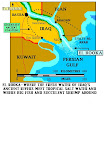
Up until a few weeks before making my varied roving observations when tramping across the Scottish Highlands, I had spent several years in charge of the Iraq Government hydrographic survey vessel, El Ghar. Manned by just a crew of 20 Iraqis and myself, we operated out of Fao, a tiny compound on the tidal banks of the Shatt-al-Arab, set among the narrow belt of date palm trees separating us from the wide desert wilderness, which stretched away for hundreds of miles.
Every day and every night I was metaphorically and literally immersed in the tides. Apart from the constant soundings I took of the shipping channels and their whole surrounding 500-square mile area, I recorded the directions and speeds at differing depths of the tidal currents. Also I studied and made approximations with simple instruments of the amount of suspended silt being carried down the river and estuary. So the tides ruled my life. Especially my wake-up time.
Because the global tidal wave is 50 minutes later each day the El Ghar would usually depart from Fao in cycles. If not spending the night at sea, one morning we would cast off with the first of the ebb at four o’clock, the next at five, then approximately six and so on until about 10 o’clock when we would jump back to about four o’clock again. This enabled us to leave with the ebb, work most of the day on the flood and chase slack water or slog back against the ebb, up the river and home to Fao. Then I would perhaps go to the office for an hour or plot my soundings on the bridge. But of course this routine was not routine. Weather, tankers aground, special assignments, religious observances, political disturbances, visiting VIPs and other visitors who wanted a trip down to salt water, assisting native ocean-going dhows hailing anywhere from Zanzibar to Burma —all these would make my days varied and unpredictable.
Monday, March 8, 2010
Bomber Pilots and Wild West cowboys...
Strangely, despite passing the strict medical examinations they must have undergone by Luftwaffe doctors, some of the German bomber pilots who incessantly droned around the night skies of London while carrying out their intense air raids during the winter of 1940-1941, appeared to suffer from a serious hearing loss.
This often became a grave matter for many Londoners on the receiving end of the Nazi’s Blitz hardware. So they tried to assist them in following the rules of good conduct in such stressful times.
Usually this happened when, after a night of sporadic aerial interruptions to their night's sleep, the populace would finally see the first welcome light of dawn and sink thankfully into a deep slumber for a brief hour or so before having to get up to go to work.
It was then, as soon as the authorities were sure everybody had at last fallen soundly asleep, that they would order the sirens to wail the loud continuous note of the all-clear signal. And wake everybody up again.
Then maybe a few minutes after the unforgettable siren sound had finally moaned into silence, and a brief sleep was once again being sought, it was then that some foolish German airman would drop yet another bomb. Now, this was very annoying. Not only had the all-clear definitely already been sounded and woken everyone up, but here was some idiotic cloth-eared enemy airman who for some reason had not heard the all-clear and was still hanging about up there dropping noisy bombs instead of heading off back home for breakfast with the rest of his gang.
Understandably, it was at that time that many bedroom windows were flung open, angry heads thrust out, and irate shouts sent skyward telling the hard-of-hearing Jerry to kindly keep his ears open for the all-clear next time he was over and, for now, to go away home and learn the rules of civilized warfare.
But not all the hard-of-hearing during the Blitz were Luftwaffe personnel up in the sky. Some were out in the American Wild West — dressed as cowboys.
On the big screens of our cinemas.
During movie shows, if the street sirens sounded the very disconcerting up and down wailing of an air-raid warning the cinema management would flash a discreet message on the bottom of the screen. This informed the audience that an alert was now in effect and any patrons who wished to leave the show were at liberty to do so. Upon seeing this strange message, strange in that most everybody had heard the sirens anyway and who on earth needed permission to leave a cinema. Few ever did. There was seldom any point to do so. Especially, during the later blitzes when Londoners had become inured to such things.
In particular, there was one evening during a cowboy film when, after the wailing of the sirens sounded the alert, I did not see a single person leave the cinema. Not one solitary soul. The show inside the movie theatre was just too good to miss.
The scene on the screen:
Two stetson-hatted, Wild West characters, six-guns in hand, are holed up inside a cabin. Some distance off from outside the cinema a bomb falls and the dull reverberation is distinctly felt by the audience.
"Listen," whispers the first screen cowboy. "I think I heard something outside."
"You're imagining things," replies his hearing-impaired partner.
Several loud voices from the cinema audience: "Of course, he is. There's nothing out there. Just some old Jerry bomber. That's all!"
"No!" whispers the first cowboy again. "Be quiet. There is something out there."
Another bomb drops, a little nearer this time.
"Did you hear it that time?" asks the lead guy. "There really is something out there."
"Maybe you're right," says the second cowboy tensely. "Look out the window and see if you can see anything."
Cinema audience: "There aren't any windows in here, stupid."
First cowboy: "Yeah! I can see something out there — I think."
Partner: "How many of them are there, out there?"
Audience: "It's no good asking him. Ask Goering."
By now the crump of a closer bomb and the crash of antiaircraft guns is loud outside the movie theatre. But inside everyone is having a wonderful time. Shouted witticisms from the audience, unbeknownst drollery by the cowboys on the screen and noises off from outside, all combined for the biggest laugh-and-sound show ever held in the REGAL CINEMA, High Road, Ilford, northeast London, that early evening in 1941.
Hollywood, unwittingly, had never before been so good.
Thursday, February 25, 2010
Contemplating aspects of the Contemplative Art
Walking through either the garish sports sections of large department stores or visiting those hallowed specialty halls of genteel commerce devoted uniquely to providing for the puritan angling devotee, one can only be impressed and enraptured by the amazing variety of lures available to today’s fisherman. They range from finely-crafted, hand-painted, and hand-carved wooden plugs (as have been made for centuries and of which Izaak Walton makes mention in The Compleat Angler, his fine book which throws such wonderful glimpses on early seventeenth-century life in England ) to modern electronically-energized high-tech lures capable of emitting flashing lights and pulsating sound. Others range from shiny plastic diving plugs and whirling metal spoons of gold and silver, and nine-inch-long by two-inch-wide bright metal flashers for attaching to the line a good three feet ahead of the actual lure, to the most realistic rubbery replicas of insects, frogs and invertebrates.
In fact, add to these the varied jars, cans and packets of preserved and live organic baits, plastic bottles of salmon jelly, power baits, scents and attractants, and the modern angler seems to have as great a selection of fishing lures to choose from as there are different living fish in all the ponds, rivers and seas the world over.
Also available, and made by artificial-fly fishermen since days of yore, are swarms of delicately-built and wonderfully true replicas of the streamside insects observed to be the favourite foods of fishes. Alongside such works of art, as many of them are, there are also myriads of cheap and gaudy mass-manufactured flies that bear little of no resemblance in appearance to any to be found in the wonderful insect array of the natural piscatorial world. Nevertheless, it is still a moot point as to which flies, the genuine quality imitations (a colourful oxymoron if ever there was one) or the garish, false psychedelic creations, which result in attracting more fish.
I bring up this debatable point as I have taken fish with a motley assortment of artificial flies and lures, some violently overdressed in screaming colours, others worn down by long use and left with but the merest trace of dull, wispy feather remaining and even at rare times with just a bare hook stuck through the merest scrap of coloured or uncoloured cloth.
In fact for all the mystique and devotion of the dedicated fly-tiers associated with the art I would venture to advise that as good an artificial fly for sport fishing can be instantly produced, for practical purposes, by simply winding an inch or two of pipe-cleaner around the shank of a good (barbless) hook and using it as is, with no more ado. This is especially so considering the wide range of colours in which pipe cleaners come. Or did some few years ago. Some are even two-toned, with red or blue spots dotted along their lengths. And having a thin wire core makes their utilization a snap. There is no need for a fly-tying vise, reels of thread, scissors or snippers, and the other paraphernalia of the art. Just hold a hook in one hand and twist a piece of pipe cleaner around its shank with the other hand. An operation easily undertaken even at the lakeside with bare hands freezing in an arctic breeze. And that’s it. No need to tie it on or make it secure with fancy knots and whippings. Its wire core will stay put for a fortnight or a season of active and productive casting.
A couple of packets of pipe-cleaners together with a box of hooks and a small reel of monofilament should be in the emergency pack of every bush pilot and other person who ventures far into the wilderness. A twist of dark brown pipe cleaner mixed with a twist of yellow and hey presto—one has a fair imitation of a mutated wasp, bee or beetle. A double or triple twist produces such an eye-catching appearance of a fat, though admittedly outlandish, exotic, juicy, appetising and furry, gourmet fly, as to catch the attention of even the most educated game fish. Especially those fish who happen to be feeling adventurous or curious that day. Yes, I know. The method used or patterns obtained are not likely to be approved by the purists, but if the fish go for it —who really cares.
As an added bonus they, the pipe-cleaners —not the flies — can be used by real fishermen for actually cleaning their pipes. (Also, as I can well attest, for tying up tomato plants). I’m sure Izaak Walton, (1593 - 1683), author of that classic angling book: The Compleat Angler, published in 1653, would have spoken well of them if they’d been around in 1653. But, in his time, three hundred and fifty years ago, tobacco had only been in use in Europe for about seventy years. He probably used something just as cunning for cleaning out his clay pipes, (and tying up his tomatoes which were themselves a newish novelty of that era) and for making jury-rig streamside fishing lures. Anyway, Izaak Walton’s clay tobacco pipes, he records enjoying in those bygone days of yore, were reported to be so cheaply mass-produced as to be thrown away immediately they became chipped or too blocked to draw. Real fishermen probably set off for a day’s angling with half a dozen in their pockets. And of course, there would be piles of free clay pipes for their customers’ pleasure in the nice country taverns Walton seemed so happy to regularly visit between his hours of angling and dalliancing with buxom milkmaids by the riverside ( Yep! I really admire that man. A really Real Fisherman — and one whom I hope to meet up with to share a tankard or two, and perhaps scrounge some of his Elizabethan tobacco, when I reach that big riverside tavern up in the sky — a probability not too far distant now).
Note to self:
I must remember to take old Izaak some coloured pipe cleaners.
Note to all hands:
This blog contains several other yarns appertaining to fishing and angling from the Persian Gulf to the Canadian Arctic. They are stuck randomly and higgledy-piggledy throughout its meandering, undisciplined length.
Sunday, February 21, 2010
A Contemplative Puff of Smoke
Years ago, in the 1950s, when my work meant sailing away to Arctic regions for regular six-month spells, from May to November, to explore and chart remote and unknown seas and coastlines, there were two particularly pleasurable routines I religiously went through before boarding the train for the East Coast.
Firstly, I would visit several of the then many well-stocked tobacconist shops in Ottawa and buy enough wonderful Bulwark pipe tobacco, imported from England, to last me comfortably for the entire six months I would be far distant from any source of resupply.
Secondly, I would take myself to the Sparks Street branch of the very reputable Birks store, a pleasing emporium of luxury jewellery, china, haberdashery and top quality requisites for the carriage trade.
There, in a surround of excellence, I would seek out the one cut-price exception for merchandise amid all else offered. For, in a modest corner of the store, on the gentlemen’s vendibles counter, there stood a large glass bowl which contained two or three hundred pipes all heaped up together in wonderful disarray. These fine pipes were perfect in every respect, but deemed otherwise by purists, who considered them flawed owing to containing very minor marks, scratches, tiny pitting or other so-called deficiencies, many so minute as to be indiscernible even to a keen and practised eye.
Delving down into the magic bowl I would select a dozen or more of those excellent pipes, enough to well see me through my six months of living aboard a small, strengthened-for-ice, chartered sealing vessel. Days, weeks and months interspersed with the climbing of mountains, the tracking of meandering coastlines, all to be followed by weeks and months of fourteen-hour-long days, every day except Sundays, aboard rolling, pitching, 30-foot-long sounding launches while running long lines of echo-soundings to complete our hydrographic surveys.
Usually I needed a dozen pipes to see me through a northern season, because invariably, there was the odd pipe lost overboard, two or three others broken in a parka pocket when stretching to lean over the ship’s railing to hand down heavy equipment, and the odd one left forgotten on a rocky mountain top with little time or inclination to repeat a laborious climb for its retrieval.
Today of course, sixty years later, such past comforts for living are disapproved of and protested into near oblivion by the inanely bigoted, insipid, or politically-correct, whose concept of the good life is the scrutiny of their navels and the adoration of screaming obscene performers with their inevitable ear-splitting electronic guitars.
Cor! I feel so much better after letting that last paragraph out.
Ok! Ok! I’m just kidding. And remembering the freedom of olden days.
I think I’ll just wander outside to my little winter hideaway shelter on our back sun deck (I haven’t smoked inside the house for decades) and have my routine noonday glass or two of IPA, from the Wells Brewery in Bedford, plus a puff of Bulwark pipe tobacco, from The Black Swan Shoppe in Scarborough — both of England, and here, in my little Ottawa hideaway, I will continue my contemplative puzzling over the mysteries of life.
Sunday, February 14, 2010
A Wartime Crossing of the North Atlantic
Wonderful Food and Jolly Good Company
In May 1944 I was one of a contingent of 121 naval airmen destined for flying training in Canada. We were fortunate to board the handsome Royal Mail Steamer Mauretania, sailing from Liverpool in England to Boston in Massachusetts, the liner’s regular port of rapid wartime turnaround. From Boston we were to be transported by train to the personnel dispersal unit at Moncton, New Brunswick, .
We formed only a small fraction of the Mauretania's total complement of varied passengers.
Converted into a fast super-troop ship, as were her two massive sister ships, The Queen Mary and the Queen Elizabeth, the RMS Mauretania was capable, because her high speed provided such a safety factor, of sailing as an individual, steering a lone, erratic zigzag course that would prove extremely unpredictable to any lurking U-Boat that might come within torpedo range.
And, strangely enough, even though all Europe was still under occupation by Nazi Germany, there was a pronounced and relaxing holiday atmosphere on board. It was almost as if we were on a cruise in peacetime. This party spirit was engendered in some part by the fine sunny, calm weather, but in far greater part by the fact that one segment of the ship’s passengers consisted of several hundred gallant aircrew members of the United States 8th Army Air Force, who having miraculously survived the completion of their allotted number of missions in their Flying Fortresses and Liberators, were heading home on leave and well away from the war for some time.
Now actually homeward bound at a fast rate of knots, as they could easily verify by looking over the ship’s rail at the blue ocean water scudding by, not yet really believing that they had actually outlived and were, at least for some time, finished with their ghastly task, they were relieving their pent up, deep down innermost feelings of sickening fear.
So the gently rolling decks of the Mauretania were athrong with happy groups of young men in much uncaring disarray of uniform, soaking up the sunshine, smoking, rolling the dice for enormous jackpots but, most of all, just sitting around and getting used to the feeling and awareness of being alive, of being okay, and with the probability of being alive and okay tomorrow and next week and the week after.
When I told them my first ever flight in an aeroplane had been by courtesy of an American Eagle Squadron pilot three years before in 1941, they were delighted and all over me. To this day they remain in my memory as the most wholesome, carefree, and uninhibited generation of Americans that ever were or ever will be. They were the crème de la crème of what the US of A professes to be. I loved them. They, as the saying went then, were the “bee’s knees”.
Some of the groups of US airmen were quiet and small, around half-a-dozen or fewer. They tended to be more subdued and kept closer together. They would arrive on deck together, go below deck together, laugh together, fall silent together. Their eyes seldom rested for more than a brief instant on any one spot and they subconsciously tended to arrange their deck chairs so they could squint up into the sun and see unimpeded between each other. And though they always seemed to be searching individual sections of a far and high horizon, at sudden commotion or noises, they would instantly all turn their heads together. These small groups had flown together and brought back their dead and wounded together. They had watched together as their buddies’ bomber aircraft, flying next to them, and closed up tightly in the defensive box formation, had suddenly erupted into flaming fragments of intermingled metal parts and segments of human bodies. It would be a while before some of them would be fully content about going their own separate ways. Alone as they never had been before. Alone and not together.
Seemingly not so caring, other larger groups of differently tempered men, or of somewhat more fortunate experience, gambled away stacks of pound notes, dollar bills, IOUs, wrist watches, even real estate properties back home, anything of value. What was the worry. They had just won the biggest gamble ever. They were euphoric. They were headed home. To the good old United States. Unlike eight out of ten of their friends who had fallen from the heavenly heights of the German killing skies.
Those USAAF guys were so clean. Their uniforms, though casually worn, were smart and clean. Their faces were clean. Their language, all in all, was clean. Incredibly, most of all, despite their hitherto hopeless horizons, their outlook was clean. What a tragedy that so many of them, the overwhelming majority of their former comrades, were lost in the, clear, subzero, thin air of high altitudes. Lost flying during many long, drawn-out, freezing, confining hours of extreme peril—an insane orchestration of brilliant sunshine, widespread lethal and maiming frostbite, and blazing flesh-rending gunfire.
How sad, also, that after bailing out from stricken aircraft, so many of these young gentlemen, who only twenty-four hours before had been chatting with fresh-faced Women's Land Army girls in peaceful, civilized English country pubs, were to be stabbed and murdered with pitchforks by German farmers—and their wives—who had sig-heiled and applauded their beloved Adolf Hitler’s greedy endeavours to conquer and evilize the whole world.
For many of our 121 neophyte naval airmen, now following in reverse geographical direction the road these US army air corps survivors had taken two or three years before, even the North Atlantic’s early summer gentle swells meant a day or two of sea sickness. Down below our cramped quarters became quite unpleasant.
So when volunteers were called for to work in the butcher’s shop, Vincent Ramos, my oppo (the naval vernacular for a buddy), and I, went for the job. Vin was an adventurous and exuberant friend. His father had been a well-to-do Spanish sherry merchant who settled in the Cheshire Wirral and became a naturalized Englishman. After the war Vin stayed in the navy and became a Lieutenant-Commander in command of a naval vessel.
Vin and I didn’t regret volunteering to work our passage one bit. For the Mauritania's butcher’s shop, several decks down, proved to be a cheery place with a crowd of cheery men and lots of less-cheery animal carcasses. So while they prepared the meats for the several thousand people aboard, Vin and I were charged with sweeping up the showers of scraps that fell to the deck from the cutting tables and sluicing buckets of water around to wash the mix of blood and other matter down the scuppers. A simple, not too strenuous task. Except, of course, that the broad deck of the butcher’s shop in Mauretania heaved in ponderous and noticeable fashion in response to the long flat ocean swell coming in from abeam. This caused the flood of animal flotsam and jetsam swirling in the bloodstained water to slosh first to port, then to starboard. This called for playing a waiting game. Waiting for the tide of detritus to approach in unison with the ship’s rolling, quickly fishing out the bigger pieces of offal and pushing as much of its liquid component as possible down the scupper drains before the tide turned and it all flowed away. Fascinating as this version of limpid deck quoits was, our days in the butcher shop had real advantages. For down here, with the ship’s bakery close at hand, we dined with the crew in luxury and amazing plenty. We had bread and pastries not seen in Britain for years. We had roasts, steaks, bacon, eggs, butter, fruits and scads of other foods, all so scrimpily rationed at home.
And we were not worked all that hard. Filling up huge garbage cans with our harvests of skin, gristle and unmentionable animal parts, plus other accumulated rubbish, we would load them on trolleys, and go off with them for an hour or more, taking elevators up and down onto different deck levels in order to reach our goal — the Mauritania's stern where a chute was positioned for ejecting garbage into the sea. Yet once there, we would not dispose of our garbage, but would place the full cans nearby in special holding racks. There they would stay until sundown, when we would return and empty them down the chute. This was because of orders never to dump material overboard during daylight hours. This was a precaution against the chance passing of a U-Boat over our track some hours later. The trail of floating garbage might lead to the deduction of our course and our expected future position being radioed to another submarine ahead of us.
On many of these trips to the ship’s stern, Vin and I went to the upper decks to watch the Yank’s crap games, enjoy being part of their total camaraderie and listen enraptured to their descriptions of the warm receptions and delights we might expect to receive from the beautiful girls who, we were told, were in such wonderful overabundance all over the USA.
A couple of times, gas-filled balloons were released from the ship so the US Army Air Corps machine-gunners could practise and demonstrate their battle-honed skills. This was more for sport than a precaution against the remote expectation of any kind of aerial attack after the first day or two out at sea. But, with the threat from U-Boats far from over, for what was a more meaningful practice, a floating and smoking drogue was left drifting astern for the chief petty officer DEMS Royal Navy gunner and his three-man crew to shoot at. While everybody watched as the target was left further and further astern, the gunner appeared to show indifference as to its whereabouts. Standing with his back to the scene, he just wiped imaginary specks of dirt from the breech and shell casings. Then just about when all hands thought the practice had been abandoned, he uttered a few words of laconic command. The gun crew slammed in a round, quickly laid their elevation and aim, fired, repeated the procedure twice more in rapid succession, then at once resumed cleaning their gun. Casually, after some seconds, the gunner looked out to mid-horizon, as did we all, to watch as the shell bursts blended with the smoking target. After that the smoke disappeared—except for the faintest of whiffs. And there was no sign of the raft. The American airmen applauded with hand-clapping, cheers and shouts of: “Just a lucky shot! Bet you ten bucks you can’t do it again!”
Getting to and from the butcher’s shop to the ship’s stern with a heavy load on a trolley meant a lengthy journey along a labyrinth of passageways, and up and down many lifts or elevators. Vin and I usually returned to our allotted sleeping quarters fairly late at night. We were lucky in having commandeered the only steel built-in bunk. All our companions had to sling hammocks every night, but we had an upper and lower bunk which was fastened into a fairly secluded corner spot inset just inside the open hatchway. I slept in the lower bunk and Vin used the upper.
About three o’clock in the middle of one night, I woke up and became quite concerned upon noticing several inches of water flooding down the passageway, which was only a foot or two from my makeshift pillow. Also, there was quite a bit of smoke about. Looking into the flat, I saw that not only had all our hammock-dwelling companions disappeared, but most of their hammocks had gone as well. I banged on the bunk above me and called to Vin. His sleepy head looked over the edge of the bunk. I was glad to see he was still there. I was glad not to be alone in this strange situation, in the middle of the ocean in the middle of the night with water and smoke about, in the middle of a war. We were discussing what to do when someone came sloshing up the passageway through the water. We called to him and he stopped to tell us not to worry. The dry canteen on the deck above had caught fire. The smoke had woken all our people who had retreated to the clear air of an upper deck with their hammocks. We had been overlooked in our little nook. And the water coming down the companionway and along the passage was just the water from the fire hoses. It was all just about over, he said, so we might as well stay where we were. He went off down the passage. Relieved, we were about to go back to sleep when we noticed that floating down the ladderway from the deck above was a variety of objects. After bumping down the steps, they floated along the passageway past our doorway. By reaching out across the low coaming and without leaving my bunk, I could grab these items out of the water. As I picked them up I passed them up to Vin who dried them with our towels and stowed them away in our kitbags. We soon had a good haul of Hershey chocolate bars, boxes of lifesaver candies, hairbrush and comb sets in cellophane packets, a few cartons of cigarettes, and other oddments. After a while, the flow ceased so we went back to sleep. But we were able to give away chocolate bars and things to the deserving and obliging for several weeks after landing ashore.
When a couple of American patrol aircraft flew out of the sunset to meet us, we knew we were near the end of our sea trip. Our US Air Force passengers went mad waving to their compatriots as they flew past the ship so low that from our promenade decks we were looking down and into the planes.
The next morning we saw the Massachusetts’ coastline and within an hour or so, we were docking in Boston and getting our first look at the new world.