Fighter pilot, Royal Navy 1945, Hydrographer Iraq 1947-52 India 1952-53, Canadian Hydrographic Arctic explorer 1953-1960, Writer-producer Canadian National Film Board 1961-72, Freelance journalist, audio-visual producer 1972-2009, National Press Club of Canada 1961 - 2006

Saturday, July 18, 2009

Suzy


An Innocent Fleeting Airborne Love Story


It was 1953.  Our Air India, Bombay-to-London flight, was flying very lightly.  In fact it was almost empty.  There was a closely-grouped party of eight or so people in the first three rows of seats.  My colleague George MacDonald and I sat a few rows further back.  A couple of rows behind us on the other, port, side, all alone and very small looking, was a young girl of very pleasant and neat appearance.

Within half an hour George had fallen asleep over his magazine so when the senior hostess came by I made discreet enquiry as the identity of the little girl behind us.  She told me that she had been put on the aircraft under her special care, and that she was the daughter of a prominent family from an important southeast-Asian nation.  Also she told me the young girl had been attending school in India and was now going to a finishing school in England.  She was being met at London airport by her uncle who had recently replaced her father as their country’s ambassador to Britain.  Intrigued I asked the hostess if she would ask the girl if I could sit by her for a little while.  After a while the hostess came back and said the young girl was in agreement with my request.

So that’s how I met Suzy, which, as this lovely fourteen-year-old girl told me, was her English name.  One couldn’t wish for a better travelling companion.  She was a wonderful mixture of American bobby soxer and classical eastern intelligence, beauty and decorum.  After a few minutes of shyness and modest reserve she told me about her school life in India.  She asked me to fill in the lengthy questionnaire in her autograph book.  I had to write down such things as who was my favourite film star, what I wanted to be when I grew up, what was my favourite colour, my favourite song, pastime, clothing style, and other such personal disclosures and ponderings.

Luckily I scored top marks in the music category owing to having listened, every morning whilst showering in my room at the Airport Hotel in downtown Bombay, to All India Radio’s repeated playing of the current top ten tunes.  I knew them by heart and found no trouble in singing them at Suzy’s request one after the other.  Several times over.  As for what I wanted to be when I grew up I told Suzy that when she became her country’s prime minister or president I’d like to be her official and private aeroplane pilot.  She promised that would be done.  At regular intervals our graceful air-hostess came along with appropriate drinks and little titbits and to see how we were getting on.  Suzy asked her if I could remain sitting by her side.  So I did.  For  the whole flight.

In a very conspiratorial whisper Suzy told me that the hostess had told her that the group of sophisticated people way up in the front of the aircraft were the stars, producers and director of Jahnsi ki Rahni, the first ever colour movie produced in Bollywood, as the studios in Bombay were later to be called.  Suzy said the movie crew were taking their film to England for some festival or other.  She said she would love to get their autographs in her book but she was too shy.  Even though I tried many times to get her to go up and approach them she was just too covered in confusion.

So at Suzy’s urging I went up forward with the autograph book and told them the story.  Of course, it helped when I could truthfully say I’d actually seen their movie, all several hours of it, full of glorious battlefield deeds from Indian history.  And I could even remember parts of it.  Effusively.

So they were very pleased to write down their particulars in Suzy’s book and a couple of them came back with me to meet her.  But Suzy was so embarrassed and shy that they soon returned to their intimate group.  Later as I passed them when going to the toilet they called to me and asked if I would be coming back to India.  I said I expected to be back there later that year.  They said they hoped I might be interested in visiting them at the studios for a talk.  Perhaps a business talk, they said.  With me?  Business?  Crumbs!  I wondered,  Surely they weren’t eyeing me for a role to play a brutal colonial villain in some future follow up of Jahnsi ki Rahni ?  I thanked them and thought no more about it except to tell a giggling Suzy.


Suzy and I chuckled, laughed and sang all the way across the Arabian Sea and desert until our aircraft landed for a brief stopover in Beirut.  Later, about local noon we landed in Rome and our small but distinguished group of passengers was taken into the airline restaurant for lunch.  In those piston-engined aircraft days it was usual for the planes, between their often lengthy hops, to land at convenient en-route airports for meals. 

In Rome we all sat at one big circular table and were served heaping plates of pasta and generous lashings of other very good Italian food.  After a while Suzy whispered into my ear that she just couldn’t eat any more and would the people think her rude if she left the rest.  I assured her that the airline staff would quite understand.  There wasn’t an actual host involved and so her ingrained cultural niceties could be treated in a free and easy, please yourself, manner in Europe.

Our next stop was in Switzerland.  I left Suzy for a brief while and went off to buy her a couple of bars of Toblerone chocolate to give to her as a surprise when we were back on the plane.  Before we left the airport she came up to me and took my hand and asked me to come over to a souvenir concession counter and look at something.  It was one of the little music boxes the Swiss make so well.  Then Suzy pulled me aside and opened her wallet to show me its contents.  She asked me if I thought she had enough money to buy the music box.  Inside that wallet was enough money to buy the whole store plus both those on either side of it.  So I helped her make her purchase and we got back on the aircraft.  

When we were airborne I gave her the Toblerone chocolate.  She was silent for many long minutes and she turned her head away to look out of the window.  And I saw her eyes were moist with tears.  And that she was overcome with embarrassment or emotion.  Over two small chocolate bars...  

So I looked the other way and leafed through a magazine.  After several minutes we slowly began to giggle and laugh again.  The merriment gave us an excuse for shedding another tear or two.

At that time I had two sisters who monitored radar screens in the London Airport GCA (Ground Control Approach) facility, —actually a portable wagon on the end of the duty runway.  So when we were flying across France I asked the air-hostess if she would ask our captain to request the London Airport control tower to give them a message that I was aboard this flight.

As soon as we landed the hostess took charge of Suzy and after the briefest of farewells she was whisked away by officialdom.  Anyway, I was busy saying goodbye to George MacDonald who was eager to catch a train to Edinburgh.  I told him I would look after all our baggage.  The message I had sent via the air-hostess must have worked because as I was trying to get the several boxes containing our survey equipment through customs, my sister Christine came up beside me and spoke to the customs people and swoosh, immediately I was through customs and in the arrivals hall.  Mary my other sister at the London Airport GCA  was apparently on duty that afternoon,  probably sitting in front of a radar screen in the control wagon stationed way out on the upwind end of the duty runway where no doubt she had assisted our Air India’s safe landing just twenty minutes before.  

As I was standing in the main hall talking with Chris and one of her colleagues I was surprised to see little Suzy coming though the crowds towards me.  Behind her was a man dressed in very formal clothes escorted by a couple of other very serious and robust looking men.  Outside, through the glass doors, I could see a big black limousine flying a colourful national flag. 

Suzy came up to me and said shyly that this was her uncle, the ambassador, and introduced us.  Then I introduced my sister and her friend.  We passed a few unimportant words and pleasantries, shook hands again and then the ambassador said to Suzy that they must really be off.  And off they went.  I watched as the uniformed chauffeur opened the door for Suzy and her uncle.  As they drove away I saw Suzy looking out the window towards me and so I waved goodbye.


The civil engineering company I worked for had sent a vehicle to the airport to pick up all the survey equipment and my colleague George.  But I stayed around the airport with Chris and some of her friends who took me to visit their hostel.  Later we went to a local pub and sat on the grass in the evening sunshine with our drinks.  Later, I went home to Ilford on the tube.  

A couple of months later I received a letter from Suzy at her English finishing school.  In it she told me of her new classmates and other congenial details of school life.  She enclosed a small photograph of herself with her family name written on the back.  Sadly it is long lost.  

I replied with an equally innocuous and friendly letter.  At once came another letter.  In it Suzy wrote that her uncle had been invited to the Coronation of Queen Elizabeth II in June.  And Suzy said:  ...would I like to come?...  Because she wrote, if I wanted to be in their party, her uncle would arrange it.  She was sure of it.  I was absolutely floored.  Scuppered.  I was right out of my depth here.  For several fundamental and obvious reasons.  Even if it was true about her uncle being amenable to inviting me it just could not be.

  (One prime reason was that the barber in Fao, Iraq, was still wearing my demob suit—the one I had given to my sweeper, in a fit of ill-fitting altruism, who had been dressed in rags.  A couple of days later when I summoned the barber to the El Ghar, I noticed as he snipped away, that under his white coverall he was wearing the same one-of-a-kind demob suit.  He had bought it from the sweeper.  Alas, its replacement which I’d had made in Basra made me look somewhat less than a royalty-connected dignitary).  

I wrote back to Suzy and said, (truthfully, as there had been talk of Scotland in the office) that I was expecting to be out of the country within the next week or so and so unavailable for such social niceties.  Or kind words to that effect.  So I gently begged off Suzy’s kindly but preposterous invitation.


Months later in Canada, I had another letter from Suzy, forwarded on from England,  She told me more of her school life in Britain and hinted of her musings as to my future whereabouts.  Shortly afterwards I set sail for several months of hydrographic exploring in Arctic waters.  Before leaving Ottawa I wrote a final, gentle, note to Suzy.

And that was that.

Our brief, one-day saga of enchanting tenderness was now just a precious memory.


Saturday, June 13, 2009

Diana

Paul Anka’s lovely Canadian Diana

and a magical memory of the Good Old Days

—in a peaceful Iraq


Eight years before Paul Anka’s Diana topped the popular song lists, I myself fell under the spell of another alluring female of the same name.

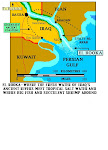
Sixty years ago Iraq was far more civilized and peaceful than it is today. It was there in the far south where the murky effluent of the Shatt-al-Arab river meets the clear, blue, sea water of the Persian Gulf, that I myself began a love affair with Diana, a girl from Baghdad.

At the time I was in charge of the Basra Port Directorate’s S.V. El Ghar, a 110-ton survey vessel. And luckily, the night I first tasted my new love, our vessel was tied up alongside in the tiny port of Fao. With most of my Iraqi crew off home for the night, I was free to indulge myself with Diana in my cabin, unobserved.


Though my first encounter with that delicate young girl was fraught with some danger I was later to dally in her company in perfect tranquility for many a night, and quite a few mornings during the next few years. I shared her favours, quite happily and usually quite amicably, with many another seafaring gentleman or expatriate European. And, if the truth can now be told, even occasionally in company with prim, fair-skinned young ladies who also succumbed to her charms.


Iraq is a somewhat mystical land where strange things happen and where the yearnings and cravings of the human spirit are assuaged as best they may. In this particular case the dominant factor would be considered quite pedestrian by many.

It was the supply of beer. Extremely erratic.

Sure, beer came up the Gulf to Basra by ship from Europe and elsewhere but there was little chance of developing any sort of brand loyalty. Variety, long droughts and flash floods were the norm in the Port Officers Shore Mess, our little club in Fao. Most of the beer that came our way was innocuous Danish, Dutch and second-rate British export beer. So apart from getting aboard some of the better-stocked Royal Fleet Auxiliaries and other well-found vessels and making private deals, the beer situation was often bleak.

Then excitement reigned. The Iraq Times newspaper was publishing full-page advertisements. They told of a brewery being established in Baghdad. Two European brewmasters were arriving to take charge. The beer would soon be marketed throughout Iraq. So one evening, when we tied up alongside our little port of Fao and heard that the new Iraqi beer was now available I sent my cook ashore to buy some.

I was delighted to see the bottles were labelled: DIANA. This I thought augured well. A famous beer in Egypt had been named STELLA and another girl's name had been used for a very acceptable beer brewed in Palestine. A third liquid girl to cherish would be welcome. So that evening I took Diana to my cabin and sampled her. Maybe to excess. She seduced me very easily.


But as we slipped our lines early next morning and headed down the Shatt-al-Arab to deep water, I saw the screaming headlines in my copy of the Iraq Times:


WARNING: DIANA BEER UNFIT FOR HUMAN CONSUMPTION.

BREWERS APOLOGIZE. DO NOT CONSUME UNTIL FURTHER NOTICE.


I was shocked. I went down to my cabin. I surveyed the several empty bottles. I peered at my eyes in the mirror. Then I read the full story. The trouble, it said, was caused by faulty bottle-washing equipment and a lack of standardized bottles. I could understand that. Hardly two of my dozen empties were the same shape. Just an assortment of large bottles similar to those to be seen standing in the doorways of local Iraqi mud-houses —and used to store kerosene for cooking stoves.

I went back up on the bridge. As the day passed I was pleased to note that my eyesight was not dimming, my stomach digested its noonday curry and paralysis did not set in. But, I remembered. Last night. Diana. She had left rather a marked aftertaste. And now that I thought of it —a definite kerosene aftertaste.


The next week another announcement appeared in the Iraq Times: Diana was now approved. Soon, in nice new, clean, custom-made bottles, Diana was being enjoyed by all hands. Her purity was certified by the health authorities. Our Iraqi Diana’s praises were well worth singing about.

All who enjoyed her attested to that.


A WELL-BEHAVED POLAR BEAR


Cutting across the top of Baffin Bay the powerful Canadian government icebreaker, d’Iberville, entered Lancaster Sound and anchored outside Resolute harbour amid ice floes in the early morning of August 16, 1956.

After breakfast I took a helicopter to Griffith Island some miles away to make some theodolite observations. Left alone on the high point of the cliff edge, the cold north wind made observing difficult and after a while the features I was looking for through the instrument’s telescope merged atmospherically into invisibility. However, things closer to hand were very visible including a polar bear making his way along the ice-bound island shoreline. As he approached my position I looked in vain for the returning helicopter but realized it would be an hour or two before I could hope to be picked up. The d’Iberville had but a short time in Resolute and lots to do before setting off for Eureka in the highest regions of the High Arctic.. With the harbour ice interfering with boat traffic the ship’s two helicopters would be very busy ferrying people between the base and ship.

The situation made me keenly interested in the bear’s movements. Intensely interested. I comforted myself with the fact that I was a couple of hundred feet up from the sea ice and if I hid behind the pile of rocks I had used as a survey marker I probably wouldn’t be seen. Anyway it was common knowledge that polar bears are only interested in seals and other marine life. It was knowledge as common as that about wolves. The common knowledge with which I had comforted myself the previous year, in 1955, when alone amid the Arctic barrens, I had found wolf tracks imprinted upon the footprints I myself had left freshly imprinted along the shores of a desolate lake.

All the same, in spite of my educated and sophisticared outlook, I was glad that I was downwind of the polar bear. If he got a whiff of my delectability he might forego his usual diet for once and might even be bothered to climb up the steep slope to inspect me more closely. I comforted myself with the thought that if he did track me down he would probably realize his mistake after the first couple of mouthfuls, feel embarrassed, and leave me alone to go off looking for real seals. Quickly I checked to see if I was wearing any sealskin apparel. Even the slightest scent was enough for a bear. I remembered the old saying about a leaf falling from a tree in the forest. The eagle saw it fall, the deer heard it fall, and the bear smelt it fall. But there were no trees around here, either for shedding leaves or for climbing up in panic. Just expanses of bare bear terrain. So, flat on my face, peeking over the edge of the rise of land I followed the bear’s meandering progress. Every few moments he stopped to sniff the breeze from seaward. Eventually, like the well-behaved, normal bear he was, he wandered away down the coast.

Flying back in the helicopter later I couldn’t see him at all, though we searched around for several minutes.

Sunday, June 7, 2009

India Pale Ale


The secret superiority of India Pale Ale


Forty years ago I read in the New Scientist scientific journal, that during the heyday of the Imperial Raj in India many shiploads of beer were sent out from Britain for the Imperial army.   Often, for various reasons, when only partially unloaded the beer-carrying sailing ships had to leave on other urgent business and months later might arrive back in UK with much of their beer cargo still aboard.  At first, it was sold off at a discount to local dockside pubs and inns, but later it was found that this beer was of a superior quality and was then sold in England as a premium ale.  Even today brewers label many of their ales as being IPA.  Anyway, some chemist fellow experimented and found that the long sea voyage and the constant rolling motion of the ship imparted a special flavour to the beer in the shipping barrels.  So he rigged up a rolling machine in his laboratory and rolled some barrels for a few weeks and sure enough he found it tasted better.  Well, he would.  Wouldn’t he?  After extensive testing, I mean.

Another aspect of how the rolling motion of vessels and strong waters interact was demonstrated years ago by the small vessels that brought casks of sherry to Britain from Spain.  The Spanish seamen learned by experience that if they laid the elongated casks fore and aft, or parallel with the length of the ship they could expect to roll their innards out while crossing the stormy Bay of Biscay.  But if they stowed the casks athwartships the rolling motion of their vessels was considerably dampened and they arrived in UK in good enough shape to enjoy some fine IPA.

Post-war ship designers incorporated this phenomena into some of their largest ships in the form of flume tanks.  Two tanks were built into  the ship, one situated on the extreme port side the other on the extreme starboard side.  They were connected by a tube or pipe and partially filled with heavy oil.  As the ship rolls to port the oil begins to roll to port also.  If continued this movement of ship and oil would result in an extreme movement.  But what happens is that as most of the oil is flowing to port the ship starts its roll to starboard.  But the weight of the oil now on the port side tends to act against this motion thus dampening its motion.  Now the oil flows to starboard just in time to dampen down the roll to port.  And so on.  The oil acts just as the sherry in the casks acted.

A few years later I was in a ship in the Bay of Fundy during a storm when the flume tanks were turned on and off to see how effective they were,  The rolling motion of the vessel was reduced tremendously.  Yet these tanks are of comparatively small size.

Today, modern ship designs incorporate other vastly improved concepts of stabilizing.

Ashoor Ahmed and Abood Assaid


Ashoor Ahmed


On November 7, 1914, a British sergeant, probably of the Dorset Regiment, looking for tough Turkish soldiers, burst through the flimsy door of a mud house or serifa in the small village of Fao (called Faw in the newspaper reports of the Iran-Iraq and recent Gulf wars) situated at the extreme southern tip of what was then Mesopotamia but today is Iraq . He so startled the young pregnant girl inside that she gave premature birth to a baby boy right then and there.

Equally startled himself, the sergeant called for his company's first-aid attendant to help the neighbour women look after the mother and child. Later, as the Mesopotamia campaign took him far up the Shatt-al-Arab river to Basra and eventually Baghdad, the sergeant sent back small presents and good wishes to the baby's family.

Thirty three years later, that somewhat premature baby, Ashoor Ahmed, stood six-feet-two-inches tall on the bridge of the Iraqi survey ship, the S.V. El Ghar (the dove) of which he was the serang or sailing master and told me that story of his spectacular birth.


And now, after arriving in Basra at the very tail end of 1947, that vessel had become my command—I was now the hydrographer in charge of El Ghar with the job of checking the miles of busy shipping channels leading in to the broad Shatt-al-Arab river from the wide, deep, blue waters at the head of the Persian Gulf.

Our ship was manned by a crew of twenty men of Iraq. The El Ghar was 110 tons, 98 feet long, had twin Gardner diesel engines, drew a draught of six feet and was built in Bombay in 1914, the same year as Ashoor Ahmed’s British Army assisted birth.


Iraq at that time was a monarchy, ruled by a regent who deputized for the young King Faisal who was at school in England, and with a seemingly civilized prime minister, Nuri Said. Sadly during later uprisings all these personages were brutally murdered to make way for successive villains of differing stripe.


Ever since Saddam Hussain’s long and ghastly war with Iran, during which my old area of operations became a major war zone, I’ve often wondered about the fate of the twenty Iraqis I had as the crew of the survey ship I commanded from 1947-52—the old El Ghar. Some of my younger ex-crew members may still be alive. Others could be in their nineties.

But there's one crew member I don't have to worry about:

Abood Assiad, one of the ship's sukhanys or helmsmen.

The El Ghar had a massive manual steering wheel as big as a cart-wheel to operate the heavy chains running in their iron channels from bridge to rudder. Moosa Sagar, the other sukhany, big and brawny as he was, had to stand off to one side to pull mightily on the big spokes when we went hard over to port or starboard.

But Abood—standing tall and built so big and broad that, if stood side by side with many of today’s Olympic athletes he would make them look puny—could stay standing dead centre on the quartermaster's floorboard and twirl that great wheel through his fingers with ease. Jet black, with a haughty bearing, handsome visage and with red-painted finger and toe nails, Abood Assiad was a man to value aboard a ship.

In a gale of wind, with a sand haze hiding the distant shoreline and with a 60-ton Muscat and Oman dhow anchored on the centreline of the outgoing channel—right in the path of an oncoming, but as yet unseen, 32,000-ton, fully-laden, T2 tanker, it was Abood who, axe in hand, leapt over the dhow's bulwarks. There amidst the considerable physical protests of disapproval of their forty-man crew. Abood chopped through their anchor hawser so we could pull their vessel away from certain disaster with just moments to spare. And it was Abood who swam mightily through the evening ebb tide to rescue the bhandary, the crew's cook, when he was being swept away out to sea.

One day, when we had steamed in error over one of the dozen big angle-iron, wire and canvas submersible drogues with which we tracked and measured the currents and tides, the El Ghar was lying adrift with both propellers held fast. The serang and all hands were down aft trying to free our propellers. Only Abood and I stayed up on the bridge. As our vessel just drifted at will into the deep waters at the head of the Persian Gulf, I spent a busy half hour at the chart table plotting the tidal measurements we had taken so far that day. Then I stood up and asked Abood if he could tell by the commotion of shouts and cries in Arabic, if the crew were making any progress in their rescue task. ‘It was getting late,’ I said, ‘the tide was more than half spent. We would loose the several other buoys we had set adrift for tracking the tide. They were now miles away.’

Abood just simply said: ‘I go fix, sahib’. And down the companionway from the bridge he went, making his way aft, stripping off his clothes as he went. Then he dived deep down under the ship. Long anxious minutes later Abood reappeared on the surface with the whole heavy mess of hardware, wire and canvas in his hands.

But, tragically, it was also big, strong, cheerful Abood, two years later, while I was away on leave, who, at the tiller of a motor boat while stretching a thousand feet of seven-stranded measuring wire from a marker beacon, was enmeshed by that same wire when it snapped and curled back. Helplessly pinioned, Abood disappeared for ever in the swift currents of the silt-laden waters of the Shatt-al-Arab estuary. That event still haunts me. I am certain that if I had been there that day it would not have happened. I would have had that wire carefully examined for flaws before putting such a strain on it. And anyway I would have used another method of measurement. How I wish the fickle finger of fate had not sent me on leave at that particular time.


Tuesday, June 2, 2009

Dogs like turkey


Further north along the uninhabited Labrador coast, I needed to land on a very small offshore island in order to take a round of horizontal theodolite angles to establish geodetic control points.  I left the ship with a launch towing a dory.  The little islet was just a few hundred feet across.  Unfortunately, some local native chap, who must have lived many miles away, had decided to use that bare piece of rock as a summer storage space for his dog team.  He had no use for his dogs when the snows went and didn’t want to bother with their feeding or care all summer.  So he stranded them on the island where he could pick them up again in the autumn.  

Eight big huskies on five acres of bare rock for five months do not find much to eat.  With only the odd dead fish and other debris washed up they get ravenous.  As we came towards the shore in the dory they waded out to meet us.  Slavering.  We back-pedalled, sculled back to the launch, then went back to the ship.  

That year the Theron  was down by the head with frozen turkeys.  The steward must have bought many scores of them as a cheap job lot in Halifax.  We were getting a little tired of eating so much turkey.

So I commandeered a dozen of the turkeys from the big freezer in the hold.  We picked up the twelve big birds and went back to the island.  When the dogs came down to meet us we threw some of the turkeys ashore then went back to the launch and waited nearly an hour.  Then we went back to the island, threw the rest of the turkeys up on the shore.  Then went up to the islands’ highest part, took a leisurely round of theodolite angles, then built a cairn of rocks as a survey marker.  Then, unmolested by the burping dogs, we got back into the dory and went back to the ship.

Friday, May 29, 2009

The Impolite Murres of Digges Islands


The Impolite Murres of Digges Islands


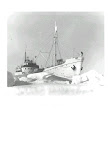
In 1954, I was aboard the MV Theron, a tough little steel, Norwegian-built sealing vessel, strengthened for work in ice and chartered by the Canadian Hydrographic Service to survey offshore areas of the Labrador Coast and the, at that time, unmapped area of Rankin Inlet, Hudson Bay.

Close to the south shore where the western end of Hudson Strait, becomes Hudson Bay, are the Digges Islands. Steeply cliffed on all sides, these islands are home to a proliferation of Thick-Billed Murres.

At the time of our vessel’s visit thousands upon thousands of the birds ranged along the miles of bare cliff ledges where they were nesting.

The high-walled islands themselves were imposing enough but with a myriad murres making a cacophony of sound, and their constant swooping down and back up from the water, the tens of thousands of seabirds was an awesome sight.

Armed with a camera, I climbed cautiously up the rock face to eventually arrive eyeball-to-eyeball with a dozen birds. The murres make no nest but just lay their single egg on the crowded flat rock ledges. To ward off my intrusion they ganged up together in a concerted defensive stratagem of a repulsive nature. As I stood on a narrow lower ledge my head was level with their nesting ledge. At once they formed a defensive circle around their eggs as did old-time pioneer wagons to repel an Indian or Zulu attack. Or rather, perhaps, more similarly, like a herd of musk-oxen in their shoulder-to-shoulder defensive ring.

But with one important difference. Instead of facing outwards to the enemy like musk-oxen, the murres faced inwards and presented their cocked rear ends. Cocked rear ends with the crucial tail feathers somehow laid back and open. This threatening gesture reminded me of the Persian gunboat that had pointed its guns at me each morning three years previously —but again with an important difference. The murres actually fired their weaponry. From a distance of only three feet in a low and flat trajectory. Another difference was that instead of the defenders remaining stationary and the attackers circling around them, the roles were reversed. I, the interloper, had to remain immobile while the defenders shuffled around so that each in turn could face, or rather about-face, me in order to aim their rear ends directly at the enemy—and fire. For me there was no stepping back out of range. My ledge was only a couple of feet wide and four feet long and there was a long drop down to the water below. All I could do was cover my head with my parka hood as best I could, put on my sunglasses, and plan my perilous retreat.

The onslaught continued for many long minutes because as each murre in turn loosed off its salvo it kept its place in the circle and somehow, while shuffling sideways, managed to reload so that, upon completing a full circle and its turn on the firing line was come again, it was also ready to discharge another fishy projectile. But, after several rotations of the defensive circle I noticed that strain as they might their firepower was fast weakening and becoming more and more just a symbolic gesture. Then having taken some photographs I carefully climbed down from the now very slippery ledge, wondering how best I could clean my soiled parka and camera. It was a difficult task. For a day or two as the Theron sailed across the north end of Hudson Bay, I was perforce to become a man who somehow stood apart from the common throng.

Sunday, May 17, 2009

My Pilot's Watch

DATELINE: AUGUST 1946

A few days after getting back to Daedalus, my demob number came up and I was released from the navy. While handing in my flying clothing, I mentioned to the petty officer storekeeper that though I didn’t mind handing over my flying boots, helmet and goggles, I was quite sad to have to say goodbye to my pilot’s watch. He commiserated with me—at length. And with deep sympathy. He shook his head sadly as he told me that all they did with returned watches was to hammer them to pieces, remove the jewels, and throw the rest away. It was a crime, he said. But, he shrugged his shoulders and said I just had to hand it over as it had a special number engraved on the back. However, he brightened upon suddenly remembering an afterthought. He speculated that maybe, for a very modest consideration, he could perhaps oblige me with a brand new watch that might still be around somewhere. It was one of the very latest, he said. If he could find it. He poked around under his counter. Successfully. I had to concur with him on how fortunate and serendipitous an event it was. And I agreed that it was a very nice watch. The best.
It still ticks merrily away sixty five years later.

Polar Bear covered in Seal blood

It was past midnight as the powerful Canadian icebreaker d’Iberville crushed through the ten-foot-thick sea-ice of the Arctic Archipelago. But here, on the top of the world at north latitude 80 degrees, there was still enough light to see the huge polar bear. He had obviously just finished eating a seal. A very big seal by the look of the bloodstained surface of the ice hummock upon which he was lying. And a big seal by his sleepy non-reaction to the loud screeching and scraping made by our approaching ship’s two-and-a-half-inch-thick steel bow plates as they rasped aside hunks of ice as big as double-decker buses.
That two-tone bear, snow-white on top with blood-red underparts, was relaxing in exquisite post-prandial tranquillity. So, as I saw Captain Caron reach over to the whistle handle to give a sudden blast to startle the Arctic stillness and get the bear up and moving, I raised my hand in polite protest and shook my head. The captain, shrugged, smiled, and desisted from his usual practice upon seeing a bear and came over to the port side of the bridge next to me. We were now within a few hundred feet of the somnolent bear and it looked as if we would pass within little more than thirty yards of him. Yet still he didn’t move. Just raised his head a little and looked at the ship’s massive bulk through glazed, uncomprehending eyes. He must have eaten a giant of a seal.
As we passed by, the captain and I engaged the bear in an eye-to-eye exchange through our binoculars. We could make out every detail of the bear and his bloodstained coat and surroundings. The staring contest went on for several long seconds. We won. He blinked first. And for the second and third times, also. That massive meal had left him totally bereft of any antagonism or interest in anything in his field of vision, direct or peripheral.

1935 collectible

In my school days, in the school playground, during periods of warm, dry weather, it was the cigarette card season that provided the most fun of the fair, the most hoopla, and the most noisy roll-up-and-see-the-great-big-so-and-so type of showmanship.
The cigarette cards produced by the major tobacco companies were all of a standard size and weight. Thus they could all be used against one another in straight competition and creative trickery.
The most popular way of manipulating a cigarette card in competition was by flicking it through the air, launched from between curved fingers that straightened out at the final one-thousandth of a second to impart direction and impetus. The pride, skill and prowess in performing this action was used to entice juvenile punters into games and contests by dozens of young, shrill entrepreneurs.
At the height of the season, scores of ground level fun-fair-type stalls of great and small ingenuity were established around the outside walls of the main school building down a narrow part of the playground protected from the winds by the big bicycle shed. Here, competitors were encouraged to try and flick their cards into specially chalked rectangles and circles, cover certain cards already in place on the ground with their own, fly through suspended rings and other obstacles or knock over carefully balanced objects. It was all very simple. If you won, you took possession of the stall owner’s bait cards; if you lost, he would take your flicked card. But every stall was different and cleverly thought-up new games, old favourites and the loud calls and tempting enticements from stall owners to drum up business all added to the fun and games. When the school bell sounded, cardboard game accessories, coloured sticks of chalk, wads of cards won by hard work or trickery, and other impedimenta of the trade were gathered up into paper bags ready for the next session at playtime or dinner hour.
The cards themselves were highly educational. One numbered card of a usual set of fifty was enclosed in every packet of cigarettes. They showed a picture of the subject on the front with written information on the back on subjects as diverse as civil aircraft, film stars, birds, inventions, historical figures and flowers. For a penny, the cigarette makers would provide an attractive album in which to paste them. Some such completed collections and albums are of considerable value today.
So at that time, no discarded empty cigarette packet was left unexamined by a passing boy or girl. No smoker on top of a London bus was left unasked if he had a card to give away and the precious cards were constantly swapped and bartered to make up the highly-desired completed sets.
But though these cards held their fascination and intrinsic collecting value the whole year through, their playground season would eventually come to an end and something like marbles would overtake them.

Hollywood Movie interrupted by the wind

The head of the gulf was blown by two winds.  One was the Shamal  from the north, which though often dusty with desert sand and hot in summer, was dry and bearable.  The other wind, the Shurgi , came up the gulf from the south and was terribly humid and made everyone irritable and often caused attacks of prickly-heat.  I remember one night sitting with a group of a dozen other limp and clammy people disinterestedly watching an outdoor cinema show as the turgid stifling shurgi  blew.  Suddenly one of the women said: I felt the Shamal!    At once everyone turned their heads to the north and stood up.  Another person said:  I just felt it, too!  Then another and another.  In a few moments everyone felt it.  At once the movie was forgotten.  People started talking happily with each other, we all moved over to the club bar.  Where morose silence had suffocated all interest just moments before, cheerfulness now abounded.  

And that is how quickly the wind did change from south to north.  And how quickly sultry misery changed to cheerful dryness.

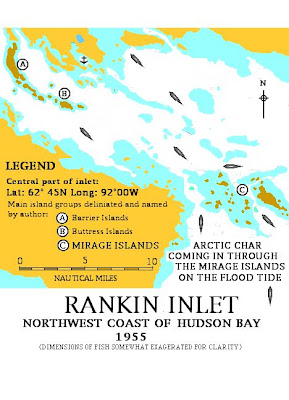
Rankin Inlet


Among other geographical features, in 1954 -55 as a senior hydrographer aboard the chartered sealer MV Theron, I delineated, charted and named, this group of islands lying off the southeast corner of Rankin Inlet, Hudson Bay. Until then that area was only rudimentarily mapped and quite unpopulated. They are called the Mirage Islands.


A London Tavern of Ancient Note


Just after World War Two, in the years 1946 and 1947, my London office was on Fenchurch Street, one of the most ancient thoroughfares in the centre of the City. That’s not the city of Greater London. Just the City. Period. Because still today, as for centuries past, that is the name which refers to the heart of the financial and business centre of Britain.

In fact, Londoners, when taking a taxi outside Buckingham Palace (or inside it for that matter) or when hailing a taxi circling the statue of Eros in Piccadilly Circus—both places considered by most people as being the centre of London—when those people tell the cabbie to take them to the City, they mean they are headed for the original site of the ancient Roman town of Londinium, which is about two miles further east, near the Tower of London. During the centuries following the withdrawal of Caesar’s Legions this historic square mile was continually overbuilt one city atop another to eventuually become the crowded medieval City of London proper and the nucleus of today’s vital hub of finance and commerce.

The bounds of this city within a city extend westerly from Aldgate Pump in the east, past London Bridge, St. Paul’s Cathedral, the Bank of England, the Mansion House and Ludgate Hill, to the Law Courts and Fleet Street, Its other dimension runs north from the Thames to the length of London Wall, a well-known Roman remains.


It was here, sixty three years ago, that one of my favourite places in the City, was a cosy tavern where full pints of honest ale and superb hot and cold edibles were readily available. It was the ancient Tiger Tavern (or according to some, the erstwhile Ye Tygre Taverne) right across from the main gate of the Tower of London itself.


Inside this compact little tavern at lunchtime, a chef would carry a tray of raw meats and delicacies—goose legs, chops, cuts of venison, sea trout, live lobsters—over to prospective diners, mostly ubiquitous so-called city-gents, for close-up scrutiny so that they might select the actual savoury morsel they wished to have broiled to their order. Moreover the pub was especially renowned for delicious ultra-fresh seafood included in its profferings. This was due no doubt to the Tiger then being but a scant quarter of a mile distant from London’s bustling Billingsgate fish market before it was removed eastwards to the modern Canary Wharf developments.


The little, tucked-away facings of the old Tiger tavern fronted directly onto the sinister cobblestoned square which in earlier centuries had been the place of public execution for many of the aristocratic and political prisoners held inside the grim walls of the adjacent nine-hundred-year-old Tower of London.

Yet, incongruously, according to a popular belief so trusted that it was fully acted upon every day, at some time in history that one-acre-square of cobbles had long ago been designated, by royal decree no less, as a place for no-holds-barred, blatant, free public speech. So thinking ourselves securely immune from any risk of being dragged across the road and thrown into the Tower’s dungeons for participating in treasonable disturbances, my two business colleagues and I, before going into the Tiger, often listened to outrageous advocates of sedition, revolution, republicanism, and personal mayhem. This was all intermingled with eccentric extolling of shocking philosophies, weird religions, devious aspects of sexual activity—plus any other deep thinkings that might occupy the minds of free-born English men and women in that immediate post-war era.

The most notable, fearless, and regular Tower Hill speaker, who took the legendary treason-immunity clause as guaranteed gospel to its ultimate reaches, was a very disreputable-looking and vociferous gentleman we all called ‘Old Proverbs’. This on account of his frequent pauses in mid saliva-spluttering speech to say he had an old proverb somewhere about his person, to bolster that particular point in his argument. Whereupon he delved into one of the voluminous pockets of his tattered overcoat to bring out sheaves of scrawled wisdom. He would pick out a shabby, creased and dirty document, loudly read out its words of enrichment, then after using his coat sleeve to wipe off most of his spittle he would refile the bespattered paper in one of his big secretarial pockets for use another day.

One of his most seditious themes which he took to extreme lengths was his rant about how ‘they’ had betrothed our lovely young princess and heir to the throne to some rotten, greasy Greek (this was in 1947). No good could come of this he goaded his large audience, just you wait and see. Well, now we have. And it appears to have turned out more or less preferable to many other royal marital adventures that followed.


All in all, the oddballs who appeared at Speakers Corner far to the west in Hyde Park on Sundays, were tame in comparison to those on Tower Hill during the workaday week. Other attractions on the Hill were acrobats, strong men, escape artists, tricksters, revolutionaries, et al.

And though it was in the nearby Cheshire Cheese under the railway bridge in Crutched Friars, near Pepys Street, (a tavern not to be confused with the quasi-tourist trap Ye Olde Cheshire Cheese along Fleet Street), where we would sometimes see Old Proverbs counting the well-earned coins his audience had dropped into his hat, it was the venerable Tiger tavern that was our big attraction.


This lovely little pub was literally within spitting distance of where Old Proverbs sputtered away at his hodgepodge audience gathered outside on the old execution ground.

Dating back hundreds of years, the Tiger was all low black beams of ancient oak thick with the musty stench of history and authentic Elizabethan spilled beer. An observation that rings literally true considering it is on record that Good Queen Bess herself patronized the place as a young princess after being released from her two months of imprisonment in the Tower in 1554. And it has been said that later on both Charles, the First and the Second, were sometime visitors.

Yet there were no boasting signs or plaques, either inside or outside the pub, which other establishments used to attract customers. The Tiger had no need to bring such attention to these past honours. Because in the Tiger it was so generally and unquestionably accepted that such visits had indeed occurred. It was just considered an established normal part of the Tiger’s role during England’s fairly recent history.

This atmosphere was advanced by the presence as often as not of half-a-dozen or so amateur historians gathered together in one corner or other of the pub where a measure of the conversation would be of past kings and queens, executions—and in particular—unassuming references regarding the notables who had been patrons over the centuries of the very pub in which we were now drinking.

These history-conscious City gentlemen, young and old, added a precious and wide perspective to the venerable Tiger pub

Dressed uniformly and sartorially-perfect in pin-striped trousers and black jackets or smartly-cut dark business suits, they were of course, all bowler-hatted, and impeccably shirted-and-tied—even during the warmest summer days. They were perfectly in tune with the tavern’s pleasing, and somehow muted hubbub. A soft civilized background murmur of quiet conversation which echoed the serious business of serving over-filled pints of ale, pink-gins and whisky-sodas in the grand old pub.


The Tiger tavern’s origins dated way back to 1500. So probably, around the period when Queen Elizabeth made her initial youthful visits, those noted navigators and sea-dogs, Sir Walter Raleigh, Sir Francis Drake and Sir Martin Frobisher quaffed many a tankard in the Tiger. Sir Walter, at least, is reported to have made numerous low-profile visits to the pub. His visits had to be low profile one supposes. Because, remarkably, they actually took place during his twelve years of imprisonment in the Bloody Tower before he was finally executed.

These remarkable stolen hours of conviviality for Sir Raleigh were facilitated by means of a secret underground passage that ran for a matter of 120 yards from inside the Tower, under the road and the cobble stones of the Tower Hill execution site, before coming up in the Tiger’s cellars. This route was also reportedly followed at least once by the then young Princess Elizabeth during her own two-month incarceration. This commendable, understandable and I expect very enjoyable royal pub session took place only four years before Elizabeth became queen.


During those romantic decades other fabled historical figures probably mingled at the Tiger’s tables. a company which particularly and momentously included William Shakespeare and Christopher Marlowe—the two most distinguished of the several famous Elizabethan writers.


Attestation regarding these most illustrious figures as being among past customers to the tavern was provided matter-of-factly by Colonel Mountjoy-ffoulkes. This cultured gentleman, about 50 years old in 1946 had at that time, in keeping with my colleagues and myself, just recently stepped out of wartime uniform to return to civilian life. Colonel Mountjoy, was very proud of his full double-barreled name (mainly because it sported the age-old and very rare English double-ff spelling denoting a capital letter) and directed the fortunes of his nearby family-owned commodity business with offices in Mincing Lane. The business also owned an adjacent strong-smelling granary warehouse housing all the different magic ingredients required by the brewing and baking industries. In fact, back then, a walk through the maze of narrow streets, passages and alleys in that part of the City meant inhaling a tantalizing, almost overpowering, mix of rich odours produced by the many variations of grains, cereals and seeds, which in Britain go collectively under the generic title of corn, all stored thereabouts. It was in that traditional locality, around Mark Lane and St. Mary Axe, where the Corn Exchange had conducted its unvarying business through the centuries.


On one occasion Colonel Mountjoy brought his elderly father to the Tiger tavern. As a young man this older Mr Mountjoy-ffoulkes had been a regularTiger customer for several years before General (Chinese) Gordon was murdered at Khartoum in 1885. He had also witnessed the Tiger’s 1893 renovation. And harking back to an even earlier generation, old Mr Mountjoy affirmed that his own father, had also been a Tiger customer reaching as far back in time as the era of the Napoleonic wars. He said his father had often spoken to him of the legendary visits to the tavern by Mr Shakespeare (the term by which both the Mountjoys referred to the bard). He, grandfather Mountjoy, had affirmed to his son, the old Mr Mountjoy, that Shakespeare’s reputed visits to the Tiger 200 years before his own, were held to be a tacit matter of historical fact by all the Tiger’s customers during and before the reign of Queen Victoria.


Envisaging jovial meetings in the Tiger between historical notables through the decade immediately following the Elizabethan-Stuart divide of 1603 could well have included such others as a very young Izaak Walton, author of the enduring 1653 classic, The Compleat Angler. In earlier years Walton had also published several other biographical and religious literary works and was only thirty years Shakespear’s junior so perhaps they conversed as writer to writer in the Tiger.

This is very feasible as during his last couple of decades or more of life, Shakespeare, beginning just after 1588—the year in which the Spanish Armada was defeated—is said to have lodged and bought houses in several places in London and was a frequent visitor to many taverns including the Boar’s Head in Eastcheap, the Pimlico in Hoxton, the Mitre in Fleet Street, the Devil’s Tavern in Wapping, the Anchor Hill on Bankside and the Mermaid in Bread Street.

And most notably, he lived for some time in Southwark, (pronounced Suthark by modern Londoners) on the south bank of the River Thames. There he was close to the Globe Theatre in which as a leading dramatist he not only had an obvious professional interest but also a substantial financial stake. Also, living in Southwark, Shakespeare was conveniently adjacent to the southern end of London Bridge, the sole bridge spanning the river at that time, and the only means for crossing the Thames other than using one of the hundreds of small ferry row-boats.


It takes little imagination to picture Shakespeare browsing among the many bookshops that are known to have been located amid the scores of other shops, mills, multistory wooden houses and market stalls built right upon and across the full 350-yard span of that old London Bridge, before it was destroyed in the Great Fire of 1666.

The northern, City end of the bridge, was lined up with Fish Street, so it was situated a little further east and downriver than subsequent London Bridges. From here the Tiger pub on Tower Hill was only 500 yards away. So, in pleasant retrospect, one can imagine the great playwright, after having breakfast in one of the taverns in Southwark, strolling across the bridge, pausing to browse in the bookshops, then taking a brisk ten-minute walk towards the Tower and into the Tiger for a glass of wine or, more likely, a tankard or two of ale.

And on some of those very same days a youthful Izaak Walton bent on visiting the same congenial destination, might also have been strolling the mile or so from his London place of abode in the vicinity of St. Paul’s.


All of which, for those of us like myself who are anglers, leads to a happy thought: Izaak Walton, who lived the first ten years of his life under the last of the Tudors, can therefore be legitimately included among the renowned writers of the Elizabethan era.

And another delightful thought: Maybe at that same time, in that same famous public house, one or two of my own family forbears drank pints of dark Elizabethan ale, smoked rich Virginian tobacco in ornamental clay pipes and relished dishes of fresh, fresh shellfish taken in the early morning from the lower reaches of the historic River Thames. They may even have discussed—both with Shakespeare and Izaak Walton himself—the merits, pro and con, of using a ten-foot-long fishing pole as against employing, a rod with nearly twice that reach, as was then often the practice.


Elizabethan Tiger patrons could have feasted on broiled salmon to their stomachs’ fullest content at what was then, most likely, give-away prices. Because at that time London had a human population far less in numbers—around 400,000 souls—than had the Thames with its thriving salmon population. For eons before the first Romans arrived and sent back reports of the bounty of fine fish there was to be had for the taking all along the river, and even up until the late eighteenth and early nineteenth centuries (a time when many labourers wanted a stipulation in their work contracts that they were to be fed salmon no more than three days a week), the exquisite Thames-run Atlantic Salmon was a bountiful source of cheap food. Then neglect and filthy garbage and sewage habits completely eradicated these wonderful fish from London’s river. Sadly, salmon were no longer to again enter Thames water until the last couple of decades of our own most recent century after new enlightened clean-up measures were taken in the 1970s. Then, miraculously, some were to return, albeit in small numbers only.


When the Tiger was extensively rebuilt in 1893 the secret tunnel under the road from the Tower was disclosed and was finally blocked off. During that reconstruction one can surmise that much of the original oak framing, panelling, fittings and furniture were retained and recycled. This would have preserved that wonderful musty Tudor smell I so relished in 1946 and 1947.


Though the nearby Tower of London itself took a direct hit from a German high explosive bomb, the ancient pub escaped destruction during the London Blitz. It was the second notable time it had narrowly escaped destruction. In 1666 the Tiger just missed obliteration by the Great Fire of London, and though probably singed on its fringes became a welcome part of the temporary market that was set up on Tower Hill to help meet the stricken city’s urgent needs.


But during a visit from Canada, three hundred and ten years after it had survived the great fire, and probably half a millennium since it was initially built, I was aghast to see this wonderful long-lived haven had been torn down and an awful modern monstrosity built to take its place. Right across from William the Conqueror’s tourist-crowded Tower of London.

I wept. Surely if such sacrilege had been done in the reign of Good Queen Bess she would have had the perpetrators’ heads chopped off. Their heads rolling over the cobblestones just a few yards away from the Tiger’s front door to spurt pools of dark arterial blood in fitting, vivid penance. And appropriately right there in the middle of the Tower Hill courtyard where so many of the Royal Blood and aristocratic elite, accused of much lesser crimes, like alleged treason and other simple transgressions against the crown, met that inexorable fate after long months and years confinement in the Tower. But certainly not for crimes as heinous as destroying the Tiger tavern.


Going to work in the ancient square mile of the City of London business district was full of interest. Every morning, as they still do today, around half a million people poured into the ancient centre of bustle and business. They arrived by bus, trolley-bus, commuter train and underground railway. Floods of people arrived at London Bridge Station from innumerable trains, then crossed over London Bridge on foot from the south side of the Thames, while thousands more came from outlying suburban areas to the north, east and west. But by seven o’clock in the evening all was quiet, the hordes had gone home to suburbia and the streets were practically deserted. So most City pubs and restaurants closed up shop when their last customers, making their way homeward, disappeared down into the tube stations or, as many of them did, headed west for the continuing night life of the West End—the Strand, Piccadilly, Mayfair, Chelsea, and Knightsbridge. For the rest of the night the City was sparsely inhabited, peopled only by office cleaners, stalwart constables of the City of London’s own police force treading their silent patrol beats, and a few late workers and lonely caretakers.

But down near the Tower and the river’s edge, the old Tiger tavern during its last two decades of existence, remained as it had ever been for generations of London’s ladies and gentlemen: An inviting haven of traditional hospitality and living history.