Thursday, February 25, 2010
Contemplating aspects of the Contemplative Art
Walking through either the garish sports sections of large department stores or visiting those hallowed specialty halls of genteel commerce devoted uniquely to providing for the puritan angling devotee, one can only be impressed and enraptured by the amazing variety of lures available to today’s fisherman. They range from finely-crafted, hand-painted, and hand-carved wooden plugs (as have been made for centuries and of which Izaak Walton makes mention in The Compleat Angler, his fine book which throws such wonderful glimpses on early seventeenth-century life in England ) to modern electronically-energized high-tech lures capable of emitting flashing lights and pulsating sound. Others range from shiny plastic diving plugs and whirling metal spoons of gold and silver, and nine-inch-long by two-inch-wide bright metal flashers for attaching to the line a good three feet ahead of the actual lure, to the most realistic rubbery replicas of insects, frogs and invertebrates.
In fact, add to these the varied jars, cans and packets of preserved and live organic baits, plastic bottles of salmon jelly, power baits, scents and attractants, and the modern angler seems to have as great a selection of fishing lures to choose from as there are different living fish in all the ponds, rivers and seas the world over.
Also available, and made by artificial-fly fishermen since days of yore, are swarms of delicately-built and wonderfully true replicas of the streamside insects observed to be the favourite foods of fishes. Alongside such works of art, as many of them are, there are also myriads of cheap and gaudy mass-manufactured flies that bear little of no resemblance in appearance to any to be found in the wonderful insect array of the natural piscatorial world. Nevertheless, it is still a moot point as to which flies, the genuine quality imitations (a colourful oxymoron if ever there was one) or the garish, false psychedelic creations, which result in attracting more fish.
I bring up this debatable point as I have taken fish with a motley assortment of artificial flies and lures, some violently overdressed in screaming colours, others worn down by long use and left with but the merest trace of dull, wispy feather remaining and even at rare times with just a bare hook stuck through the merest scrap of coloured or uncoloured cloth.
In fact for all the mystique and devotion of the dedicated fly-tiers associated with the art I would venture to advise that as good an artificial fly for sport fishing can be instantly produced, for practical purposes, by simply winding an inch or two of pipe-cleaner around the shank of a good (barbless) hook and using it as is, with no more ado. This is especially so considering the wide range of colours in which pipe cleaners come. Or did some few years ago. Some are even two-toned, with red or blue spots dotted along their lengths. And having a thin wire core makes their utilization a snap. There is no need for a fly-tying vise, reels of thread, scissors or snippers, and the other paraphernalia of the art. Just hold a hook in one hand and twist a piece of pipe cleaner around its shank with the other hand. An operation easily undertaken even at the lakeside with bare hands freezing in an arctic breeze. And that’s it. No need to tie it on or make it secure with fancy knots and whippings. Its wire core will stay put for a fortnight or a season of active and productive casting.
A couple of packets of pipe-cleaners together with a box of hooks and a small reel of monofilament should be in the emergency pack of every bush pilot and other person who ventures far into the wilderness. A twist of dark brown pipe cleaner mixed with a twist of yellow and hey presto—one has a fair imitation of a mutated wasp, bee or beetle. A double or triple twist produces such an eye-catching appearance of a fat, though admittedly outlandish, exotic, juicy, appetising and furry, gourmet fly, as to catch the attention of even the most educated game fish. Especially those fish who happen to be feeling adventurous or curious that day. Yes, I know. The method used or patterns obtained are not likely to be approved by the purists, but if the fish go for it —who really cares.
As an added bonus they, the pipe-cleaners —not the flies — can be used by real fishermen for actually cleaning their pipes. (Also, as I can well attest, for tying up tomato plants). I’m sure Izaak Walton, (1593 - 1683), author of that classic angling book: The Compleat Angler, published in 1653, would have spoken well of them if they’d been around in 1653. But, in his time, three hundred and fifty years ago, tobacco had only been in use in Europe for about seventy years. He probably used something just as cunning for cleaning out his clay pipes, (and tying up his tomatoes which were themselves a newish novelty of that era) and for making jury-rig streamside fishing lures. Anyway, Izaak Walton’s clay tobacco pipes, he records enjoying in those bygone days of yore, were reported to be so cheaply mass-produced as to be thrown away immediately they became chipped or too blocked to draw. Real fishermen probably set off for a day’s angling with half a dozen in their pockets. And of course, there would be piles of free clay pipes for their customers’ pleasure in the nice country taverns Walton seemed so happy to regularly visit between his hours of angling and dalliancing with buxom milkmaids by the riverside ( Yep! I really admire that man. A really Real Fisherman — and one whom I hope to meet up with to share a tankard or two, and perhaps scrounge some of his Elizabethan tobacco, when I reach that big riverside tavern up in the sky — a probability not too far distant now).
Note to self:
I must remember to take old Izaak some coloured pipe cleaners.
Note to all hands:
This blog contains several other yarns appertaining to fishing and angling from the Persian Gulf to the Canadian Arctic. They are stuck randomly and higgledy-piggledy throughout its meandering, undisciplined length.
Sunday, February 21, 2010
A Contemplative Puff of Smoke
Years ago, in the 1950s, when my work meant sailing away to Arctic regions for regular six-month spells, from May to November, to explore and chart remote and unknown seas and coastlines, there were two particularly pleasurable routines I religiously went through before boarding the train for the East Coast.
Firstly, I would visit several of the then many well-stocked tobacconist shops in Ottawa and buy enough wonderful Bulwark pipe tobacco, imported from England, to last me comfortably for the entire six months I would be far distant from any source of resupply.
Secondly, I would take myself to the Sparks Street branch of the very reputable Birks store, a pleasing emporium of luxury jewellery, china, haberdashery and top quality requisites for the carriage trade.
There, in a surround of excellence, I would seek out the one cut-price exception for merchandise amid all else offered. For, in a modest corner of the store, on the gentlemen’s vendibles counter, there stood a large glass bowl which contained two or three hundred pipes all heaped up together in wonderful disarray. These fine pipes were perfect in every respect, but deemed otherwise by purists, who considered them flawed owing to containing very minor marks, scratches, tiny pitting or other so-called deficiencies, many so minute as to be indiscernible even to a keen and practised eye.
Delving down into the magic bowl I would select a dozen or more of those excellent pipes, enough to well see me through my six months of living aboard a small, strengthened-for-ice, chartered sealing vessel. Days, weeks and months interspersed with the climbing of mountains, the tracking of meandering coastlines, all to be followed by weeks and months of fourteen-hour-long days, every day except Sundays, aboard rolling, pitching, 30-foot-long sounding launches while running long lines of echo-soundings to complete our hydrographic surveys.
Usually I needed a dozen pipes to see me through a northern season, because invariably, there was the odd pipe lost overboard, two or three others broken in a parka pocket when stretching to lean over the ship’s railing to hand down heavy equipment, and the odd one left forgotten on a rocky mountain top with little time or inclination to repeat a laborious climb for its retrieval.
Today of course, sixty years later, such past comforts for living are disapproved of and protested into near oblivion by the inanely bigoted, insipid, or politically-correct, whose concept of the good life is the scrutiny of their navels and the adoration of screaming obscene performers with their inevitable ear-splitting electronic guitars.
Cor! I feel so much better after letting that last paragraph out.
Ok! Ok! I’m just kidding. And remembering the freedom of olden days.
I think I’ll just wander outside to my little winter hideaway shelter on our back sun deck (I haven’t smoked inside the house for decades) and have my routine noonday glass or two of IPA, from the Wells Brewery in Bedford, plus a puff of Bulwark pipe tobacco, from The Black Swan Shoppe in Scarborough — both of England, and here, in my little Ottawa hideaway, I will continue my contemplative puzzling over the mysteries of life.
Sunday, February 14, 2010
A Wartime Crossing of the North Atlantic
Wonderful Food and Jolly Good Company
In May 1944 I was one of a contingent of 121 naval airmen destined for flying training in Canada. We were fortunate to board the handsome Royal Mail Steamer Mauretania, sailing from Liverpool in England to Boston in Massachusetts, the liner’s regular port of rapid wartime turnaround. From Boston we were to be transported by train to the personnel dispersal unit at Moncton, New Brunswick, .
We formed only a small fraction of the Mauretania's total complement of varied passengers.
Converted into a fast super-troop ship, as were her two massive sister ships, The Queen Mary and the Queen Elizabeth, the RMS Mauretania was capable, because her high speed provided such a safety factor, of sailing as an individual, steering a lone, erratic zigzag course that would prove extremely unpredictable to any lurking U-Boat that might come within torpedo range.
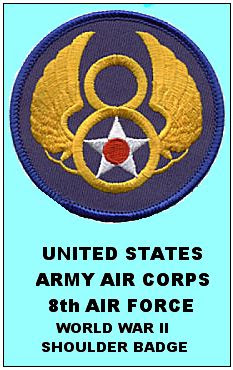
And, strangely enough, even though all Europe was still under occupation by Nazi Germany, there was a pronounced and relaxing holiday atmosphere on board. It was almost as if we were on a cruise in peacetime. This party spirit was engendered in some part by the fine sunny, calm weather, but in far greater part by the fact that one segment of the ship’s passengers consisted of several hundred gallant aircrew members of the United States 8th Army Air Force, who having miraculously survived the completion of their allotted number of missions in their Flying Fortresses and Liberators, were heading home on leave and well away from the war for some time.
Now actually homeward bound at a fast rate of knots, as they could easily verify by looking over the ship’s rail at the blue ocean water scudding by, not yet really believing that they had actually outlived and were, at least for some time, finished with their ghastly task, they were relieving their pent up, deep down innermost feelings of sickening fear.
So the gently rolling decks of the Mauretania were athrong with happy groups of young men in much uncaring disarray of uniform, soaking up the sunshine, smoking, rolling the dice for enormous jackpots but, most of all, just sitting around and getting used to the feeling and awareness of being alive, of being okay, and with the probability of being alive and okay tomorrow and next week and the week after.
When I told them my first ever flight in an aeroplane had been by courtesy of an American Eagle Squadron pilot three years before in 1941, they were delighted and all over me. To this day they remain in my memory as the most wholesome, carefree, and uninhibited generation of Americans that ever were or ever will be. They were the crème de la crème of what the US of A professes to be. I loved them. They, as the saying went then, were the “bee’s knees”.
Some of the groups of US airmen were quiet and small, around half-a-dozen or fewer. They tended to be more subdued and kept closer together. They would arrive on deck together, go below deck together, laugh together, fall silent together. Their eyes seldom rested for more than a brief instant on any one spot and they subconsciously tended to arrange their deck chairs so they could squint up into the sun and see unimpeded between each other. And though they always seemed to be searching individual sections of a far and high horizon, at sudden commotion or noises, they would instantly all turn their heads together. These small groups had flown together and brought back their dead and wounded together. They had watched together as their buddies’ bomber aircraft, flying next to them, and closed up tightly in the defensive box formation, had suddenly erupted into flaming fragments of intermingled metal parts and segments of human bodies. It would be a while before some of them would be fully content about going their own separate ways. Alone as they never had been before. Alone and not together.
Seemingly not so caring, other larger groups of differently tempered men, or of somewhat more fortunate experience, gambled away stacks of pound notes, dollar bills, IOUs, wrist watches, even real estate properties back home, anything of value. What was the worry. They had just won the biggest gamble ever. They were euphoric. They were headed home. To the good old United States. Unlike eight out of ten of their friends who had fallen from the heavenly heights of the German killing skies.
Those USAAF guys were so clean. Their uniforms, though casually worn, were smart and clean. Their faces were clean. Their language, all in all, was clean. Incredibly, most of all, despite their hitherto hopeless horizons, their outlook was clean. What a tragedy that so many of them, the overwhelming majority of their former comrades, were lost in the, clear, subzero, thin air of high altitudes. Lost flying during many long, drawn-out, freezing, confining hours of extreme peril—an insane orchestration of brilliant sunshine, widespread lethal and maiming frostbite, and blazing flesh-rending gunfire.
How sad, also, that after bailing out from stricken aircraft, so many of these young gentlemen, who only twenty-four hours before had been chatting with fresh-faced Women's Land Army girls in peaceful, civilized English country pubs, were to be stabbed and murdered with pitchforks by German farmers—and their wives—who had sig-heiled and applauded their beloved Adolf Hitler’s greedy endeavours to conquer and evilize the whole world.
For many of our 121 neophyte naval airmen, now following in reverse geographical direction the road these US army air corps survivors had taken two or three years before, even the North Atlantic’s early summer gentle swells meant a day or two of sea sickness. Down below our cramped quarters became quite unpleasant.
So when volunteers were called for to work in the butcher’s shop, Vincent Ramos, my oppo (the naval vernacular for a buddy), and I, went for the job. Vin was an adventurous and exuberant friend. His father had been a well-to-do Spanish sherry merchant who settled in the Cheshire Wirral and became a naturalized Englishman. After the war Vin stayed in the navy and became a Lieutenant-Commander in command of a naval vessel.
Vin and I didn’t regret volunteering to work our passage one bit. For the Mauritania's butcher’s shop, several decks down, proved to be a cheery place with a crowd of cheery men and lots of less-cheery animal carcasses. So while they prepared the meats for the several thousand people aboard, Vin and I were charged with sweeping up the showers of scraps that fell to the deck from the cutting tables and sluicing buckets of water around to wash the mix of blood and other matter down the scuppers. A simple, not too strenuous task. Except, of course, that the broad deck of the butcher’s shop in Mauretania heaved in ponderous and noticeable fashion in response to the long flat ocean swell coming in from abeam. This caused the flood of animal flotsam and jetsam swirling in the bloodstained water to slosh first to port, then to starboard. This called for playing a waiting game. Waiting for the tide of detritus to approach in unison with the ship’s rolling, quickly fishing out the bigger pieces of offal and pushing as much of its liquid component as possible down the scupper drains before the tide turned and it all flowed away. Fascinating as this version of limpid deck quoits was, our days in the butcher shop had real advantages. For down here, with the ship’s bakery close at hand, we dined with the crew in luxury and amazing plenty. We had bread and pastries not seen in Britain for years. We had roasts, steaks, bacon, eggs, butter, fruits and scads of other foods, all so scrimpily rationed at home.
And we were not worked all that hard. Filling up huge garbage cans with our harvests of skin, gristle and unmentionable animal parts, plus other accumulated rubbish, we would load them on trolleys, and go off with them for an hour or more, taking elevators up and down onto different deck levels in order to reach our goal — the Mauritania's stern where a chute was positioned for ejecting garbage into the sea. Yet once there, we would not dispose of our garbage, but would place the full cans nearby in special holding racks. There they would stay until sundown, when we would return and empty them down the chute. This was because of orders never to dump material overboard during daylight hours. This was a precaution against the chance passing of a U-Boat over our track some hours later. The trail of floating garbage might lead to the deduction of our course and our expected future position being radioed to another submarine ahead of us.
On many of these trips to the ship’s stern, Vin and I went to the upper decks to watch the Yank’s crap games, enjoy being part of their total camaraderie and listen enraptured to their descriptions of the warm receptions and delights we might expect to receive from the beautiful girls who, we were told, were in such wonderful overabundance all over the USA.
A couple of times, gas-filled balloons were released from the ship so the US Army Air Corps machine-gunners could practise and demonstrate their battle-honed skills. This was more for sport than a precaution against the remote expectation of any kind of aerial attack after the first day or two out at sea. But, with the threat from U-Boats far from over, for what was a more meaningful practice, a floating and smoking drogue was left drifting astern for the chief petty officer DEMS Royal Navy gunner and his three-man crew to shoot at. While everybody watched as the target was left further and further astern, the gunner appeared to show indifference as to its whereabouts. Standing with his back to the scene, he just wiped imaginary specks of dirt from the breech and shell casings. Then just about when all hands thought the practice had been abandoned, he uttered a few words of laconic command. The gun crew slammed in a round, quickly laid their elevation and aim, fired, repeated the procedure twice more in rapid succession, then at once resumed cleaning their gun. Casually, after some seconds, the gunner looked out to mid-horizon, as did we all, to watch as the shell bursts blended with the smoking target. After that the smoke disappeared—except for the faintest of whiffs. And there was no sign of the raft. The American airmen applauded with hand-clapping, cheers and shouts of: “Just a lucky shot! Bet you ten bucks you can’t do it again!”
Getting to and from the butcher’s shop to the ship’s stern with a heavy load on a trolley meant a lengthy journey along a labyrinth of passageways, and up and down many lifts or elevators. Vin and I usually returned to our allotted sleeping quarters fairly late at night. We were lucky in having commandeered the only steel built-in bunk. All our companions had to sling hammocks every night, but we had an upper and lower bunk which was fastened into a fairly secluded corner spot inset just inside the open hatchway. I slept in the lower bunk and Vin used the upper.
About three o’clock in the middle of one night, I woke up and became quite concerned upon noticing several inches of water flooding down the passageway, which was only a foot or two from my makeshift pillow. Also, there was quite a bit of smoke about. Looking into the flat, I saw that not only had all our hammock-dwelling companions disappeared, but most of their hammocks had gone as well. I banged on the bunk above me and called to Vin. His sleepy head looked over the edge of the bunk. I was glad to see he was still there. I was glad not to be alone in this strange situation, in the middle of the ocean in the middle of the night with water and smoke about, in the middle of a war. We were discussing what to do when someone came sloshing up the passageway through the water. We called to him and he stopped to tell us not to worry. The dry canteen on the deck above had caught fire. The smoke had woken all our people who had retreated to the clear air of an upper deck with their hammocks. We had been overlooked in our little nook. And the water coming down the companionway and along the passage was just the water from the fire hoses. It was all just about over, he said, so we might as well stay where we were. He went off down the passage. Relieved, we were about to go back to sleep when we noticed that floating down the ladderway from the deck above was a variety of objects. After bumping down the steps, they floated along the passageway past our doorway. By reaching out across the low coaming and without leaving my bunk, I could grab these items out of the water. As I picked them up I passed them up to Vin who dried them with our towels and stowed them away in our kitbags. We soon had a good haul of Hershey chocolate bars, boxes of lifesaver candies, hairbrush and comb sets in cellophane packets, a few cartons of cigarettes, and other oddments. After a while, the flow ceased so we went back to sleep. But we were able to give away chocolate bars and things to the deserving and obliging for several weeks after landing ashore.
When a couple of American patrol aircraft flew out of the sunset to meet us, we knew we were near the end of our sea trip. Our US Air Force passengers went mad waving to their compatriots as they flew past the ship so low that from our promenade decks we were looking down and into the planes.
The next morning we saw the Massachusetts’ coastline and within an hour or so, we were docking in Boston and getting our first look at the new world.
Wednesday, February 3, 2010
A Long Dormant Financial Oversight
A SPECIAL CALL TO ARMS:
Wake up all Royal Navy ex-Petty Officer pilots and join me in protesting to the UK government and the Royal Navy about how badly we were exploited when we were flying on RNAS squadron No: 805, in 1945. Surely we are due large lumps of cash in compensation. There must be many sympathetic boards and commissions before whom we can successfully plead our long-tolerated and hidden grievance.
This gripe stems from watching footage of modern US aircraft carrier operations. All navy pilots today are two-ring lieutenants or above in rank and highly paid. Or Marine Majors and colonels. All raking in umpteen thousands of bucks every month.
Yet we poor Petty Officer navy pilots were fobbed off with what? As far as I remember it was 7/6d a day. Or it could have been a few peanuts more or less. Ok, anyway, plus just five or six bob a day as flying pay for a whopping total of perhaps 13/6d.
But for that we had to go round and round Machrihanish air space flying our powerful Seafire XVs, time after time, practising ADDLES (Advanced Dummy Deck Landings) in anticipation of imminently flying aboard our aircraft carrier and joining the Pacific Naval Fleet. So there we were up in the air all day, manoeuvring crabwise about thirty degrees sideways, letting down in long, low, flat and slow, labouring curves, so we
could peer out to port past the long engine cowling in order to keep the batsman and the white lines, marked out on the runway, all in shimmering view.
Keeping lots of power on in order to hang from the prop in a nose-up attitude meant banking round with the pilot’s head sticking out the cockpit and peering through an obscuring hot cloud of thick exhaust ejecta often composed of flame-spurting, eyebrow singeing, mixture-rich unburned gases which would violently ignite when coming out through the hot exhaust pipes.
Ok, so we did wear goggles, a helmet and oxygen mask but a scarf round the neck came in handy when those unburned mixture-rich gases went pop-bang-pop. It was a time for full flaps, full mixture, fully-fine pitch and full exaggerated use of wiggly controls gone extra sloppy through keeping the airspeed down so dangerously low, just above the stall. In all, a very unnatural and unseemly display of airmanship.
Ah, those were the days. There’s no life like it. But don’t let on, my lads. We need all the sympathy we can muster if we’re going to make our case for lots of lolly in recompense for our dedication. Think of it, many months of back pay—including 65 years of accumulated interest.
Yeah! So, Goff Parker of Coventry and Danny Bannatyne of the Isle of Arran, the only old 805 squadron comrades I'm still in touch with, here’s our case:
Lookit! Say we did ten addles a day. That’s 13/6d divided by ten, that’s about 1/6d an addle. What a bargain their Lordships of the Admiralty were getting. One and sixpence a go. Christ! Just about what a good seat in a movie cinema cost in those days. (and about 30 cents sixty-six years ago in 1944 Canada when a 5c bottle of pop suddenly jumped up to 6¢).
Yeah, I know our Seafire XVs only cost about £7,000 ($28,000) and today’s modern jets go for many millions each, and we did get our gasoline free, but still...
On top of that we had to keep all those lovely WRENS' girls happy and contented. Washing out piles of their undies every evening and making them special dainty gourmet meals. You know how fastidious the Wrens were, especially those in flying control.
So, all that work for what? Peanuts:
13/6d a day, £4-14s a week, £17-10-00 a month, £215-12-6 a year.
I dunno why we didn’t take strike action.
I should have started our compensation campaign for supplementing our past pittances when I spoke with, and smoked a pipe with, UK Prime Minister Harold Wilson when he visited the press club long years ago, in the 1970s.
Another opportunity lost.
Just call me a limey
A Claim to Fame
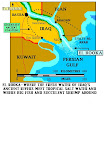
In Iraq, some time around 1950, finding that most of my teeth had mysteriously become loose, I left my hydrographic survey vessel El Ghar tied up alongside the mooring barges in Fao and hied up the nearly hundred miles to Basra to see a local Iraqi dentist. He looked at my teeth and said everything looked all right. They were just very loose.
So I went off to see my friend Doctor RD Maclean, an ex-wartime Royal Navy seagoing sawbones, who was now the Port of Basra’s Chief Medical Officer. He examined me, puzzled around a bit with his books, then slapped his hands in glee. Delightedly he reckoned I had the beginnings of scurvy, something he had never seen before. He told me I obviously had been ignoring vegetables in my diet and what I needed was a large dose of vitamin C.
But, incredibly, there was none available right then.
So I went back across the desert, south to Fao, went aboard my survey vessel,
El Ghar, and sailed off into the blue and there met one of Her Majesty’s sloops, either the Wren or the Wild Goose, and they gave me a a couple of tins of lime or lemonade powder. After drinking that for a couple of days all my teeth sprang back rigidly to attention as if they were expecting to be inspected by Chief Petty Officer Wilmot, the fearsome senior disciplinarian during my initial days as a cadet at HMS St. Vincent, in 1943.
So ever after that when anyone called me a ‘Limey’ I could state that, yes, that’s what I was, and probably the only living, classically-true, English-Canadian limey they would ever meet.
Thursday, January 28, 2010
Skylarking in the Skies over Machrihanish, Scotland, in 1945
and Crossover Turns
As our Royal Naval Air Squadron, No: 805, flying Seafire XV fighters, readied for imminent departure for the Pacific war, most of our flying time was in what was called ‘the loose open-finger formation’ ; the four aircraft of the formation taking positions similar to the four finger tips of a spread out hand.
Being spread out like this meant that each pilot could keep in formation but be far enough from the other aircraft in the flight to allow him to safely keep his head moving around in order to search the surrounding sky. I always flew as the flight’s number four aircraft, the little finger tip, and two aircraft away from the leader.
When we closed up into the alternate ‘tight box’, diamond-shaped formation, my position was right behind and a little lower than our leader’s number one position. Normally the number two aircraft was on the leader's right (starboard) wing and number three on the leader's left (port) wing.
When in open finger configuration and the leader signalled the formation to change course by more than about twenty-five degrees we used a manoeuvre called a crossover turn. This was an effort to ensure that each aircraft used the same amount of fuel during a long patrol. Because if a wide circular patrol of an area required a series of turns all to port, or all to starboard, to be made the aircraft on the inner or port (or starboard) side has to reduce power to keep position in relation to the leader. Whereas the aircraft on the other, outer side of the turn have to increase their power to keep in place when travelling along their extended turning arcs. This involves several propeller speed adjustments, and more importantly, often some throttle adjustments, each of which, even if very minor, cause the engine to gulp substantial quantities of fuel. Therefore, after an hour or more, the aircraft on the outside of the turns have considerably less fuel left in their tanks than the aircraft on the inside of the turns. This leads to the formation's effective patrol duration being shortened for the whole flight of four aircraft.
To negate this effect, ‘crossover turns’ would be used. These required the outside aircraft to lose just a few feet of height and pass slowly below the leader while the inside aircraft went down a few feet further in order to slide under both of them, and for me to go down even further and pass below all three of the other turning aircraft. In this way, sliding the formation inside out, as it were, all the aircraft traversed approximately the same radius of turn and ideally had no significant engine throttle adjustments to make.
When the turn was completed, the finger formation was regained but was now reversed, with numbers two and three in exchanged positions and number four now on the other furthest side of the formation. After some practice, and I presume a few more white hairs on the leader's head, it worked quite smoothly.
Another Tricky Manoeuvre
While in our open battle formation, we would practise breaking to port or starboard. With plenty of space between our Seafires, we could all watch out for enemy bandits. As soon as any member of the flight saw a bandit coming up on the port side, he was instructed not to waste time reporting the same to the leader but to immediately shout: ‘C Flight. Break Port. Break, Port. Go!’
At this, all pilots immediately banged the control column to port, slammed the pitch lever and throttle fully open and then violently tugged the stick back into the stomach. This resulted in four aircraft all madly banked into a vertical maximum 180-degree turn at full power. As this exercise turned out best if every aeroplane turned in the same direction, we practised knowing which way was port and which way was starboard to a very considerable extent. And then some.
Monday, January 25, 2010
The Puzzling Elasticity of Time
A Brief Personal View
One aspect of being more than eighty years old, apart from the constant whizzbang passing of the weeks is, not too surprisingly, the sharper view one gets of the accelerating passage of elapsed time.
Qualifying statements, made by, or attributed by others to younger people and meant to impress by lauding their twelve years of experience in certain fields of endeavour just simply fail to do so. To octogenarians twelve years is peanuts. Even two dozen years can sometimes seem nothing more than a very small hill of coconuts.
But past personal experience does provide a rough measuring stick in viewing the past and the probable future.
One old person I remember well from about 1940, during the first Nazi air raids of the blitz on London, was Grandma Ray, who lived with her elderly daughter and retired son-in-law two houses away. I think at that time she was about ninety-years-old, but of very sound mind. She told me that as a young girl she had known old men who had fought at the Battle of Waterloo. So I have spoken with people who have spoken with people who fought with the Duke of Wellington against Napoleon!
This gives one a personal scale to measure the fascinating passage of history.
Saturday, January 23, 2010
Dr J F Caley of the GSC
and the Athabasca Tar Sands 1960
Fifty years ago, during an exclusive interview, I spent a pleasant and fascinating morning listening to Dr. J F Caley, a senior member of the Geological Survey of Canada, outline his personal thoughts on how best to extract the oil from the Athabscan tar sands.
A very engaging and soft-spoken gentleman-geologist, Dr Caley amazed me, first by stating that the Alberta oil sands were of greater potential than the deposits of Saudi Arabia, and then secondly, by his particular hopes for their development.
Dr. Caley, with paper and pencil, sketched out a plan involving the drilling of a deep hole down into the centre of the tar sands and exploding a suitably-sized atomic bomb far underground.
His theory was that that an enormous subterranean saucer-shaped cavern would be created with walls lined with a thick and hard glasslike deposit of atomized rock. He predicted that the oil, heated from the atomic blast and largely freed from the sand particles, would drain and flown into this huge basin. From there, in time, it could be pumped to the surface for commercial processing.
Whatever became of Dr Caley’s idea? I suppose the exigencies at that time of keeping the delicate balance between the cold war opponents under stable control was of greater importance then than was the balance between domestic and middle-eastern oil resources.
Friday, January 22, 2010
Adjusting to de luxe television technology
Watching movies on my wide screen HDTV
Watching television, if done for relaxation, like reading a book or magazine, surfing the internet or playing solitaire, is best enjoyed as a solitary occupation.
Even among close household members, interests and tastes vary so widely that few family groups can seldom watch the same TV presentation with equal appreciation.
So that makes me wonder. Why are the new HDTV home sets, advertised as ‘Home Entertainment Centres’, getting so monstrously large, with some screens now measuring almost five feet across?
When I watch my 23” television screen I sit about ten feet away from it.
And that’s just fine. I can see the whole screen.
But If I were to have a 60” TV I’d have problems.
I would be unable to watch the entire screen at the same time. So if I were watching a movie I would have to keep my eyes going from side to side as if I was at Wimbledon watching a tennis match. But then I would miss not only the action in the middle but also any action occurring on the opposite side during the moments in which I was looking at the other side.
So if I had such a large TV I would have to watch my movie three times.
During the first run through I would concentrate on the left hand side of the screen. On the second run through I would look exclusively at the right hand 24” of the screen and finally I would have to run the whole caboodle through again and concentrate only on the middle 24" of screen. Then I could marry the three separate viewings together mentally and so get the full gist of the movie as a whole.
But this would call for a drastic time-consuming alteration to my TV viewing procedures.
It would be very confusing.
Unless of course I was watching an actual tennis match being broadcast from centre-court at Wimbledon.
Especially say, a match between Roger Federer and Maria Sharapova. Then it would be just fine. I could let my whole head swivel back and forth. Very naturally.
And exceedingly realistic.
Wednesday, January 13, 2010
Dateline: Wave-hopping over the North Atlantic 1968
via Toronto, Gander, Keflavik, Dublin, Avignon, Paris, London
Not long after my 1967 visit to Sable Island where I gave a seaside concert to the local seal population, the operators of the Canso flying boat which had flown me there, Kenting Aviation of Toronto, called my Ottawa office. They had signed a contract with the French government to send three of their Canso aircraft, which had been modified into water-bombers, to Marseilles, to help fight the forest-fires in that region. Being pleased with my story and photographs which had been featured in dozens of daily newspapers and publicised their role in the Sable Island story (recounted elsewhere in this blog) they invited me, if I thought it would make a worthwhile story, to go along with them to France. Well, I certainly did. And I also thought it might be as adventurous as my ten-day Sunderland flying boat hitchhiking trip from Basra to England back in 1949.
So, off I went, and fairly adventurous and enjoyable it proved to be.
I flew down to Toronto and met the six pilots of the three Canso aircraft. The next day, in very loose formation, I picked one of the aircraft to fly in at random and we flew to Gander in Newfoundland, plugging along at an airspeed all of 120 miles an hour. That evening over a couple of beers the three teams of a pilot and a co-pilot prepared for the second, longest and most hazardous leg of our trip to Marseilles. On odd scraps of paper and half empty match covers, among our beer glasses, we plotted the next day’s course to steer for Iceland and estimated our time of arrival at Keflavik as sometime before midnight. It was all very high-tech stuff and took a good part of the evening and several more beers.
In the low light just before dawn I changed aircraft and joined the lead Canso, piloted by the senior pilot — he who had flown me to Sable Island a couple of months before and with whom I had spent several happy hours in Halifax taverns.
Soon after heading out north-easterly across the forbidding leaden water of the Atlantic the matching forbidding leaden cloud cover overhead, lowered and thickened. The skipper climbed up through the heavy murk in an endeavour to get above the weather. Unfortunately, the Canso, as the US Consolidated Catalina made in Canada was called. just can’t fly that high. At about 10,000 feet, as we struggled to gain height amid the dark of the thick murk we began to seriously ice up. The rime along the leading edges built up at a higher rate than it could be removed. When the propeller blades began hurling large pieces of ice against the fuselage with resounding bangs, our pilots, after consulting by radio with the other two Cansos, hidden somewhere out there a mile or two away in the murk, we decided to go right down on the deck and look for an air layer warm enough to melt the ice.
So cautiously we let down and down and down through the thick overcast. Then down some more. Then more. And more. Until finally at a couple of hundred feet the the grey rollers and white caps of the angry sea came into desolate and threatening view. But the ice did begin to fall off and we felt relieved that we were not faced with the prospect of landing our comparatively puny craft upon the roiling surface of that wide expanse of lonely and violent ocean.
Meanwhile through all this I was making like a steward, preparing coffee over the little stove and making sandwiches for my companions.
No sign of the other two Canso aircraft could be seen, but shortly after passing two or three hundred miles east of the southern tip of Greenland, one of the US weather ships, hove to on its lonely station in mid-Atlantic, inquired by radio as to who we three aircraft were and to where we were bound. After receiving our reply that we were three Catalinas headed for Iceland, they replied that they could see on their radar screens that two of us were headed for Iceland but that the third was way off course for such an intended track and looked as if he was more likely headed for far distant Spitzbergen. Getting this extremely helpful advice from those fine US Navy oceanic guardians, resulted in a flurry of radio contacts between we three players in this small but potentially deadly drama. Because unfortunately, the fourth, and now the most important player—our errant number three Canso—was the one member of the cast not in radio-contact with the other three. He was blithely and obliviously heading for some remote and disastrous point of no return. It appeared that not only was our off-course comrade having trouble with his compass, but neither was his radio working as it should. Try as he would, our skipper could only raise squeaky indecipherable replies to his urgent messages to his wandering lamb. Nor could our other companion Canso contact him. Once more the US weather ship came to the rescue. They finally contacted the wanderer, gave him a series of corrected courses to steer, and relayed messages back and forth from our flight leader.
Many hours later, when we landed in the dark at Keflavik our number two aircraft was but ten minutes behind us. But we had parked the two Cansos, booked into the airport hotel, and even depleted a small percentage of the first case of beer that a kindly room service attendant managed to provide us with at that late hour, before our wayfaring brothers in Canso number three finally made it onto the runway and, seemingly very casually, joined us in a relaxing bottle.
The next morning, the weather remained overcast and bleak. So in order to spread my moral support around in fair fashion, I transferred myself to our wandering boy of the day before, Canso number three. Just before takeoff several Icelandic aircraft buffs gathered around to take photographs of what were then, in 1967, already vintage aircraft. A couple of them were really vintage, with much of their structure and fixtures cannibalized from other even older, and long-pensioned-off, other Cansos. Many of these flying boats still in operation were manufactured back in the mid 1930s.
Travelling aboard this third Canso was the seventh Kenting Aviation crew member, an elderly, senior aircraft engineer whom the Toronto company had sent along to be the three-aeroplane flight’s one-man expert maintenance facility during its stay in France. This engaging, and obviously thoroughly competent air-mechanic of the old school, put me in mind of the boys adventure books I had so avidly read back in the late 1930s. He could well have been, one of Biggles devoted comrades during that fictional hero’s wonderful aerial escapades of battling air pirates and smugglers.
And I did not have to wait very long to witness an actual demonstration of our company engineer’s mechanical prowess. As we in Canso number three were the last, as usual, to arrive over Dublin airport, our port undercarriage stuck halfway down. With one wheel down and the other in mid-position we circled around as our pilot tried to get both the wheels either fully back up or the stuck one fully down. Finally our grizzled air-mechanic passenger selected one of his handy, state-of-the-art tools—a full ten-foot-length of two-by-four sturdy spruce lumber.
Poking it through the open wheel well he jabbed mightily at the wheel’s oleo-leg in its stuck position. For two full circuits of Dublin airport his persuader went noisily bonk-bonk-bonk. Must have caused inquiring comment in many a quiet pub down below. But that cranky oleo-leg knew when it had met a skilled engineer. After taking a few more resounding thumps it gracefully bowed to superior technology and slid firmly into its locked down position.
Within the hour we were relaxing and listening to the peaceful playing of a live string quartet as we took afternoon tea in our big Dublin hotel, soon to be followed by a merry evening of real Irish pub hopping.
Early the next morning we assembled in the airport control tower. The controller regretted that owing to the foul weather he could not give our three Cansos flight clearance for our intended course across the Irish Sea, southern England, the Channel and then over France to Marseilles. The weather was clamped in, almost to ground level. And our Cansos were incapable of reaching the 15,000 feet of altitude needed to fly above it.
We all put as brave a face on it as we could. We sadly drove back to the hotel, animatedly planning our extra day in Dublin with its abundance of restaurants, enticing pubs and wonderful people.
The next morning, fairly early and much refreshed, we again drove out to the met-office. We spoke with the controller. It was just about the same weather situation, he said. We were halfway out the door, heading back to the hotel and another day of good bacchanal Irish life, when the control officer called to us. We paused, and looked back. However, he said, if we got off right away he could give us a low-altitude clearance for 1,200 feet.
It was good news. in a way. Such a clearance was right up our Canso aircraft’s performance alley. But we would have to forego another day of touring the pubs of Dublin.
So we readied ourselves to continue along on our bumpy way to Marseilles.
We went out to our Cansos, dispersed the usual group of local aircraft buffs with their cameras, taxied out, roared off down the runway and climbed up to just below the murky ceiling.
I had now changed back into the lead aircraft. Soon, within a half hour, the cloud base forced us lower and lower. Within the hour in the middle of the Irish Sea we were forced down to a couple of hundred feet. Looking out from the starboard observation bubble, I saw ahead a Royal Navy destroyer heading northwards up St. George's Channel. I visualized the scene on its bridge. The port lookout’s surprising sudden call to the officer-of-the-watch: ‘Catalina flying boat approaching on the port bow, sir!’ The OOW’s languid reply: ‘Oh, for Goodness sakes, Seaman Jenkins! Take another look. A Catalina? Of all things! This is 1967. Try something else, man. You’ll be seeing a Viking galley, next.’
Then again, Seaman Jenkins: ‘TWO Catalinas approaching on port bow, sir—no, sir, Crikey! THREE Catalinas, sir!’
By now the OOW has picked up his own binoculars. ‘Good God! Jenkins, you’re right. Where on earth are they from? The Twilight Zone? Did they fly out to sea twenty five years ago and are just now coming back through some mysterious time warp...?’
Sheering off to starboard to avoid the Welsh hills we crossed the north Devon coastline. Now we were rising and dipping and weaving to keep between the low cloud base and find a safe path through the lowest parts of the undulating land below. Thankfully there were no continuous heights of land across our track but our constrained close proximity to the ground was exhilarating enough by itself.
I can still recall one particular well-remembered scene. As we passed over a small town centre, I peered vertically down from my observation plexiglass bubble. It was like looking down at a tabletop layout of a model town site. There was the centre-town shopping district agog with midday activity. Perhaps it was market-day. In the middle was a fairly busy cross-roads complete with a helmeted policeman on traffic duty. As we passed over, pedestrians and shoppers, cyclists, mothers pushing baby carriages, school children, all looked up in unison at our sudden and noisy overhead appearance. On that murky, overcast day, the spectacle of those pleasant, all-white Devonshire faces of forty-three odd years ago, all turned skyward simultaneously, was akin to the flashes of a battery of press cameras at the arrival of a celebrity. People in shop doorways and cars joined in, poking their heads skywards from out of doorways and through the opened windows of halted automobiles.
And best of all, was when I looked straight down at the bobby on point duty. With one arm stretched out sideways, the other commandingly to his front with upturned palm, and surrounded by a medley of little English automobiles, I looked directly at his upturned face. Even a month later I could have picked him out from a police line-up with ease. Even a line-up of policemen all wearing helmets.
The recollection of those four or five seconds of our low passing over that little town is amongst the most vivid of my life.
And then we were crossing the south coast and again flying over the sea. The angry cloud base lifted somewhat so that over France we were at a more comfortable height for keeping clear of uplands. But just below the roiling cloud base there was very heavy turbulence, and in fact, I seem to remember a domestic Air France Caravelle flight was lost that day. Of our two Canso companions we saw nothing more until we had jostled, shuddered, and stirred our way down onto the ground at Marseilles.
After taking photographs and talking with the French officials conducting the forest-fire-fighting operations, I left my Canso companions, except for one of the pilots who was originally from Avignon and who I accompanied to that pleasant town. There I spent a couple of idyllic days of ease in the local cafés, and then flew to Paris and then over to England to visit my own family members.
Hearing that Canada’s Shakespearean company was playing at the recreated Globe Theatre in Chichester, Hampshire, I hied off thence and took several photographs of actors, including William Hutt, applying make-up in their dressing rooms and then performing on stage. Thinking that was enough to contain my Canadian National Film Board cultural commitments for a while I returned forthwith, via several country pubs, to London, the Big Smoke, as it had long been called.
By this time, though, the big smoke had became fairly smokeless owing to new and effective regulations. And even Old Father Thames, befouled for hundreds of years, had been largely cleansed and was welcoming back the first salmon along its reaches for nearly two centuries.
Reflecting on these evolving aspects of a brave new world, on a sudden whim, I turned into Canada House by Trafalgar Square. I asked the staff, therein, what sort of photolibrary they maintained in order to quickly and efficiently service any British magazines or newspapers who wished to illustrate some exciting aspect of our modern, upcoming, and leading-edge nation. Well, said a local young lady staff member, a native of Clapham Common, we let them sort through this filing cabinet drawer.
I slid open the indicated drawer. It was half empty. I pulled out the first photograph to hand. It was creased and stained. It was a picture of several despondent-looking horses. The attached, yellowed and curled up, stuck-on caption read: Some of the wild horses of Alberta now being rounded up to feed the starving peoples of Europe. It was dated July, 1945. Few of the other photos in the drawer were better than that sparkling tribute to Canadian progress and humanitarianism. The girl from Clapham Common grimaced when I asked her how often she ate horse meat. She said she preferred New Zealand lamb.
Back in Canada I spoke with the people over at External (now Foreign) Affairs) and they arranged for copies of our modern photostories to replace the outdated contents of those sorry filing cabinets.
Then I flew home to Ottawa using one of the complimentary Con D passes which Air Canada often provided me with.
All in all, thanks to Kenting Aviation, an enjoyably adventurous excursion.
Saturday, January 9, 2010
Pointless Heroics
After watching Britain’s Light Brigade of Cavalry charge directly into the muzzles of Russian cannon during the Crimea War, and suffer fifty-percent casualties in just one half hour, French Army Marshal, Pierre Bosquet said:
"C'est magnifique, mais ce n'est pas la guerre. C'est de la folie" ("It is magnificent, but it is not war. It is madness.")
And so it was, I think, for Calgary Herald reporter, Michelle Lang, to be embedded among the ill-fated crew of a Light-Armoured Vehicle in Afghanistan recently.
To what purpose was she there?
To gather a few platitudes for newspaper readers concerned in varying degree over today’s much lower Canadian casualty rate, enormously sorrowful as it is, but spread over eight years? Or to provide interesting journalistic snippets for curious war watchers? Or to help her climb another rung up a promising career ladder?
More importantly, does it actually help the overall situation, in general or in particular?
Or maybe, might it possibly hinder?
What obvious or subconscious effects might the close presence of a strange non-group person, inserted into a confined small tactical unit, have on operational efficiency? Especially by the mandated official intrusion of a young female amid young males agog with raised adrenaline when immersed in a dangerous situation?
Which leads to the worrying thought: might it even be distracting to the point of fatal hindrance? Such as an individual soldier’s mental attention being diverted in an effort to compose a politically and socially correct, and polite response to a journalist’s varied or irrelevant questions.
Might vital watchful eyes, scanning the ground ahead for danger signs, be completely unaffected by such unusual factors? In similar fashion to those factors strongly considered to affect their own family members if using their cellphones while driving their cars back home in Canada. So strongly considered that such distractions are forbidden by law ?
Would a brain surgeon, airline pilot or ground controller be completely unfazed by an inquisitive and questioning reporter’s close-up presence during similar critical moments during his intricate work?
The time for such get togethers, verbal investigations and measured responses is in the peaceful atmosphere of the base cafeteria or Tim Hortons — not during periods of dangerous activity.
The embedding of journalists in wartime operational situations is unnecessary.
Saturday, December 26, 2009
Relaxing in our little isolated club
The Port Officers Shore Mess,
Fao, Iraq, circa 1948
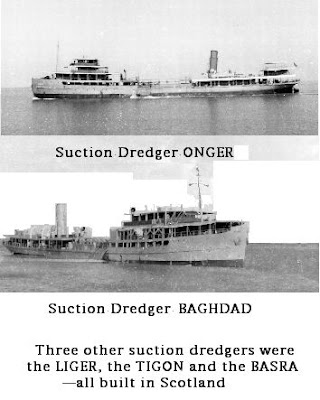
Our fleet of five big, ocean-going suction-dredgers each had four deck officers and four engineer officers, for a fleet total of twenty European, mostly British, officers. So when all five dredgers were in port together, tied up to the mooring barges, we played a lot of snooker in the Fao POSM, our nice little club. Our version of snooker was called twenty-one because we used to add the white-spot billiard-ball to the table. It was a wild card item and was worth 21 points and made the game much more unpredictable than usual.
During the usual ten-day periods when the dredgers were thirty or more miles away out in the far outer reaches of the gulf or away to Bombay for boiler cleaning, the club was largely deserted. Apart from myself, the doctor, the communications officer and the odd visitor, the club was deserted.
Except for our remote compound's two most senior and elderly gentlemen: Mr Gray, the Dredging Superintendent, and Mr McKnight, the Workshop Manager. They sat together every evening at the same table in virtual silence in the big, empty, polished tiled hall.
These two strong silent bachelors lived together in the 'monastery', a nice bungalow so named because Mr Gray and McKnight had lived there in seclusion for a very long time. Abood, the barman kept a close watch on them as it was beneath their dignity or too tiring for them to call out to him. Or even look at him. One or the other would just lift a hand without even turning his head and at once two of the same drinks they’d been drinking for years would be placed before them. And unless something really out of the ordinary had taken place that day that small hand motion was their total communication to each other or anyone else. They had said it all long years ago. Pointless to repeat it. They just smoked their pipes and drank their drinks amid the quietness of the hot Iraqi night and thought their secret thoughts.
They remained silent and placid even when the ships were in and a dredger officer would wander woozily and noisily from the bar to their table and slap down the resignation he had just written out with a few choice words as to the reasons he was right now reneging on his contract and somehow getting up to Basra to get the next plane out.
Mr Gray would calmly murmur a few words of agreement to the complainant and put the resignation in his pocket. Sometimes, if the ultra humid Shurgi wind was particularly bad and had been blowing for some days, he would end up with a full handful of these scribbled signed notes by the end of the evening. I don’t know why a convenient resignation box had not been put up on the wall somewhere so that Mr Gray could be left in peaceful silence. Because nothing ever actually came of these performances. The aggrieved ones would sail off in their ships the next day and I expect at the same time old Gray just chucked them into the office waste paper basket.
Hal Roach, the chief engineer of one of the dredgers, was a true gentleman. Hal never used coarse language, was always neatly dressed and polite to everyone and had a small dog. He was interested in photography and puttered about in his large cabin, lit only by a low-wattage red light bulb, with developer and fixer. When Hal came into the club he came into the bar for a drink or two and then usually went over to Gray and McKnight’s table where he was welcomed as another silent partner. Invariably Hal’s little dog, relieved to be free and off the dredger for a while, would start running back and forth across the width of the hall. Skidding on the polished red tiles the little dog went from wall to wall to wall to wall for long exhausting periods. Hal would proudly follow his dog’s performance like a spectator at a slow-motion tennis match, his head turning slowly from side to side and only stopping to take a sip from his pink gin and soda mai or water. But after several gins Hal’s head movements and glazed eyes encountered difficulty in being synchronized with the frenzied movements of his back and forth racing dog. Slowly but surely the dog would get ahead of his eyes so that by the time Hal was looking at the wall on the left the dog had already been there, had now turned around, and was on his speedy way back. So Hal’s eyes would start tracking towards the right wall but by now the discrepancy in space time was even more enlarged and the dog would race to the left, pass through Hal’s laggard gaze which was just now returning to the wall on the right. After several more runs the dog would be a complete lap ahead of Hal’s eyes and so all would be in sync again for a brief moment. Then the whole business would start again. None of this seemed to bother old Gray and McKnight at all. Probably they never noticed it.
Sometimes, before he went out into the hall to sit with old Gray and McNight and watch his dog exercising, I enjoyed listening to Hal Roach’s list of the the many hundreds of the best pubs in Britain. I think he had been in every one of them.
Unfortunately, we lost dear old Hal for a while when he had to go to hospital up in Basra. One night after going back to his ship from the club he decided to do a bit of dark-room work and in the gloom mistook his glass beaker of developer or fixer for his glass of gin and drank some of it.
A year or two later, poor Hal wending his way up the steep wooden walkway up to his ship very late one night, disappeared over the side of the mooring barge into the Shatt. The noise of the splash awoke the nearby sleeping watchman but it was too late. There was a strong ebb tide running. Hal's body was fished out of the water several miles downriver a couple of days later.
One of the people my friend Dr. Maclean, the Port of Basra's Chief Medical Officer, had befriended was a fellow doctor who was a member of an Iraqi family which was very prominent during those years. This doctor’s prosperous relations were important in government, commerce, agriculture and most every other aspect of Iraqi life. So when doc McLean told me of a hunting party that was being arranged by this family with the ambassadors of Kuwait and some other countries as guests and said he and I were also invited I, John Ough, was happy to go along.
Our large caravan of vehicles set off across the desert north-east of Basra. After a couple of hours skirting the swamp areas and shooting a couple of gazelle we went further into the deep desert. One of those large station-wagon-bus-type vehicles took the lead with several men holding falcons sitting on the vehicle’s roof. I was amazed at their complete control of their birds of prey which they set off to fly about five hundred feet ahead of the lead bus and about 100 feet high in the air. If the column was about to change course to left or right the falconers had but to whistle and their birds would turn in the new direction before the vehicles did. Also they could call particular birds back to the bus for a rest while other birds took their place. Until then I had always understood that falcons could only be flown after being starved for a couple of days so that when they caught a prey they would stay with it until the falconer could recover his valuable hunting bird, or, if no prey was caught a piece of meat was swung on a piece of cord around the falconer’s head to entice the bird back. Therefore any particular falcon could only be flown once every two days or so.
In case we inadvertantly wandered into Persian territory and encountered an army patrol, our party leader had obtained a ‘to-whom-it-may-concern’ letter from the Iranian consul or ambassador explaining who, why and what we were doing out in their desert. They made the error of telling our guides about this letter who promptly took us miles away across the desert straight to an isolated Iranian army outpost. It was very scenic, biblical and ancient, built on a rise of ground and with mud walls about twenty feet high and thick. Over the massive gate of this lonely outpost of the Peacock Throne was pinioned not a peacock but a dead eagle with outstretched wings that must have been eight feet across.
The garrison inside this fort must have thought we were an invasion task force approaching because they closed the big gate and took up defensive positions atop the battlements. When our leaders asked to speak with the fort’s senior officer they were told by a sergeant that their officer was off somewhere for the day and that he, the sergeant was in charge. Unfortunately he couldn’t read or at any rate couldn’t get the sense of the letter our diplomats showed him. He said we were to remain where we were until his officer returned as we were now under arrest.
Well, we didn’t think anything of that but we were happy to hang around a while as the old fort was interesting to look at. On every hand the desert stretched absolutely featureless to the horizon twenty miles distant. Absolutely featureless. Flat. Not one stone atop another.
After a while we thought we’d be off. When we told the sergeant that he said he had a couple of trucks in the back of the fort with machine guns mounted upon them and if we went off he would chase us and fire on us.
Doc Maclean and I went wandering about in innocent fashion and not only saw no sign of a machine gun but came to the conclusion that the dozen Persian soldiers that had come out to gawk at us as we were gawking at them comprised the total establishment of that lonely outpost. We also reckoned our party not only had an advantage in numbers over the garrison but we had twice their fire power.
Our caravan was just about to drive away when a man atop the battlements called out that the officer was returning. After several minutes we saw a small cloud of dust a few miles off and as the sergeant was getting pitifully worried and tearful by now we waited until his officer, with a couple more soldiers, finally drove up in an American army leftover jeep. This young officer also was at a loss as to what his duty was but at least he could read and he made a few notes from the letter and asked if we would stay to coffee. Then someone gave him a small souvenir and we took off westwards.
Not long afterwards the falcons caught half a dozen turkey-bustards and then we stopped in the middle of that featureless desert to have a rather elaborate lunch spread out on the ground between two of our vehicles. A very large blanket spread from roof top to roof top made a welcome shade. And as is usual, within a few minutes a small band of wandering Arabs seemed to magically rise up from a hole in the sand to share our luncheon party. Maybe it was a desert but not a deserted desert. All in all, it was a pleasant little outing.
I was still a little naive when, with the El Ghar undergoing some repairs for a couple of weeks, I took over another survey vessel, the Kamala, which was usually engaged on river work between Abadan and Basra. I was sounding cross sections of the river when the body of a young girl floated past the ship. The Kamala crew showed some animated interest for a few moments but were surprised, if not amazed, when I told the serang to stop and pick up the body. I suppose they wondered what I wanted it for. I told the serang we would take it to the police post a few miles upriver so they could look into the matter.
At the police post a couple of crew members placed the girl on the little wharf and had some words with the policemen who appeared. The police looked strangely puzzled, then amused, shrugged their shoulders and kept pointing at the river, obviously saying that my men should chuck it back in. When I leaned out from over the bridge and called to my crew to get back aboard the police desisted from this un-Sherlock Holmes attitude and seemed more positive in manner. For the moment anyway. I suspect that soon after we disappeared up river that poor little body was tossed back in the water.
Every day and every night I was metaphorically and literally immersed in the tides. Apart from the constant soundings I took of the shipping channels and the whole surrounding area, I recorded the directions and speeds at differing depths of the tidal currents. Also I studied and made approximations with simple instruments of the amount of suspended silt being carried down the river and estuary. So the tides ruled my life. Especially my wake-up time. Because the global tidal wave is 50 minutes later each day the El Ghar would usually depart from Fao in cycles. One morning we would cast off at four o’clock, the next at five, then six and so on until about 10 o’clock when we would jump back to about four o’clock again. This enabled us to leave with the ebb, work most of the day on the flood and chase slack water up the river home to Fao. Then I would perhaps go to the office for an hour or plot my soundings on the bridge. But of course this routine was not routine. Weather, tankers aground, special assignments, religious observances, political disturbances, visiting VIPs and other odd visitors who wanted a trip down to salt water—all these would make my days varied and unpredictable.